Managing Canine Obesity: Portion Control and Daily Routines
Manage canine obesity with practical portion control, exact caloric calculations, and daily routine adjustments to help your dog reach a healthy weight safely.
The Hidden Epidemic: Understanding Canine Obesity
According to the Association for Pet Obesity Prevention, nearly 56% of dogs in the United States are classified as overweight or obese. While a chubby pup might seem cute, excess adipose tissue is an active endocrine organ that secretes inflammatory hormones, drastically increasing the risk of osteoarthritis, type 2 diabetes, cardiovascular disease, and certain cancers. Beyond the severe health implications, canine obesity carries a heavy financial burden. Owners of obese dogs often spend hundreds of dollars annually on joint supplements like Dasuquin Advanced (approximately $65 per month), pain medications like Carprofen, and specialized veterinary diagnostics.
Tackling canine obesity requires more than simply 'feeding less.' It demands a strategic overhaul of your dog's daily routine, precise nutritional mathematics, and environmental enrichment. In this deep dive, we will explore actionable, science-backed methods to safely transition your dog to a healthy weight without sacrificing their happiness or your bond.
Step 1: Calculating True Caloric Needs
The most common mistake owners make is feeding for their dog's current weight rather than their ideal target weight. To establish a safe weight loss protocol, veterinary nutritionists rely on the Resting Energy Requirement (RER) formula. The Tufts University Cummings School of Veterinary Medicine Clinical Nutrition Service recommends calculating the RER based on the dog's target healthy weight to ensure they receive adequate micronutrients while in a caloric deficit.
The RER Formula
The formula for Resting Energy Requirement is: RER = 70 x (ideal body weight in kg)^0.75.
Let us look at a practical example. Suppose you have a Labrador Retriever who currently weighs 40 kg (88 lbs), but their ideal body condition score indicates they should weigh 30 kg (66 lbs).
- Step A: Convert ideal weight to kilograms (30 kg).
- Step B: Calculate 30 to the power of 0.75 (which is approximately 12.8).
- Step C: Multiply by 70. (70 x 12.8 = 896 kcal/day).
Your dog's target daily caloric intake for weight loss should be approximately 896 calories per day. This number must include all food, treats, and edible chews. If you feed 800 calories of kibble but give 150 calories worth of training treats and peanut butter-filled toys, your dog will not lose weight.
Step 2: Precision Portion Control
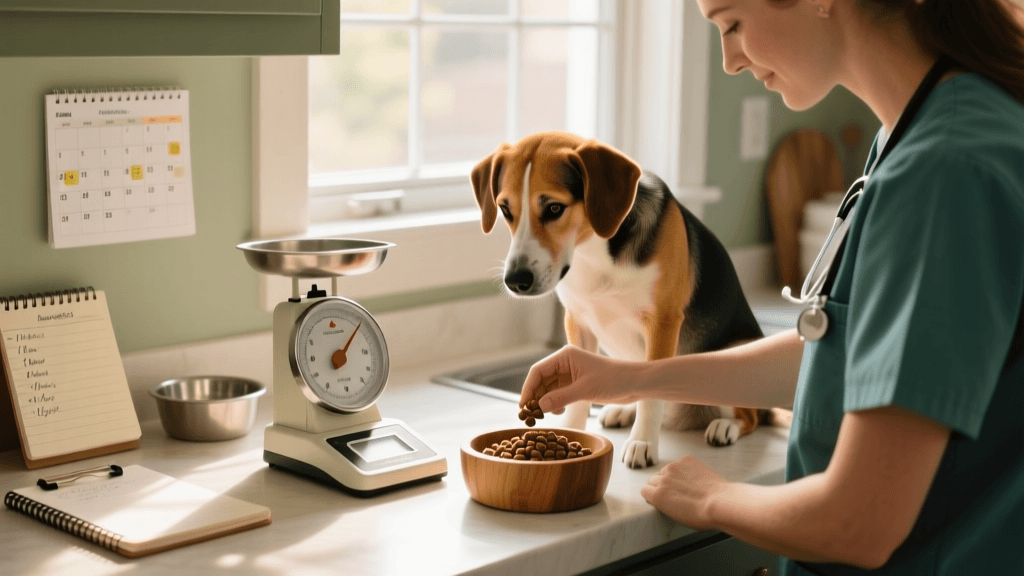
Measuring cups are notoriously inaccurate. Studies have shown that pet owners can overestimate or underestimate kibble portions by up to 20% when using standard measuring cups, depending on the shape of the kibble and how the cup is scooped. To achieve clinical precision, invest in a digital kitchen scale (such as the Ozeri ZK14-S Pronto, which costs around $15) and measure your dog's food in grams.
Below is a comparison chart demonstrating how different diet types impact daily portion sizes for our hypothetical 30 kg Labrador requiring 896 kcal per day.
| Food Type (Example) | Caloric Density | Grams per 100 kcal | Daily Amount (896 kcal) |
|---|---|---|---|
| Standard Dry Kibble (e.g., Purina Pro Plan Weight Management) | ~350 kcal/cup (approx. 100g/cup) | 28.5g | 255 grams |
| Wet Canned Diet (e.g., Hill's Science Diet Perfect Weight) | ~320 kcal/12.5oz can (approx. 354g/can) | 110g | 985 grams |
| Air-Dried Raw (e.g., Ziwi Peak Beef Recipe) | ~560 kcal/cup (approx. 115g/cup) | 48g | 430 grams |
Note: Always verify the exact caloric density on your specific bag of food, as formulations frequently change. Weighing in grams eliminates the guesswork and ensures your dog is in a consistent, safe caloric deficit.
Step 3: Restructuring Your Daily Routine
Weight loss is not solely about what happens in the food bowl; it is about how your dog expends energy and interacts with their environment throughout the day. Sedentary routines exacerbate weight gain and lead to behavioral issues born of boredom. Here is how to restructure a typical day for a weight-loss dog.
Morning: The 15-Minute 'Sniffari'
Instead of a brisk, high-impact 30-minute walk (which can damage the joints of an overweight dog), start the morning with a 15-minute 'Sniffari.' Allow your dog to lead the walk at their own pace, stopping to sniff every tree, bush, and fire hydrant. Olfactory processing requires immense cognitive energy. Fifteen minutes of intense sniffing can tire a dog out as much as a mile-long run, burning calories while protecting vulnerable joints from repetitive pavement pounding.
Mid-Day: Ditch the Bowl for Enrichment
Dogs do not need to eat out of a stainless steel bowl. In the wild, canines spend up to 80% of their waking hours foraging. Replicate this by feeding their mid-day portion through puzzle toys. A classic Kong toy (approx. $18) stuffed with a portion of their daily wet food and frozen overnight forces the dog to work for 20 minutes to extract their meal. Alternatively, scatter their dry kibble across a snuffle mat ($25-$35) to encourage natural foraging behaviors. This slows down eating, prevents bloat, and increases the thermic effect of food digestion.
Evening: Structured Leash Walking and Training
In the evening, engage in a 20-minute structured heel walk, followed by a 10-minute low-impact training session. Use a portion of your dog's daily kibble allocation as training rewards. Teaching new tricks like 'spin,' 'touch,' or 'crawl' builds lean muscle mass, which in turn elevates the dog's basal metabolic rate.
Step 4: Navigating Begging and Multi-Pet Households
The psychological toll of a dog begging for food is often the primary reason owners abandon weight loss protocols. It is vital to reframe begging: your dog is not necessarily hungry; they are seeking engagement and dopamine. When your dog begs, substitute food with a 3-minute belly rub, a game of indoor tug-of-war, or a brushing session.
If you must use treats for training, utilize ultra-low-calorie options. A single frozen green bean contains approximately 2 calories. A baby carrot contains about 4 calories. You can feed dozens of green beans throughout the day for the caloric equivalent of a single commercial biscuit.
The Multi-Pet Challenge
Managing a dieting dog in a multi-pet household where another dog is at a healthy weight (or is a 'free feeder') requires strict environmental management. Free-feeding must end immediately. You must transition to scheduled, supervised meal times. If your healthy dog eats quickly and steals the dieting dog's food, consider investing in a microchip-activated feeder like the SureFeed Microchip Pet Feeder (approx. $160). This device reads your dog's implanted microchip or RFID collar tag and only opens the food bowl lid for the designated pet, completely eliminating food theft and ensuring precise caloric control.
Step 5: Tracking Progress and Adjusting
Do not rely solely on the bathroom scale to track your dog's progress, as fluctuations in hydration and muscle gain can skew the numbers. Instead, utilize the World Small Animal Veterinary Association (WSAVA) Body Condition Score (BCS) chart. The BCS is a 9-point visual and tactile scale.
- Ribs: You should be able to easily feel your dog's ribs without pressing hard, similar to running your fingers over the back of your hand. If it feels like the palm of your hand, they are carrying excess fat.
- Waist: Viewed from above, there should be a distinct hourglass tuck behind the ribs.
- Abdomen: Viewed from the side, the abdomen should tuck up toward the hind legs, not hang down parallel to the floor.
Weigh your dog and assess their BCS every 14 days. A safe rate of weight loss for a dog is 1% to 2% of their total body weight per week. If your dog loses weight too rapidly, increase their daily calories by 10%. If their weight stalls for three consecutive weeks, decrease their daily caloric intake by 10% or add an extra 10 minutes of daily low-impact activity.
When to Consult Your Veterinarian
If you are strictly adhering to your calculated RER, weighing food in grams, and maintaining a daily enrichment routine, but your dog is still not losing weight after a month, schedule a veterinary examination. Underlying endocrine disorders such as hypothyroidism or hyperadrenocorticism (Cushing's disease) can severely blunt weight loss efforts and require specific medical interventions alongside dietary management.
Conclusion
Managing canine obesity is a marathon, not a sprint. By abandoning the guesswork of measuring cups, embracing the precision of digital scales, and transforming your daily routine to include mental and physical enrichment, you are not just helping your dog lose weight—you are actively adding years to their life. The effort required to calculate calories and stuff puzzle toys is a small price to pay for the reward of a vibrant, pain-free, and energetic companion by your side for years to come.
anouk-beaumont
All our authors care for dogs every day — read more of their work on the authors page.