Large Breed Puppy Diet: Calcium, Phosphorus & Joint Health
Discover the exact calcium and phosphorus ratios your large breed puppy needs to prevent joint issues. Includes feeding charts and top food picks.
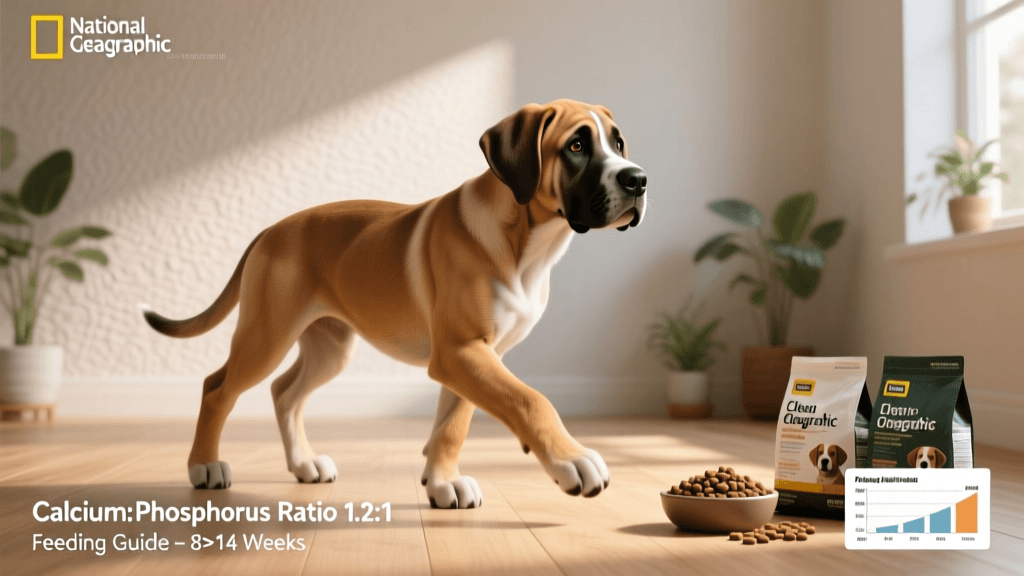
The Hidden Dangers of Rapid Growth in Large Breed Puppies
Bringing home a large breed puppy—such as a Great Dane, German Shepherd, Golden Retriever, or Mastiff—is an incredibly exciting experience. However, their massive adult size (typically defined as an expected adult weight of 70 pounds or more) comes with unique physiological challenges. Unlike small or medium-sized dogs, large and giant breed puppies grow at an astonishing rate during their first year of life. This rapid skeletal and muscular expansion makes them highly susceptible to Developmental Orthopedic Diseases (DOD).
Conditions such as hip dysplasia, osteochondrosis dissecans (OCD), and hypertrophic osteodystrophy (HOD) can cause lifelong lameness, chronic pain, and expensive surgical interventions. According to the American Kennel Club (AKC), the primary culprit behind these skeletal abnormalities is not just genetics, but improper nutrition during the critical growth windows. Overfeeding, excessive caloric intake, and imbalanced mineral ratios force the puppy's skeleton to grow faster than the supporting cartilage and musculature can adapt, leading to structural failures.
The Science of Calcium and Phosphorus Ratios
When diving deep into canine nutrition, calcium and phosphorus are the most critical minerals to monitor for large breed puppies. While calcium is essential for bone ossification, too much calcium disrupts the normal process of cartilage maturation and bone remodeling. Puppies do not possess the mature gastrointestinal regulatory mechanisms required to limit calcium absorption; therefore, whatever calcium is present in the diet is absorbed into the bloodstream and forced into the bones, leading to abnormal skeletal development.
To combat this, the Association of American Feed Control Officials (AAFCO) established specific nutrient profiles for large breed puppies. The maximum allowable calcium content for large breed growth diets is strictly capped at 1.8% on a Dry Matter Basis (DMB). Furthermore, the calcium-to-phosphorus (Ca:P) ratio must be tightly controlled, ideally falling between 1:1 and 1.8:1. Phosphorus is equally vital, as it works synergistically with calcium to form hydroxyapatite, the mineral matrix of bone. An imbalance in either direction can trigger severe metabolic bone diseases.
Understanding Dry Matter Basis (DMB)
To accurately compare dog foods, you must look past the guaranteed analysis on the back of the bag, which is based on 'as-fed' weight and includes moisture. To find the true mineral content, you must calculate the Dry Matter Basis (DMB). The Tufts Cummings School of Veterinary Medicine strongly recommends that owners learn this simple calculation to ensure their puppy's food meets the strict 1.8% calcium maximum.
How to Calculate DMB:
- Find the moisture percentage on the label (e.g., 12%).
- Subtract the moisture from 100 to find the dry matter percentage (100 - 12 = 88% dry matter).
- Divide the guaranteed calcium percentage by the dry matter percentage, then multiply by 100.
- Example: If a food has 1.5% calcium and 88% dry matter, the math is (1.5 / 88) * 100 = 1.70% Calcium DMB. This is safe for a large breed puppy, as it is under the 1.8% threshold.
Regular vs. Large Breed Puppy Food: A Nutritional Comparison
Feeding a standard puppy formula to a Great Dane or Labrador Retriever can be disastrous. Standard puppy foods are formulated for rapid growth and are significantly higher in calories, fat, and calcium. Below is a comparison chart based on the World Small Animal Veterinary Association (WSAVA) and AAFCO guidelines.
| Nutrient Profile | Standard Puppy Food | Large Breed Puppy Food |
|---|---|---|
| Calcium (Max DMB) | Up to 2.5% or higher | Strictly capped at 1.8% |
| Phosphorus (Max DMB) | Up to 1.6% | Typically 0.8% to 1.6% |
| Fat Content | High (17% - 22%+) | Moderate (12% - 16%) |
| Caloric Density | High (400+ kcal/cup) | Lower (300 - 375 kcal/cup) |
| Growth Rate Target | Rapid / Maximum | Slow / Controlled |
Actionable Feeding Guidelines and Caloric Restriction
Nutrient ratios are only half the battle; caloric restriction is the other. Large breed puppies should be kept intentionally lean. The ideal Body Condition Score (BCS) for a growing large breed puppy is a 4 out of 9, or a lean 5 out of 9. You should be able to easily palpate (feel) their ribs without pressing hard, and they should have a visible abdominal tuck when viewed from the side.
Feeding Measurements and Timing
- Months 2 to 4: Feed 3 to 4 measured meals per day. Free-feeding (leaving a bowl out all day) is strictly prohibited, as it invariably leads to overconsumption and rapid weight gain.
- Months 4 to 12: Transition to 2 to 3 measured meals per day. Adjust portions weekly based on weight checks and BCS evaluations.
- Cost Expectations: High-quality large breed puppy food typically costs between $60 and $100 per month, depending on the brand and the puppy's current weight. Expect to feed a 50-pound puppy roughly 3.5 to 4.5 cups per day, split across meals.
Top Large Breed Puppy Foods on the Market
Not all commercial diets meet the rigorous standards required for large breed skeletal development. When shopping, look for the AAFCO statement on the bag that specifically includes the phrase: 'This product is formulated to meet the nutritional levels established by the AAFCO Dog Food Nutrient Profiles for growth/all life stages including growth of large-size dogs (70 lbs or more as an adult).'
Here are three highly recommended, WSAVA-compliant options:
1. Purina Pro Plan Large Breed Puppy Focus
This formula is a staple among veterinary nutritionists and breeders. It contains optimal levels of calcium and phosphorus, alongside DHA from omega-rich fish oil for brain and vision development. It features real chicken as the first ingredient and includes live probiotics for digestive health.
- Estimated Cost: ~$65 for a 34 lb bag.
- Caloric Density: ~387 kcal/cup.
2. Hill's Science Diet Large Breed Puppy
Hill's employs a massive team of PhD-level nutritionists and veterinarians. Their large breed puppy diet is strictly formulated to avoid excessive calcium spikes. It uses a precise blend of antioxidants and vitamins C and E to support a developing immune system.
- Estimated Cost: ~$75 for a 30 lb bag.
- Caloric Density: ~363 kcal/cup.
3. Royal Canin Giant Puppy
Designed specifically for giant breeds (expected adult weight over 100 lbs), this kibble is engineered to encourage chewing, which slows down eating and promotes dental health. The calcium and phosphorus levels are meticulously balanced to support safe joint and bone mass accrual.
- Estimated Cost: ~$90 for a 30 lb bag.
- Caloric Density: ~338 kcal/cup.
The Supplement Trap: Why More is Not Better
A common and dangerous mistake made by well-meaning owners is adding calcium supplements, milk, cottage cheese, or bone meal to a commercially complete and balanced large breed puppy diet. Because large breed puppy foods are already formulated at the maximum safe threshold of calcium, adding supplements will immediately push the diet into toxic territory, virtually guaranteeing the onset of osteochondrosis or hypertrophic osteodystrophy. Unless explicitly prescribed by a board-certified veterinary nutritionist to treat a specific diagnosed deficiency, never add calcium or mineral supplements to your puppy's diet.
Similarly, be cautious with joint supplements like glucosamine and chondroitin during the early growth phases. While they are highly beneficial for adult and senior dogs with osteoarthritis, their efficacy in preventing DOD in growing puppies is not strongly supported by current veterinary literature. Focus your budget on high-quality, AAFCO-approved food instead.
Transitioning to Adult Food: Timing is Everything
Knowing when to switch your large breed puppy to an adult maintenance diet is just as crucial as the puppy diet itself. While a Chihuahua might reach skeletal maturity by 9 months, large and giant breeds continue to grow and fill out until they are 18 to 24 months old. Transitioning to adult food too early deprives them of the necessary building blocks for their final stages of skeletal maturation. Plan to begin a gradual, 7-to-10-day transition to a high-quality large breed adult formula around your dog's 18-month birthday, consulting with your veterinarian to assess their specific growth curve and body condition.
By strictly managing your large breed puppy's calcium intake, controlling their caloric consumption, and resisting the urge to over-supplement, you are giving them the absolute best foundation for a lifetime of pain-free mobility and vibrant health.
jonas-cole
All our authors care for dogs every day — read more of their work on the authors page.