Stop Puppy Biting: A Behaviorist's Redirection Guide
Discover expert behavior analysis techniques to stop puppy biting and mouthing. Learn redirection, timing, and top teething toys for lasting results.

The Ethology of Puppy Mouthing: A Behaviorist's Perspective
Bringing a new puppy home is an exciting milestone, but it often comes with a painful reality: needle-sharp teeth constantly latching onto your hands, ankles, and clothing. From an expert behavior analysis standpoint, puppy biting and mouthing are not signs of aggression or dominance. Instead, they are deeply ingrained ethological behaviors driven by exploration, teething discomfort, and social development. Puppies lack the dexterous paws of primates; therefore, they use their mouths to investigate the texture, taste, and reactivity of their environment.
As canine behaviorists, our goal is never to suppress a dog's natural drive to chew or use their mouth. Suppression through physical punishment or intimidation only leads to fear-based responses and can severely damage the human-animal bond. According to the ASPCA, mouthing is a normal developmental phase that requires strategic redirection and the teaching of 'bite inhibition' rather than outright elimination of the behavior itself.
Bite Inhibition vs. Behavioral Suppression
Bite inhibition is the ability of a dog to control the force of their jaw pressure. In a natural litter environment, puppies learn this through peer feedback. If Puppy A bites Puppy B too hard, Puppy B will yelp and cease playing. This immediate withdrawal of social reinforcement teaches Puppy A that hard bites result in the end of fun. We must replicate this operant conditioning loop in our homes.
When owners attempt to suppress biting by holding the puppy's mouth shut, tapping their nose, or using 'alpha rolls,' they are applying positive punishment. The American Kennel Club (AKC) and leading veterinary behaviorists strongly advise against these methods. Punishment fails to teach the puppy what they should do, and it often triggers a defensive bite response or escalates the arousal level, making the biting worse. Instead, we utilize Differential Reinforcement of Incompatible Behavior (DRI) and negative punishment (the removal of a desired stimulus, such as your attention) to shape the puppy's choices.
The 3-Step Behaviorist Protocol for Redirection
To effectively modify mouthing behavior, you must implement a consistent, timing-sensitive protocol. Dogs learn through immediate consequences; a reaction delayed by even three seconds is entirely ineffective. Here is the exact framework used in professional behavior modification.
Step 1: The 'Ouch' and Withdraw Technique (Negative Punishment)
When the puppy's teeth make contact with your skin, immediately emit a high-pitched, genuine yelp or say 'Ouch!' in a sharp, calm tone. This mimics the corrective feedback of a littermate. The moment you vocalize, you must initiate a complete withdrawal of attention. Stand up, cross your arms, and look at the ceiling for exactly 10 to 15 seconds. Do not push the puppy away with your hands, as they will interpret pushing as a wrestling game. If the puppy continues to bite your ankles, step behind a physical barrier, such as a baby gate, for 30 seconds. This creates a clear contingency: teeth on skin equals the immediate end of play.
Step 2: Strategic Redirection (DRI)
Once the puppy has disengaged and is calm, you must offer an appropriate, high-value alternative. This is where product selection and preparation are vital. Keep a rotation of approved chew items within arm's reach in every room. When you return from your brief timeout, immediately present the toy. When the puppy bites the toy, offer enthusiastic verbal praise ('Yes! Good chew!'). You are reinforcing the incompatible behavior of chewing an object rather than a human.
Step 3: Management and Enrichment
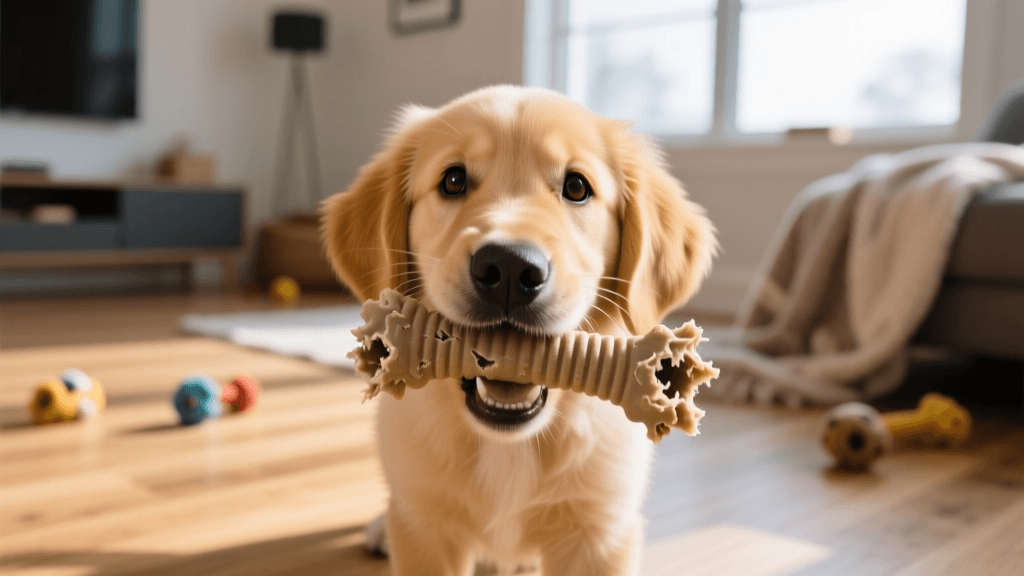
Behaviorists know that management prevents rehearsal of unwanted behaviors. Puppies often bite out of boredom or overstimulation. Implement the '5-minute rule' for structured exercise (5 minutes of activity per month of age, twice a day) and supplement with mental enrichment. Stuffing a KONG Classic Red ($12-$15) with a mixture of plain Greek yogurt and kibble, then freezing it for 45 minutes, provides a soothing, long-lasting outlet for the urge to chew. The cold temperature numbs inflamed gingival tissue, while the extraction of food taps into their natural foraging instincts.
Understanding the 'Extinction Burst'
When you first implement the withdrawal of attention, you will likely experience an 'extinction burst.' This is a well-documented behavioral phenomenon where an unwanted behavior temporarily increases in frequency and intensity before it begins to fade. Your puppy may bite harder, jump, or bark when they realize their old tactic (biting to get a reaction) is no longer working. It is absolutely critical that you do not give in during an extinction burst. If you yield and push them away or yell, you have just taught them that they need to bite harder to get your engagement. Stay consistent, and the behavior will extinguish.
Teething Timeline and Toy Matrix
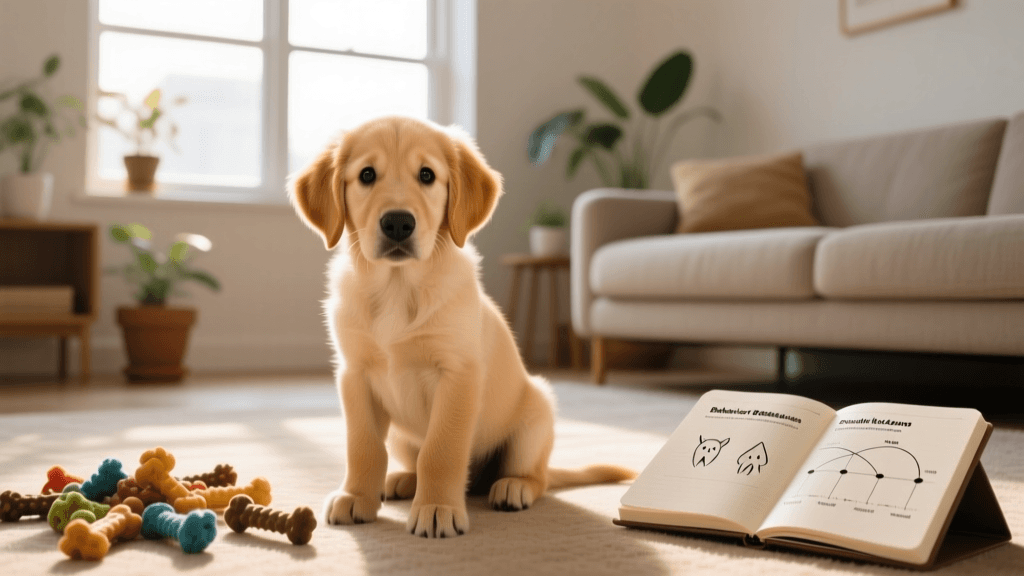
Understanding the physiological timeline of canine teething allows you to match the correct toy texture to your puppy's dental development. Providing a toy that is too hard can fracture a deciduous (baby) tooth, while a toy that is too soft will be destroyed and potentially ingested, leading to gastrointestinal blockages.
| Age (Weeks) | Dental Stage | Behavioral Symptom | Recommended Tool & Cost |
|---|---|---|---|
| 3-6 Weeks | Deciduous Incisors & Canines Erupt | Light nibbling, littermate mouthing | Soft plush toys, fleece tug toys ($8-$12) |
| 12-16 Weeks | Deciduous Premolars Erupt | Increased chewing, seeking hard surfaces | Nylabone Puppy Power Rings ($8.99), Frozen carrots ($2) |
| 16-24 Weeks | Adult Teeth Begin Replacing Baby Teeth | Bleeding gums, dropped baby teeth, intense biting | West Paw Toppl (Frozen) ($22.95), Chilled KONG ($15) |
| 24-32 Weeks | Adult Molars Fully Emerge | Heavy jaw pressure, destruction of soft items | Benebone Wishbone (Puppy Formula) ($18), Bully sticks ($6 each) |
Note: Always supervise your puppy with chew toys, especially natural chews like bully sticks, and discard them when they become small enough to pose a choking hazard.
Environmental Management: The 'Puppy Zone'
When a puppy becomes overtired, their bite inhibition plummets. Much like a human toddler throwing a tantrum, an overtired puppy loses their capacity for impulse control. Behaviorists recommend setting up a designated 'Puppy Zone'—a 4x4 foot exercise pen equipped with a comfortable bed, water, and a safe chew toy. If your puppy enters a frenzy of biting that cannot be redirected, calmly place them in the Puppy Zone for a 20-minute enforced nap. In 90% of behavior consultations, owners report that 'witching hour' biting is simply a symptom of sleep deprivation. Puppies require 18 to 20 hours of sleep per day during their first few months.
When to Seek Professional Intervention
While mouthing is normal, true aggression is not. If your puppy exhibits stiff body language, deep guttural growling, or bites that result in puncture wounds without releasing, this falls outside the scope of normal developmental mouthing. The Humane Society recommends consulting with a veterinarian to rule out underlying medical causes of pain, followed by an evaluation from a certified applied animal behaviorist (CAAB) or a veterinary behaviorist (DACVB). Early intervention using force-free, science-based methods is the most effective way to ensure your puppy develops into a well-adjusted, bite-inhibited adult dog.
Final Thoughts on Consistency
Modifying puppy biting requires patience, impeccable timing, and absolute consistency from every member of the household. If one person allows the puppy to chew on their hands while another enforces the timeout rule, the puppy will become confused, and the behavior will persist. Invest $35 to $50 in a high-quality starter rotation of interactive chew toys, commit to the 3-step redirection protocol, and remember that this challenging phase is temporary. By guiding your puppy with empathy and behavioral science, you are laying the foundation for a trusting, lifelong relationship.
robin-maitland
All our authors care for dogs every day — read more of their work on the authors page.