Best Teething Toys for Puppy Bite Training in 2026
Discover the best teething toys for puppy bite inhibition training in 2026. Learn to redirect chewing and teach gentle mouthing with expert tips.
The Behavioral Science of Puppy Teething and Bite Inhibition
Bringing a new puppy home is an exhilarating experience, but it quickly introduces one of the most challenging phases of canine development: teething. As we navigate the pet care and behavioral science landscape in 2026, veterinary behaviorists emphasize that teething is not merely a physical milestone; it is a critical window for behavioral conditioning and obedience training. Between the ages of three and six months, your puppy's deciduous (baby) teeth will fall out, making way for their 42 adult teeth. This process causes significant gingival discomfort, driving an instinctual, relentless need to chew.
However, how you manage this chewing directly dictates your dog's lifelong bite inhibition. According to the American Kennel Club (AKC), puppies explore the world with their mouths much like human toddlers use their hands. If a puppy is not provided with appropriate, textured outlets for their oral fixation, they will default to chewing on baseboards, footwear, or worse, human skin. The strategic use of specialized teething toys transforms a destructive phase into a foundational training opportunity, teaching your puppy what is acceptable to bite and how to modulate jaw pressure.
Top 3 Teething Toys for Behavioral Redirection in 2026
Not all chew toys are created equal, especially when the goal is active behavioral redirection rather than passive distraction. Based on current 2026 veterinary recommendations, material safety standards, and canine ergonomic studies, here are the top three teething toys that double as powerful training tools.
1. KONG Puppy Classic (Best for Positive Conditioning and Crate Training)
The KONG Puppy Classic remains the gold standard for behavioral conditioning. Made from a proprietary, ultra-soft natural rubber formula designed specifically for developing puppy teeth and gums, its unpredictable bounce and hollow center make it an indispensable training tool. Training Application: Use the KONG for 'Crate Association' and 'Duration Training.' By stuffing the toy with a mixture of plain Greek yogurt, pureed pumpkin, and kibble, then freezing it for 4 to 6 hours, you create a long-lasting puzzle that soothes inflamed gums through cold therapy. This conditions the puppy to view their crate as a relaxing sanctuary rather than a place of isolation, significantly reducing separation anxiety and destructive crate chewing.
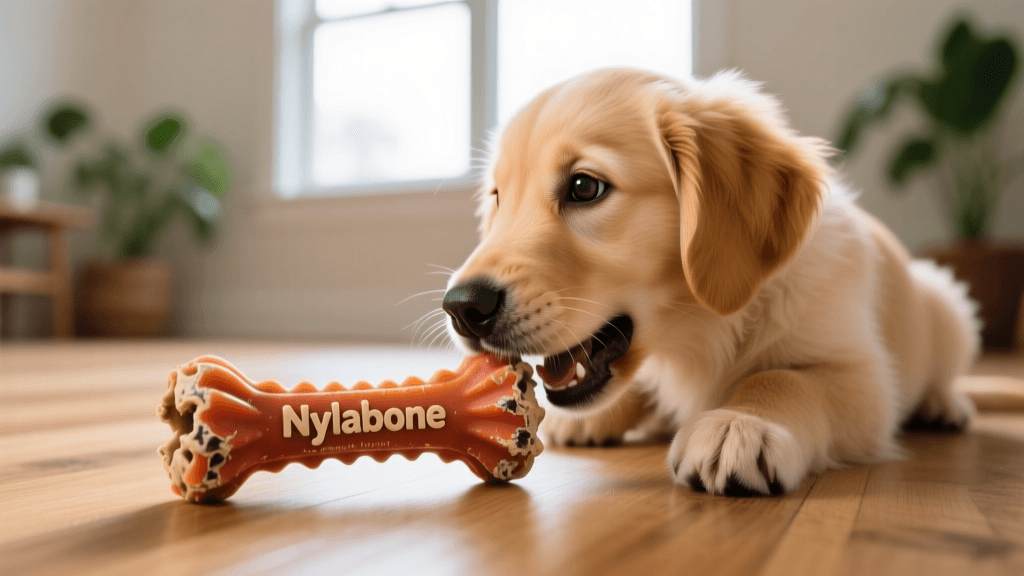
2. Nylabone Puppy Chew Rings (Best for Gum Massage and Furniture Redirection)
Nylabone's textured Puppy Chew Rings feature multiple raised bristles and nubs that mimic the sensation of gnawing on natural wood or bones, but without the splintering risks. The ring shape is highly ergonomic, allowing puppies to grip it with their paws while chewing. Trading Application: This toy is your primary tool for the 'Trade-Up' method. When you catch your puppy chewing on a forbidden item (like a table leg), do not scold them. Instead, approach calmly, offer the Nylabone ring, and praise them enthusiastically when they release the furniture to take the toy. The varied textures provide immediate gingival relief, reinforcing the toy as the superior chewing option.
3. Benebone Puppy Wishbone (Best for Independent Play and Jaw Strengthening)
Infused with 100% real bacon and molded into an ergonomic wishbone shape, the Benebone Puppy line is engineered for 2026's most aggressive juvenile chewers. The concave design allows the puppy to pin the toy down securely, satisfying their primal instinct to hold and tear. Training Application: Use the Benebone to teach independent play and impulse control. Because of its high value and durability, it is an excellent reward for completing a sequence of obedience commands (e.g., Sit, Down, Stay) before being released to enjoy the chew session.
Step-by-Step Bite Inhibition Training Protocol
Owning the right toy is only half the equation; knowing how to deploy it during a biting incident is where the actual training occurs. The AKC's guide on puppy biting stresses that bite inhibition must be taught before the puppy reaches six months of age, as their jaw strength increases exponentially alongside their adult teeth eruption.
- Step 1: The 'Ouch' and Freeze Method. When your puppy's teeth make contact with your skin, immediately let out a high-pitched 'Ouch!' or yelp to mimic the sound of a littermate. Instantly go limp and freeze all movement for 3 to 5 seconds. This triggers their predatory pause instinct and teaches them that biting humans makes the 'game' stop.
- Step 2: The 3-Second Redirect. After the brief freeze, present your chosen teething toy (e.g., the Nylabone Ring). The moment the puppy's mouth closes around the toy instead of your hand, offer calm, verbal praise ('Good chew!').
- Step 3: The Reverse Time-Out. If the puppy ignores the toy and continues to bite your skin with high arousal, stand up, cross your arms, and turn your back for 15 seconds. You are removing your attention, which is the puppy's most valued resource. Return only when they are calm, and re-offer the toy.
2026 Teething Toy Comparison Chart
Choosing the correct tool for your specific training scenario is vital. Below is a comparison of the top behavioral redirection toys available this year.
| Toy Brand & Model | Primary Material | Best Training Application | 2026 Avg. Retail Price |
|---|---|---|---|
| KONG Puppy Classic | Soft Natural Rubber | Crate training, duration, soothing | $12.00 - $16.00 |
| Nylabone Puppy Rings | Textured Nylon Polymer | Furniture redirection, gum massage | $8.00 - $11.00 |
| Benebone Puppy Wishbone | Bacon-Infused Nylon | Independent play, high-value reward | $14.00 - $18.00 |
| West Paw Toppl | Zogoflex (BPA-Free) | Slow feeding, puzzle conditioning | $18.00 - $22.00 |
Advanced Obedience: Teaching 'Drop It' and 'Leave It'
Teething toys are the perfect props for teaching essential impulse control commands, which are foundational for a well-behaved adult dog. The ASPCA's resource on destructive chewing highlights that teaching a dog to voluntarily relinquish items prevents resource guarding and keeps them safe from ingesting dangerous objects.
Training the 'Drop It' Command
Start a tug-of-war game with a soft rubber toy like the KONG Puppy. Let the puppy win and hold the toy. Present a high-value treat (like a piece of boiled chicken) directly to their nose. The moment they open their mouth to drop the toy for the treat, say 'Drop It' in a clear, upbeat tone. Give the treat, then immediately return the toy to them. This teaches the puppy that dropping an item on command doesn't mean the fun ends; it actually results in a reward and the continuation of play.
Training the 'Leave It' Command
Place a less exciting teething toy on the floor and cover it with your hand. When the puppy stops sniffing and pawing at your hand and looks up at you, mark the behavior with a 'Yes!' and reward them with a treat from your *other* hand. Gradually progress to uncovering the toy, and eventually dropping it from a standing position. 'Leave It' is crucial for preventing puppies from picking up hazardous debris during outdoor socialization walks.
Common Training Mistakes to Avoid in 2026
Even well-intentioned owners can inadvertently reinforce bad habits during the teething phase. Avoid these common pitfalls to ensure your behavioral conditioning remains effective:
- Using Hands as Tug Toys: Wrestling with your puppy using your bare hands teaches them that human skin is an acceptable chew toy. Always keep a plush or rubber toy between your skin and their teeth.
- Punitive Scolding: Yelling or physically disciplining a puppy for chewing the wrong item only teaches them to fear you, or to hide their chewing under the bed where they might ingest something dangerous. Redirection is scientifically proven to be vastly superior to punishment.
- Providing Toys that Resemble Forbidden Items: Do not give a puppy an old shoe or a rolled-up sock to chew on. Puppies cannot distinguish between an 'old' shoe and your brand-new 2026 running sneakers. Keep chew toys visually and texturally distinct from household items.
- Leaving Toys Out 24/7: If all toys are always available on the floor, they lose their novelty and value. Rotate your puppy's teething toys every 48 hours to maintain their interest and keep the toys highly rewarding for training sessions.
Transitioning to Adult Chew Toys
By the time your puppy reaches seven to eight months of age, the teething phase will conclude, and their adult teeth will be fully set. At this stage, the soft rubber and polymer toys designed for puppy gums must be retired. Continuing to use puppy-specific toys with an adult dog's bite force can lead to shattered toys and severe gastrointestinal blockages. Transition to heavy-duty adult versions of these toys (such as the classic red KONG or the black KONG Extreme) and shift your training focus from bite inhibition to advanced trick teaching, agility foundations, and off-leash recall. Mastering the teething phase with patience, consistency, and the right tools sets the stage for a lifetime of trust and obedience with your canine companion.
priya-sutaria
All our authors care for dogs every day — read more of their work on the authors page.