How To Train A Rescue Dog With Unknown History
Learn about how to train a rescue dog with unknown history with expert tips and data-backed advice.
Starting From Zero: What Unknown History Really Means
Bringing a rescue dog home is one of the most rewarding things a person can do — and one of the most humbling. Unlike a puppy raised from birth, a rescue dog arrives with a full life already lived. You may know nothing about that life: whether the dog was ever trained, whether it experienced abuse or neglect, whether it lived indoors or outdoors, or whether it ever learned to trust a human being. That blank slate is not a disadvantage. It is simply a different starting point, and understanding it changes everything about how you approach training.
The Association of Professional Dog Trainers (APDT) estimates that roughly 3.1 million dogs enter U.S. shelters every year, and a significant proportion of those arrive with no documented history. Behavioural assessments conducted at intake are often limited to a 15-minute observation window — far too short to capture the full picture of a dog's temperament, triggers, or learning history. What this means in practice is that you, as the new owner, become the primary researcher. Every session is data collection as much as it is training.
The Decompression Period: Give the Dog Time Before You Train
Before any formal training begins, most certified trainers recommend a decompression period of at least two to three weeks. During this time, the dog is allowed to settle into the new environment without pressure to perform or comply. The 3-3-3 rule, widely referenced by shelters including the Austin Pets Alive! organisation in Texas, describes this process: three days to feel overwhelmed, three weeks to learn the routine, and three months to feel at home.
Resist the urge to start obedience work immediately. A dog that is still in a stress response — characterised by elevated cortisol, hypervigilance, or shutdown behaviour — cannot learn effectively. Research published by the Cummings School of Veterinary Medicine at Tufts University has shown that chronic stress impairs memory consolidation in dogs, meaning commands taught during this window are less likely to stick. Let the dog sniff, rest, and observe. Keep interactions calm and predictable. Establish a consistent daily schedule for feeding, toileting, and sleep.
Reading Stress Signals Before You Begin
Learning to read canine body language is not optional — it is the foundation of everything that follows. A dog showing whale eye (visible whites of the eyes), a tucked tail, flattened ears, or excessive yawning during training is telling you it is over threshold. Continuing to push commands at this point does not build resilience; it builds negative associations with the training context itself.
Keep a simple log during the decompression period. Note what triggers a stress response, what seems to relax the dog, and what the dog naturally gravitates toward. This information will shape your reward hierarchy — the ranked list of reinforcers you will use in training. For some dogs, food is the highest-value reward. For others, it is play, proximity, or the opportunity to sniff.
Building a Reward Hierarchy and Choosing Your Tools
Positive reinforcement training, the method endorsed by both the APDT and the Certification Council for Professional Dog Trainers (CCPDT), operates on a simple principle: behaviours that are rewarded are more likely to be repeated. The challenge with a rescue dog is that you do not yet know what the dog finds rewarding, and you cannot assume. A dog that was food-deprived may be highly food-motivated. A dog that was isolated may value social contact above all else.
Spend the first week conducting informal preference tests. Offer small pieces of five different foods — boiled chicken, commercial training treats, cheese, hot dog, and kibble — and observe which the dog consumes fastest and which it ignores. The fastest-consumed item becomes your high-value reward, reserved for new or difficult behaviours. Kibble or lower-value treats are used for maintenance of already-learned behaviours.
"The single most important thing a trainer can do with a dog of unknown history is to build a reinforcement history before asking for anything. Deposit into the account before you make a withdrawal." — Karen Overall, MA, VMD, PhD, DACVB, author of Clinical Behavioral Medicine for Small Animals, referenced in APDT training curricula (2019)
Clicker Training and Marker Words
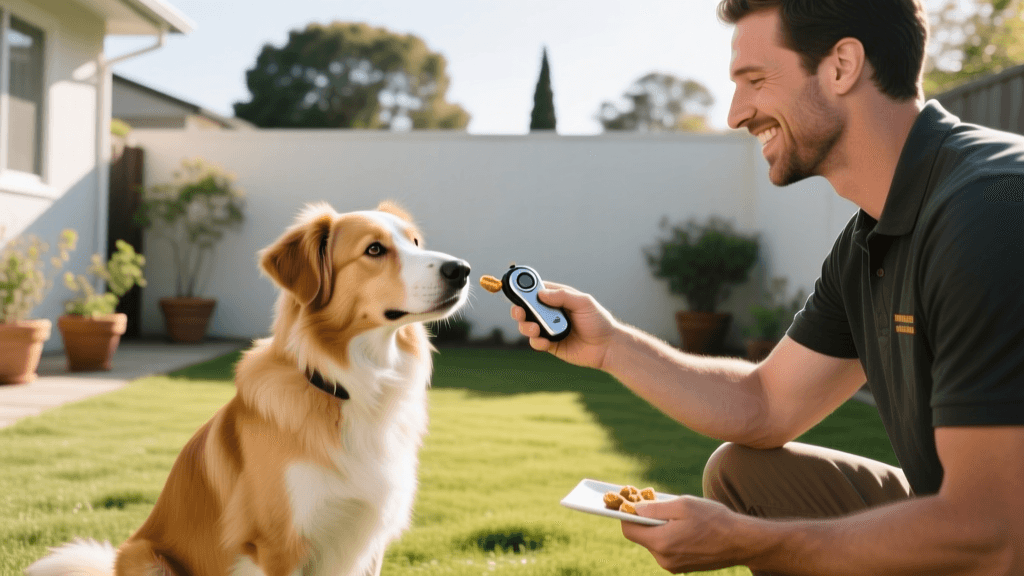
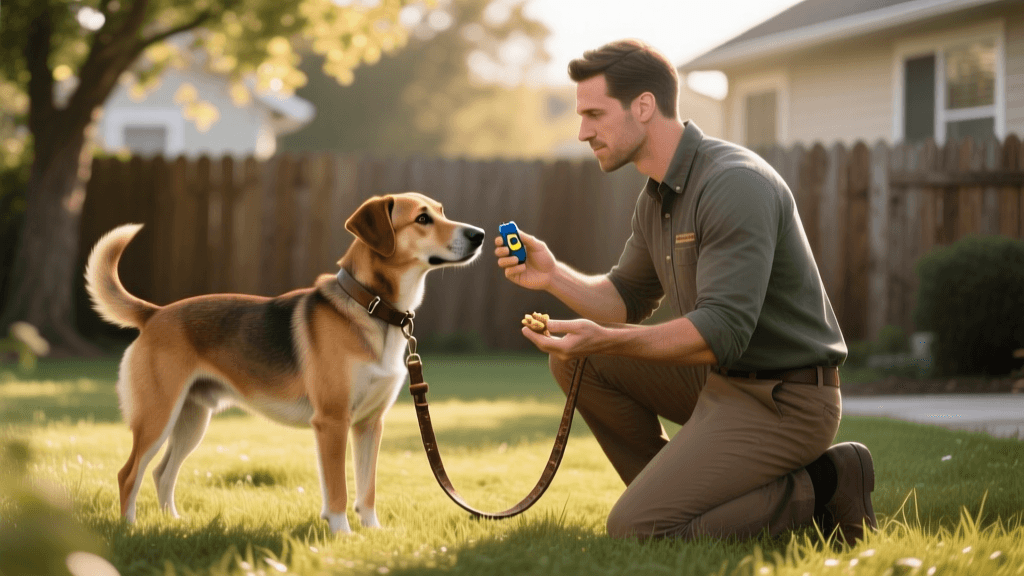
A clicker or a consistent marker word — "yes" spoken in a neutral, even tone — serves as a bridge signal. It tells the dog precisely which behaviour earned the reward, even if the treat takes two or three seconds to deliver. Timing is critical: the marker must land within half a second of the desired behaviour to be effective. Research in operant conditioning consistently shows that delays beyond 1.5 seconds significantly reduce the association between behaviour and consequence.
To introduce the clicker, run 20 repetitions of click-then-treat with no behaviour required. This is called "charging the clicker." Do this across three separate sessions on the first day. By the end of the third session, most dogs will show an anticipatory response — ears forward, attention on you — at the sound of the click. That response tells you the association has been made and you can begin shaping behaviours.
The First Five Commands and How to Teach Them
Start with behaviours that are low-stakes, easy to achieve, and immediately useful. The goal in the first four weeks is not a perfectly obedient dog — it is a dog that has learned that engaging with you produces good things. Every successful repetition builds what trainers call "reinforcement history," and reinforcement history is the currency of trust.
- Name recognition: Say the dog's name once in a neutral tone. The moment the dog orients toward you — even a flick of the ear — mark and reward. Aim for 30 repetitions per day across three short sessions. Within five to seven days, most dogs will reliably turn toward their name.
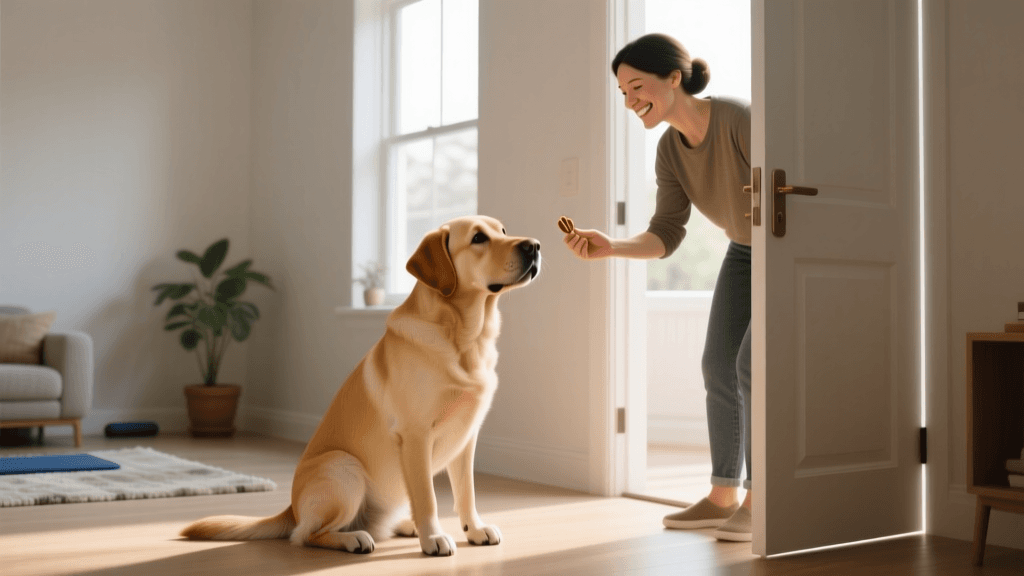
- Sit: Hold a treat at the dog's nose and slowly move it back over the head. As the nose goes up, the hindquarters go down. Mark the moment the dog's bottom touches the floor. Do not push the dog into position — luring is faster and creates no negative associations. Ten repetitions per session, three sessions per day.
- Hand target (touch): Present an open palm six inches from the dog's nose. Most dogs will investigate. The moment the nose touches the hand, mark and reward. This command becomes a recall foundation and a way to redirect attention in stressful situations.
- Leave it: Place a low-value treat on the floor and cover it with your hand. Wait. The moment the dog stops trying to get the treat and looks away or looks at you, mark and reward with a different, higher-value treat from your other hand. This teaches impulse control without confrontation.
- Go to mat: Place a mat or towel on the floor. Any time the dog steps on it, mark and reward. Gradually shape duration by waiting for the dog to remain on the mat for two seconds, then five, then ten before marking. This gives the dog a safe, predictable place to settle in any environment.
Session Length and Frequency
Keep training sessions short. For a dog still adjusting to a new home, three to five minutes per session is sufficient. Longer sessions lead to mental fatigue, which manifests as distraction, disengagement, or frustration behaviours. Three to five sessions distributed across the day outperform a single 20-minute block. End every session on a success — ask for something the dog knows well, mark and reward generously, and release with a consistent word like "free" or "all done."
Addressing Fear and Reactivity Without a Known Trigger History
Many rescue dogs display reactivity — barking, lunging, or freezing — in response to stimuli that seem ordinary: men in hats, children, bicycles, other dogs, or specific sounds. Without a history, you cannot know what the dog was exposed to or what it associates with threat. Your job is not to eliminate the reaction immediately but to change the emotional response underneath it.
The technique most supported by behavioural science is counter-conditioning paired with systematic desensitisation, often abbreviated as CC/DS. The process works in three stages. First, identify the threshold distance — the point at which the dog notices the trigger but has not yet reacted. This might be 30 feet from another dog, or 15 feet from a stranger. Second, at that distance, present the trigger and immediately deliver high-value food, regardless of the dog's behaviour. The trigger predicts the food. Third, over multiple sessions, gradually decrease the distance as the dog's body language remains relaxed.
Progress is measured in weeks, not days. A study conducted at the University of Bristol's School of Veterinary Sciences found that dogs undergoing structured CC/DS protocols for leash reactivity showed measurable improvement in cortisol levels and behavioural indicators after six weeks of consistent work, with sessions conducted four to five times per week at 10 to 15 minutes each.
| Week | Focus | Session Length | Sessions Per Day | Expected Milestone |
|---|---|---|---|---|
| 1–3 | Decompression, name recognition, clicker charging | 3–5 minutes | 3 | Dog responds to name, tolerates handling |
| 4–6 | Sit, touch, leave it, mat work | 5–7 minutes | 3–4 | 4 of 5 commands at 80% reliability indoors |
| 7–10 | Generalisation to new environments, loose-leash walking | 7–10 minutes | 2–3 | Commands reliable in low-distraction outdoor settings |
| 11–16 | CC/DS for identified triggers, recall under distraction | 10–15 minutes | 4–5 | Measurable reduction in reactive threshold distance |
When to Bring in a Professional
There is no shame in recognising the limits of what you can safely manage alone. If your rescue dog displays aggression — growling, snapping, or biting — toward people or other animals, or if fear responses are severe enough to prevent the dog from eating, sleeping, or moving freely through the home, a certified professional is not a luxury. It is a necessity.
Look for trainers who hold credentials from the CCPDT (Certified Professional Dog Trainer – Knowledge and Skills, or CPDT-KA) or who are members of the APDT. These organisations require demonstrated knowledge of learning theory and adherence to a code of ethics that prohibits the use of pain or intimidation. Avoid trainers who rely on dominance-based frameworks or who recommend prong collars, shock collars, or alpha rolls for a dog with an unknown trauma history. Aversive tools applied to a fearful dog do not address the underlying emotional state — they suppress behaviour while increasing the risk of redirected aggression.
The San Francisco SPCA's Animal Behavior and Training department, one of the most respected shelter behaviour programmes in the United States, publishes free resources on finding qualified trainers and distinguishing evidence-based methods from outdated approaches. Their guidelines align with the position statements of the American Veterinary Society of Animal Behavior (AVSAB), which explicitly recommends against punishment-based training for dogs with fear or anxiety histories.
- Verify credentials through the CCPDT or APDT member directories before booking a consultation.
- Ask the trainer to describe how they would handle a dog that refuses food during a session — a qualified trainer will discuss threshold management, not escalation.
- Observe a session before committing to a programme. A good trainer should welcome this.
- If medication is recommended by a veterinary behaviourist, treat it as a tool that lowers the dog's baseline anxiety enough for training to work — not as a substitute for training itself.
Training a rescue dog with unknown history is not a linear process. There will be weeks of apparent regression, days when the dog seems to have forgotten everything it learned, and moments when a trigger you never anticipated sends the dog over threshold in a context that felt safe. These are not failures. They are information. Each one tells you something about the dog's internal map of the world, and each one gives you a new opportunity to replace an old association with a better one. The work is slow, the progress is real, and the relationship built through it is unlike anything a shortcut could produce.
Priya Sutaria
All our authors care for dogs every day — read more of their work on the authors page.