Training A Dog To Be Calm Around Visitors
Learn about training a dog to be calm around visitors with expert tips and data-backed advice.
Understanding Why Dogs React to Visitors
When a dog barks, jumps, or lunges at guests walking through the front door, the behaviour is rarely about aggression. In most cases, it stems from one of two sources: over-arousal driven by excitement, or anxiety triggered by the presence of an unfamiliar person in a space the dog considers its own. Both states produce the same outward chaos — spinning, vocalising, jumping — but they require subtly different approaches to resolve. Getting the distinction right from the start saves weeks of misdirected training effort.
The Association of Professional Dog Trainers (APDT) notes in its 2022 position statement on behaviour modification that the majority of door-greeting problems presented to trainers are rooted in a lack of an incompatible behaviour, not in dominance or wilful disobedience. In plain terms, the dog has never been taught what to do instead of jumping. That gap is exactly what a structured visitor-greeting protocol fills.
The Science Behind Calm Behaviour
Behavioural science gives trainers two powerful levers: classical conditioning and operant conditioning. Classical conditioning changes how a dog feels about a stimulus — in this case, the doorbell or a knock. Operant conditioning changes what the dog does in response to that stimulus. Effective visitor training uses both in sequence.
Research published by the Companion Animal Psychology Research Group at the University of Lincoln in 2019 found that dogs trained with positive reinforcement alone reached criterion behaviour an average of 1.5 times faster than dogs trained with punishment-based methods, and showed significantly lower cortisol levels during training sessions. Lower cortisol means a calmer emotional baseline, which is precisely the state you need when a stranger walks through the door.
Threshold and Arousal Levels
Every dog has a threshold — the point at which arousal or anxiety tips from manageable into reactive. Below threshold, a dog can think, take treats, and respond to cues. Above threshold, the limbic system takes over and learning stops. Visitor training must happen below threshold at every stage. If your dog cannot take a high-value treat (such as a small piece of cooked chicken, roughly 1 cm cubed) when a guest is present, you are already above threshold and need to increase distance or reduce the intensity of the trigger.
The Role of Predictability
Dogs that know what comes next are calmer dogs. A consistent ritual around visitor arrivals — the same cue, the same location, the same reward — builds a predictable pattern that reduces anticipatory anxiety. Aim to repeat the full greeting sequence at least 20 times across varied visitors before expecting reliable generalisation. Generalisation across people, ages, and clothing styles is one of the most commonly skipped steps and one of the most important.
Building the Foundation: Core Skills Before Visitors Arrive
Before any real visitor sets foot in your home, your dog needs three solid foundation behaviours: a reliable "sit," a "go to place" cue (directing the dog to a mat or bed), and a default four-on-the-floor behaviour when greeting people. Each of these should be trained to a success rate of at least 80% in low-distraction environments before adding the complexity of an actual guest.
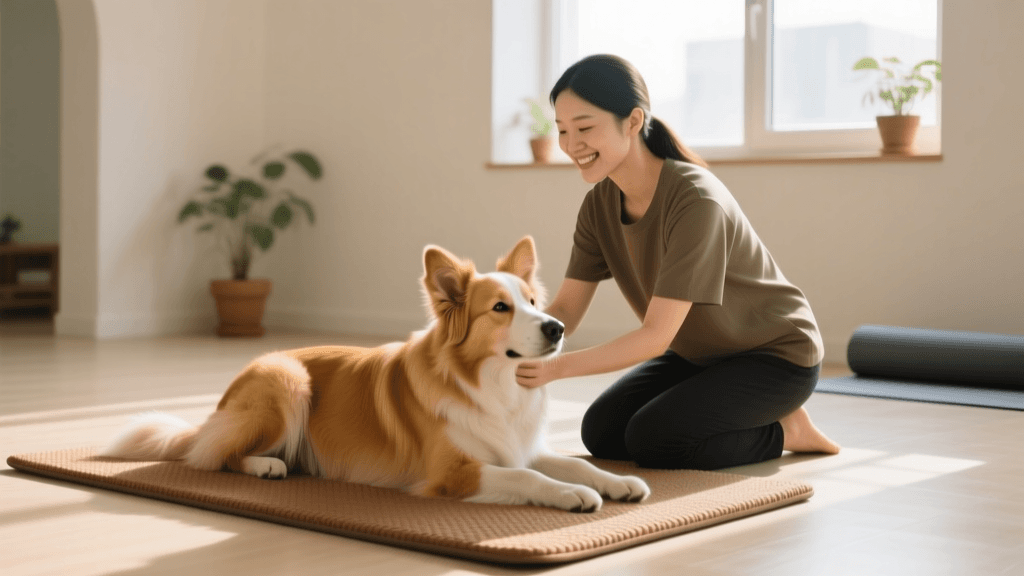
Start "go to place" by luring the dog onto a mat with a treat, marking the moment all four paws land on the mat with a clicker or a verbal marker such as "yes," and delivering the reward. Repeat 10 repetitions per session, two sessions per day, for three to five days. Once the dog moves to the mat reliably on the verbal cue alone, begin adding duration by delaying the reward by one second, then two, building to 30 seconds of calm mat behaviour before moving on.
Doorbell Desensitisation
The doorbell is often the first trigger in the visitor chain. Play a recording of a doorbell sound at low volume — roughly 40 decibels, comparable to a quiet conversation — and immediately deliver a treat. Repeat 15 times per session. Over three to five sessions, gradually increase the volume. The goal is a conditioned emotional response: doorbell predicts good things, so the dog orients toward you rather than the door. The Certification Council for Professional Dog Trainers (CCPDT) includes this type of systematic desensitisation in its 2023 Humane Hierarchy guidelines as a first-line intervention before any behaviour modification protocol.
The Visitor Protocol: Step-by-Step
Once foundation skills are solid, you can introduce a structured visitor protocol. The sequence below is designed to be repeatable and scalable, starting with a helper who can follow instructions precisely and progressing to real, unpredictable guests.
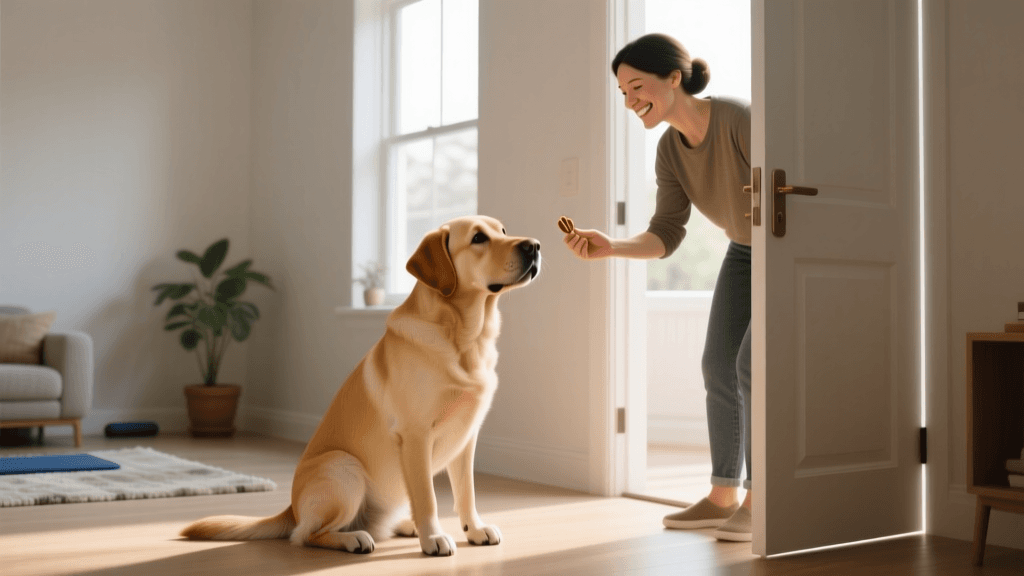
- Cue "go to place" the moment you hear the doorbell or knock. Reward the dog on the mat before opening the door.
- Ask the dog to stay while you open the door. If the dog breaks, calmly reset without scolding. Close the door, cue "go to place" again, and restart.
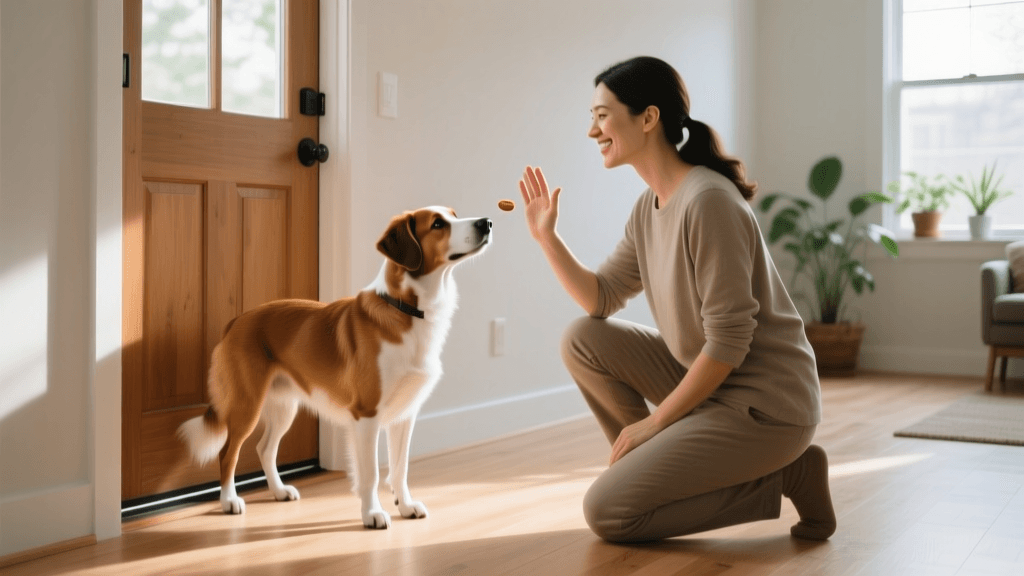
- Invite the visitor in while keeping your body between the dog and the guest. Reward the dog for remaining on the mat with a high-value treat every 3 to 5 seconds for the first 60 seconds.
- Release the dog with a cue such as "say hello" only when all four paws are on the floor and the dog is visibly calm. The visitor should turn sideways and avoid direct eye contact initially.
- Reward calm greeting behaviour immediately. Any jumping results in the visitor turning away and all attention being withdrawn for 5 seconds before trying again.
Run this sequence with a helper visitor at least 15 times before introducing a genuine guest who has not been briefed. Each repetition should last no longer than 3 minutes in the early stages to keep arousal levels manageable.
Managing the Environment During Training
Management is not training, but it is essential while training is in progress. Every time a dog successfully jumps on a visitor and receives attention — even negative attention — the behaviour is reinforced. A single unmanaged repetition can set back a week of careful work. Use a baby gate, a tether attached to a wall anchor, or a leash held by a second person to prevent rehearsal of the unwanted behaviour during the learning phase.
The following table outlines the management tools most commonly recommended by certified trainers, along with their appropriate use cases:
| Tool | Best Use Case | Limitation |
|---|---|---|
| Baby gate | Keeping dog in adjacent room during initial entry | Dog must be comfortable with confinement |
| Tether / wall anchor | Allowing visual access while preventing jumping | Requires prior tether training to avoid frustration |
| Leash held by handler | Active training sessions with helper visitors | Handler must remain calm and avoid tension on leash |
| Crate with open door | Dog that self-settles in crate when overwhelmed | Should never be used as punishment |
| Exercise pen | Puppies or small dogs in open-plan spaces | Less effective for large, athletic dogs |
The goal is to reduce the dog's opportunity to practise the problem behaviour to as close to zero as possible while the replacement behaviour is being built. Once the dog is reliably going to its mat and greeting calmly across 20 or more varied visitors, management tools can be faded gradually.
Working With Anxious Dogs
For dogs whose visitor reactivity is driven by fear rather than excitement, the protocol above needs to be modified. Forcing an anxious dog to approach a visitor — even with treats — can worsen the underlying anxiety if the dog has not been given genuine choice and control. The key modification is to let the dog set the pace entirely.
Place high-value treats on the floor in a trail leading toward the visitor, who should be seated and ignoring the dog completely. Allow the dog to approach, sniff, and retreat at will. Do not call the dog toward the visitor, do not reach out to pet, and do not make eye contact until the dog has voluntarily made contact at least three times across separate sessions. This approach, sometimes called "two-cookie greeting" in applied behaviour analysis circles, was formalised by researchers at the Horner Institute for Positive Behaviour Support and has been adapted widely in companion animal training since the early 2010s.
If a dog shows hard signs of fear — lip licking, yawning, whale eye, tucked tail, or attempts to flee — during any session, end the session immediately and consult a certified professional. The CCPDT's 2023 directory lists over 3,800 certified trainers across North America who specialise in fear and anxiety cases. A board-certified veterinary behaviourist should be consulted if the dog's anxiety is severe enough to prevent eating treats in the presence of visitors even at a distance of 10 metres or more.
Consistency Across All Household Members
One of the most reliable ways to stall progress is inconsistency between household members. If one person enforces the mat behaviour while another allows jumping, the dog learns that the rule is person-dependent rather than absolute. Hold a brief household meeting before beginning the protocol and agree on three non-negotiable rules:
- No one greets the dog while it is jumping, regardless of how excited or cute the behaviour appears.
- Every visitor who enters the home is briefed before arrival — a simple text message explaining the protocol takes 30 seconds and prevents weeks of setbacks.
- The "go to place" cue is used consistently by every adult in the household, using the same word and the same hand signal every time.
Children in the household present a particular challenge because their unpredictable movements and high-pitched voices are inherently arousing for most dogs. Teach children to stand still like a tree if the dog jumps, crossing their arms and looking away. This removes the social reward of attention without requiring the child to manage the dog actively. Practise this with children during low-arousal moments so the response becomes automatic when a visitor arrives.
Progress in visitor training is rarely linear. Expect two steps forward and one step back, particularly when introducing new visitor types — people in hats, people with walking aids, or people who move unpredictably. Each new category of visitor is, neurologically speaking, a partially new stimulus. Budget four to six weeks of consistent daily practice for most dogs to reach a reliable greeting behaviour, and up to three to four months for dogs with a long history of rehearsing the problem behaviour or significant underlying anxiety. The investment is worth it: a dog that greets visitors calmly is a dog that can be included in more of daily life, which is better for the dog's welfare and the owner's relationship with their pet.
Robin Maitland
All our authors care for dogs every day — read more of their work on the authors page.