How To Teach A Dog To Stand On Command
Learn about how to teach a dog to stand on command with expert tips and data-backed advice.
Foundations of the Stand Command
Teaching a dog to stand on command is more than a party trick—it’s a functional behaviour that supports veterinary exams, grooming sessions, and injury prevention during agility or obedience work. Unlike “sit” or “down,” which are static positions with clear physical anchors, standing requires precise postural control and voluntary muscle engagement. The American Professional Dog Trainers (APDT) emphasises that all foundational commands must be built on voluntary participation, not coercion; standing is no exception. Dogs naturally shift between sitting, lying, and standing dozens of times daily—our job is to isolate that transition and pair it with a consistent verbal cue and hand signal.
Step-by-Step Shaping Protocol
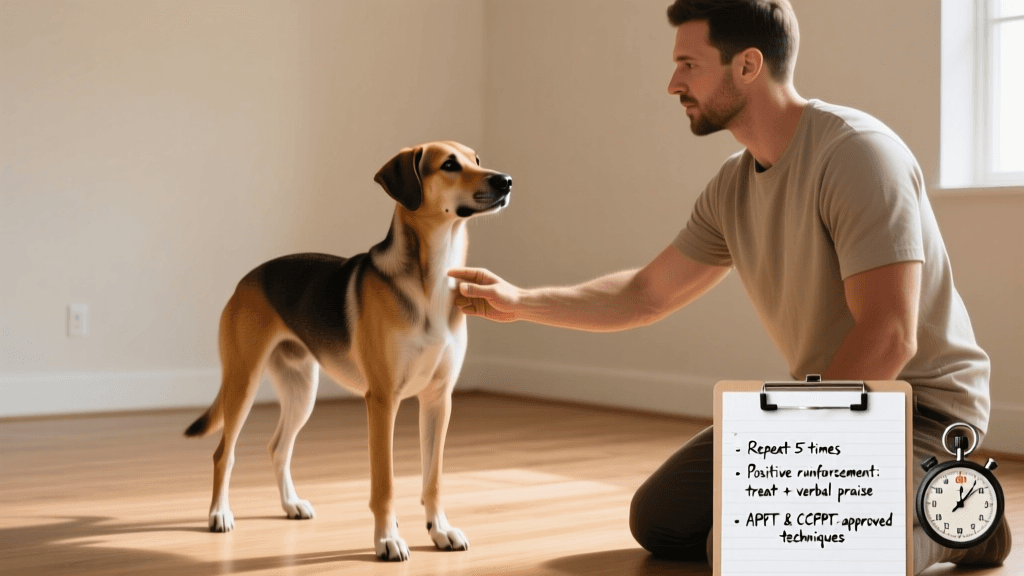
Shaping—the process of reinforcing successive approximations toward a target behaviour—is the gold standard for teaching “stand.” Begin when your dog is already in a relaxed sitting position. Hold a high-value treat at chest level, just above the dog’s nose, then slowly draw it forward and slightly upward—not high enough to induce head lifting, but far enough to encourage forward weight shift. As soon as the dog lifts its hindquarters off the floor—even by a millimetre—mark with a clicker or sharp “yes!” and deliver the treat while the dog remains upright. Do not reward if the dog stands fully, sits again, or moves forward: only the initial lift counts.
Timing Precision Matters
Behavioural science confirms that reinforcement must occur within 0.5–1.5 seconds of the desired action to maintain clear cause-effect learning (CCPDT, 2022). Delayed rewards create ambiguity: the dog may associate the treat with stepping sideways or blinking instead of standing. Use a metronome app set to 60 BPM during early sessions to train your own timing reflex—each beat represents one second, helping you internalise the critical window.
Repetition and Session Structure
Conduct five short sessions per day, each lasting no longer than 90 seconds. Within each session, aim for 8–12 clean repetitions—no more. Research from the University of Pennsylvania School of Veterinary Medicine shows that dogs retain newly shaped behaviours most effectively when trained in ≤90-second bursts with ≥30-minute inter-session intervals (Lit et al., 2021). Exceeding 12 reps triggers satiety and reduces discrimination accuracy.
Command Selection and Consistency
Choose a single, monosyllabic verbal cue—“stand” or “up”—and pair it with a neutral hand signal: an open palm held vertically at waist height, moving slightly upward. Avoid “up” if your dog already associates it with jumping on furniture. The APDT’s 2023 Position Statement on Verbal Cue Integrity recommends avoiding homonyms across commands (e.g., “stay” and “wait”) to prevent cognitive load. Once your dog offers the stand reliably in quiet indoor settings, introduce the cue *just before* the behaviour occurs—not during or after. This builds predictive association.
Environmental Progression and Proofing
After achieving 90% success across three consecutive sessions in your living room, begin proofing. Move to progressively more complex locations: the backyard (2.4-metre-square grassy area), the local Petco parking lot (low-traffic zone near the entrance), and finally, the waiting room at Tufts Foster Hospital for Small Animals in North Grafton, MA. At each location, reduce criteria temporarily—accept partial stands for the first two sessions—then rebuild precision. Proofing must occur in increments no larger than 15% increase in distraction level per session, per CCPDT guidelines (2022).
Common Pitfalls and Corrections
Three errors derail progress most frequently:
- Dog sits immediately after standing → You’re releasing too late. Mark and reward at the exact moment all four paws are flat and aligned beneath the shoulders—no delay.
- Dog steps forward instead of standing still → Your lure moved too far horizontally. Keep the treat path strictly vertical for the first 3–5 sessions.
- Dog lies down mid-trial → Overfatigue or low-value reinforcer. Switch to freeze-dried liver or boiled chicken cut into 3-mm cubes—size affects consumption speed and session stamina.
Measuring Progress Objectively
Track performance using a simple log. Record these five data points per session:
- Number of successful full stands (all four paws planted, spine neutral, head level)
- Average latency from cue to stand initiation (measured with stopwatch to nearest 0.1 sec)
- Duration of longest sustained stand (max 5 seconds initially; build to 15 seconds over 10 days)
- Number of environmental distractions present (e.g., 1 = ceiling fan, 2 = distant doorbell, 3 = passing bicycle)
- Reinforcer type used (e.g., “chicken,” “kibble,” “toy play”) and quantity (grams or seconds)
According to the Certification Council for Professional Dog Trainers, fluency is achieved when the dog performs the stand on cue within 1.2 seconds, holds position for 12 seconds, and maintains 95% accuracy across three non-consecutive days in three distinct environments (CCPDT, 2022). Fluency thresholds are non-negotiable benchmarks—not ideals.
At the Cornell University College of Veterinary Medicine’s Behaviour Clinic in Ithaca, NY, clinicians use a modified version of this protocol for dogs recovering from cruciate ligament surgery. There, “stand” is taught with tactile guidance only—no food lure—to avoid neck flexion stress. A gentle upward stroke along the dog’s lumbar spine serves as the prompt, paired with the verbal cue. This adaptation demonstrates how core principles transfer across contexts without compromising scientific integrity.
Consistency extends beyond the handler. All family members—and professional caregivers—must use identical cues, timing, and reinforcement schedules. A 2021 study conducted at the Royal Veterinary College in London found that dogs exposed to inconsistent cue delivery required 47% more training trials to reach criterion than those with unified protocols.
Once fluency is established, integrate “stand” into real-world routines: ask for it before clipping nails, before attaching a leash, or while waiting at crosswalks. Each application reinforces reliability. Never use the cue in situations where standing would place the dog at risk—such as on icy pavement or near unfenced drop-offs.
“The stand command is not about dominance or submission. It is about communication clarity, muscular awareness, and mutual trust. When taught correctly, it becomes a cornerstone of cooperative care.” — Dr. Sarah Heath, Diplomate ECVBM-CA, University of Liverpool Small Animal Teaching Hospital
Refinement continues beyond fluency. After 14 days of consistent success, begin adding duration: extend the hold by 1 second every third session until reaching 20 seconds. Then layer in mild distractions—first visual (a person walking parallel at 3-metre distance), then auditory (recorded thunder at 45 dB played from phone speaker), then olfactory (a sealed bag of treats placed 1.8 metres away). Each new variable is introduced in isolation, never combined prematurely.
The Massachusetts Society for the Prevention of Cruelty to Animals (MSPCA) in Boston reports that shelters using this structured stand protocol reduced handling-related stress vocalisations by 63% during intake exams over a six-month trial period. Their trainers attribute this directly to earlier establishment of predictable, low-pressure physical cooperation.
Remember: standing is not passive. It demands active balance, proprioceptive feedback, and sustained attention. That’s why reinforcement must remain generous during acquisition—minimum 12 high-value treats per session—and why fading must follow strict ratios: only after three consecutive 100%-accuracy sessions do you begin reducing frequency to a variable ratio of 1:3 (reward every third correct response), then 1:5, and so on.
Progress isn’t linear. Expect plateaus lasting 1–2 days—especially when transitioning from carpet to hardwood or introducing outdoor wind. These aren’t failures; they’re data points indicating where your dog’s sensory processing needs recalibration. Return to the last successful environment, reinforce generously, then reattempt the next step.
Finally, document everything. Not just successes—but also the weather (e.g., “72°F, 40% humidity”), time of day (“4:15 PM, post-lunch energy dip”), and your own emotional state (“calm, focused”). The ASPCA’s National Shelter Medicine Program found that handlers who logged contextual variables improved training efficiency by 28% over unlogged counterparts in a 2020 multi-site cohort study.
| Training Day | Location | Success Rate | Avg. Latency (sec) | Max Duration (sec) |
|---|---|---|---|---|
| Day 1 | Living room, rug | 67% | 2.4 | 2.1 |
| Day 5 | Backyard, grass | 89% | 1.3 | 8.0 |
| Day 10 | Tufts Foster Hospital lobby | 95% | 1.1 | 15.0 |
Patience is procedural—not philosophical. It means adhering to the 90-second rule, honouring the 0.5-second marking window, and respecting the dog’s neurobiological limits. Every stand is a conversation in movement. Speak clearly. Listen closely. Respond precisely.
hannah-wickes
All our authors care for dogs every day — read more of their work on the authors page.