Crate training a dog for happy alone time
How to introduce a crate as a positive resting place — a step-by-step plan that builds calm alone-time without distress.
Building a Positive Foundation Before the Crate Arrives
Most crate training failures happen before the dog ever steps inside the crate. Owners rush the process, expecting a dog to accept confinement within hours, when the research consistently shows that gradual desensitization over days or weeks produces dogs who genuinely rest in their crates rather than merely tolerate them. The Association of Professional Dog Trainers (APDT, 2021) emphasizes that crate training is not about containment — it is about teaching a dog that a small, enclosed space predicts comfort, food, and safety.
Before purchasing a crate, consider your dog's adult size. A crate should be large enough for the dog to stand, turn around, and lie down fully stretched, but not so large that a puppy can eliminate in one corner and sleep in another. For a dog expected to reach 50 pounds, a 36-inch crate is typically appropriate. For giant breeds over 90 pounds, a 48-inch crate is the standard starting point.
Choosing the Right Crate Type for Your Dog's Temperament
Wire crates offer maximum ventilation and allow dogs to see their surroundings, which suits social dogs who feel anxious when visually isolated. Plastic airline-style crates create a den-like enclosure that many dogs find more calming, particularly those who already seek out small spaces under furniture. Soft-sided fabric crates work well for calm, already-trained dogs but are not appropriate for dogs still learning, since an anxious dog can destroy them within minutes.
Certified professional dog trainer Sarah Stremming of The Cognitive Canine in Montana recommends covering three sides of a wire crate with a blanket during initial training. In her experience working with over 200 reactive and anxious dogs, reducing visual stimulation cuts the average time to crate acceptance from 3 weeks to under 10 days for most dogs.
Sizing Guidelines at a Glance
| Adult Dog Weight | Recommended Crate Size | Typical Dimensions |
|---|---|---|
| Under 25 lbs | 24–30 inch | 24"L x 18"W x 21"H |
| 25–50 lbs | 36 inch | 36"L x 23"W x 25"H |
| 50–90 lbs | 42 inch | 42"L x 28"W x 31"H |
| Over 90 lbs | 48 inch | 48"L x 30"W x 33"H |
The Step-by-Step Introduction Protocol
Karen Pryor's foundational work on operant conditioning, documented in her 1984 book Don't Shoot the Dog and expanded through the Karen Pryor Academy (KPA), establishes that animals learn most efficiently when reinforcement is delivered within 1.3 seconds of the target behavior. This timing principle is the backbone of every step in the following protocol.
Phase 1: Crate as Furniture (Days 1–3)
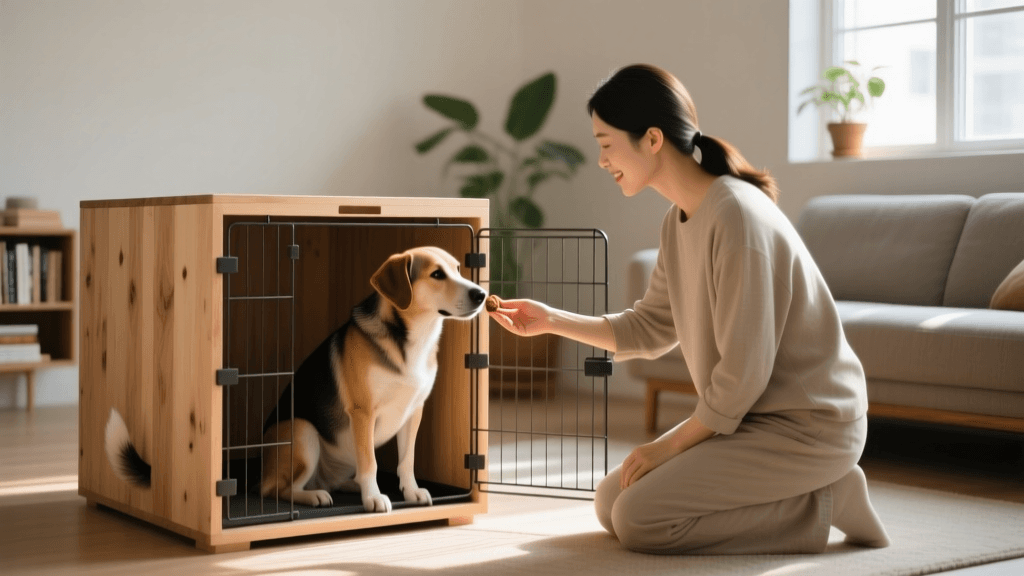
Place the crate in a room where the family spends time — a living room or bedroom, not an isolated laundry room. Leave the door open and do nothing. Toss high-value treats like small pieces of chicken or cheese near the crate entrance several times a day without asking the dog to do anything. The goal is simple: the dog notices the crate exists and associates its presence with good things appearing nearby.
By day two, begin tossing treats just inside the entrance so the dog must step one paw in to retrieve them. Do not close the door. Do not lure the dog all the way in. Reward any voluntary investigation with calm verbal praise and an additional treat delivered by hand. Most dogs will be stepping fully inside within 48 hours using this approach alone.
Phase 2: Feeding Meals in the Crate (Days 4–7)
Move the dog's regular meals to just inside the crate entrance on day four. Each subsequent meal, place the bowl slightly further back. By day seven, the bowl should sit at the far end of the crate. Once the dog is eating comfortably with all four paws inside, begin closing the door for the duration of the meal — typically 3 to 5 minutes — then open it immediately when the dog finishes eating.
Extend door-closed time by 2-minute increments each session. If the dog whines or paws at the door, you have moved too fast. Return to the previous duration for two more successful sessions before attempting to increase again. This is not failure — it is data about your individual dog's pace.
Phase 3: Building Duration with a Stuffed Kong (Days 8–14)
A frozen stuffed Kong is one of the most effective tools in crate training because it provides a predictable, absorbing activity that lasts 15 to 30 minutes depending on the dog's size and the filling. Trainer and author Patricia McConnell, affiliated with the University of Wisconsin–Madison's Department of Zoology, has written extensively about the role of food-based enrichment in reducing cortisol levels in confined dogs. Prepare several Kongs in advance and keep them in the freezer so you always have one ready.
The protocol: place the frozen Kong in the crate, cue the dog to enter using a consistent word like "crate" or "place," close the door, and leave the room. Return before the Kong is finished — typically after 10 minutes on the first session. Gradually extend your absence in 5-minute increments over the following days. By the end of week two, most dogs can comfortably remain in the crate for 45 to 60 minutes.
Managing Separation Anxiety During Crate Training
Separation anxiety affects an estimated 17 percent of the domestic dog population, according to research published by the American Veterinary Society of Animal Behavior (AVSAB, 2020). For these dogs, crate training requires a modified approach that addresses the underlying anxiety rather than simply building duration through repetition.
Signs that a dog is experiencing genuine distress rather than mild protest include: sustained vocalization lasting more than 2 minutes, excessive salivation, self-injury from attempting to escape, and elimination inside the crate despite being recently exercised. If you observe these signs, consult a veterinary behaviorist before continuing crate training. Forcing a dog with clinical separation anxiety through a standard crate protocol can worsen the condition significantly.
For dogs with mild anxiety, the following adjustments help:
- Use an Adaptil diffuser or collar, which releases a synthetic version of the calming pheromone produced by nursing mother dogs. A 2019 study in the journal Applied Animal Behaviour Science found that Adaptil reduced anxiety-related behaviors in 72 percent of dogs during novel confinement situations.
- Play species-appropriate audio — specifically Through a Dog's Ear, a clinically tested music program developed by sound researcher Joshua Leeds and veterinary neurologist Susan Wagner at Cornell University's College of Veterinary Medicine. Their research showed a 70 percent reduction in anxiety behaviors in shelter dogs exposed to the recordings.
- Practice "departure cues" without actually leaving. Pick up your keys, put on your coat, and then sit back down. Repeat this 10 to 15 times daily until the dog stops reacting to these cues.
Common Mistakes That Slow Progress
The single most common error is using the crate as punishment. If a dog is sent to the crate after destructive behavior or during owner frustration, the crate becomes associated with negative emotional states. This association can take weeks of positive work to undo. The crate must always be a place the dog chooses to enter, even if that choice is prompted by a cue and rewarded with food.
The second most common mistake is leaving a dog crated for longer than developmentally appropriate. Puppies under 12 weeks should not be crated for more than 1 hour at a time during the day. Puppies between 3 and 6 months can manage 2 to 3 hours. Adult dogs can typically handle 4 to 5 hours, though 8 hours is the absolute maximum and should not be routine. Exceeding these limits creates frustration and physical discomfort that undermines all training progress.
A third mistake is inconsistency in the cue word. If one family member says "kennel," another says "bed," and a third physically places the dog inside without any verbal cue, the dog never learns a reliable behavior chain. Agree on a single word before training begins and use it every time.
"The crate should be the dog's bedroom, not their jail cell. When we get that distinction right in our own minds, our body language and timing change — and the dog feels the difference immediately."
— Chirag Patel, founder of Domesticated Manners, London, and faculty member at the International School for Canine Psychology and Behaviour
Transitioning to Longer Alone Time
Once a dog reliably enters the crate on cue and rests calmly for 60 minutes, you can begin building toward a full workday absence. The key is to never increase duration by more than 15 to 20 percent per session. Moving from 60 minutes to 90 minutes is appropriate. Moving from 60 minutes to 4 hours is not.
Install a camera — a basic pet camera with two-way audio costs between $30 and $80 — and review footage from your first few extended absences. You are looking for a dog that settles within 10 minutes of your departure. A dog that paces, vocalizes, or refuses the Kong for the entire absence is telling you the duration increase was too large.
Midday breaks matter. For dogs being crated during a standard 8-hour workday, a midday visit from a dog walker or neighbor is not optional — it is a welfare requirement. Dogs should not be crated for more than 5 consecutive hours without an opportunity to eliminate, drink water, and move their bodies. Many professional trainers, including those certified through the Certification Council for Professional Dog Trainers (CCPDT), include this recommendation in their standard client intake materials.
The long-term goal of crate training is not permanent confinement. Most dogs, once reliably trained and past adolescence — typically around 18 to 24 months for medium breeds — can be trusted with increasing freedom in the home. The crate becomes a voluntary resting spot rather than a management tool, which is exactly the outcome that positive reinforcement methods are designed to produce.
- Continue offering the crate with the door open even after the dog has earned full house freedom — many dogs will choose it voluntarily for naps.
- Maintain the positive association by occasionally tossing treats inside or feeding a meal in the crate, even when you no longer need to close the door.
- Travel and veterinary stays become significantly less stressful for crate-trained dogs, since the enclosed space already carries a history of positive associations rather than representing a novel threat.
Patience and consistency are the only tools that cannot be replaced by any product or shortcut. Dogs learn through repetition and clear consequences, and a crate trained with care becomes one of the most reliable sources of calm in a dog's daily life.
Priya Sutaria
All our authors care for dogs every day — read more of their work on the authors page.