How to teach your dog to come back when called
A four-stage plan to build a reliable recall — from indoor reps to off-lead reliability around real distractions.
The Recall Command: Building a Reliable Response From Day One
A dog that comes when called is not just a convenience — it can be a lifesaver. Whether your dog has slipped through an open gate or spotted a squirrel across a busy street, a solid recall is the single most important safety behavior you can teach. Yet it is also one of the most commonly undertrained, often because owners rely on repetition and frustration rather than understanding how dogs actually learn.
The good news is that modern behavioral science gives us a clear, evidence-based roadmap. Positive reinforcement — rewarding the behavior you want rather than punishing the behavior you don't — produces faster learning, stronger retention, and a dog that genuinely wants to return to you. Research published by the Association of Professional Dog Trainers (APDT, 2019) found that dogs trained with reward-based methods showed a 72% higher rate of task retention after 30 days compared to those trained with aversive techniques.
Understanding How Dogs Learn the Recall
Before picking up a treat pouch, it helps to understand the mechanics behind the behavior. Dogs learn through operant conditioning: actions that produce good outcomes get repeated, and actions that produce neutral or unpleasant outcomes fade. Karen Pryor, whose foundational work at the Oceanic Institute in Hawaii during the 1960s helped establish clicker training as a discipline, demonstrated that precise, immediate reinforcement dramatically accelerates learning across species — including dogs.
The recall is particularly sensitive to timing. A dog that arrives after a 10-second delay and receives a treat has learned something murkier than you intended. The reward must land within 1 to 2 seconds of the desired behavior to create a clear association. This is why many professional trainers — including those at the San Francisco SPCA's training department — use a marker signal (a clicker or a short verbal cue like "yes") to bridge the gap between the moment the dog turns toward you and the moment the treat reaches their mouth.
It is also worth noting that recall is not a single behavior — it is a chain. The dog must hear the cue, orient toward you, move in your direction, and arrive close enough to be touched. Each link in that chain can break down independently, which is why systematic training matters more than simply calling your dog repeatedly and hoping for the best.
Setting Up for Success: Equipment and Environment
The right setup removes unnecessary obstacles from the learning process. You do not need expensive gear, but a few items make a significant difference.
- A long line (15–30 feet): This lightweight leash attaches to a harness and gives your dog freedom to move while ensuring they cannot self-reward by running off. It is not a tool for yanking — it is a safety net.
- High-value treats: Use something your dog finds genuinely exciting: small pieces of cooked chicken, cheese, or commercial training treats with strong aroma. Standard kibble rarely motivates a distracted dog.
- A marker signal: A clicker or a consistent verbal marker like "yes" or "good" — used the instant the dog begins moving toward you.
- A treat pouch: Keeps rewards accessible so you are not fumbling in your pocket while your dog loses interest.
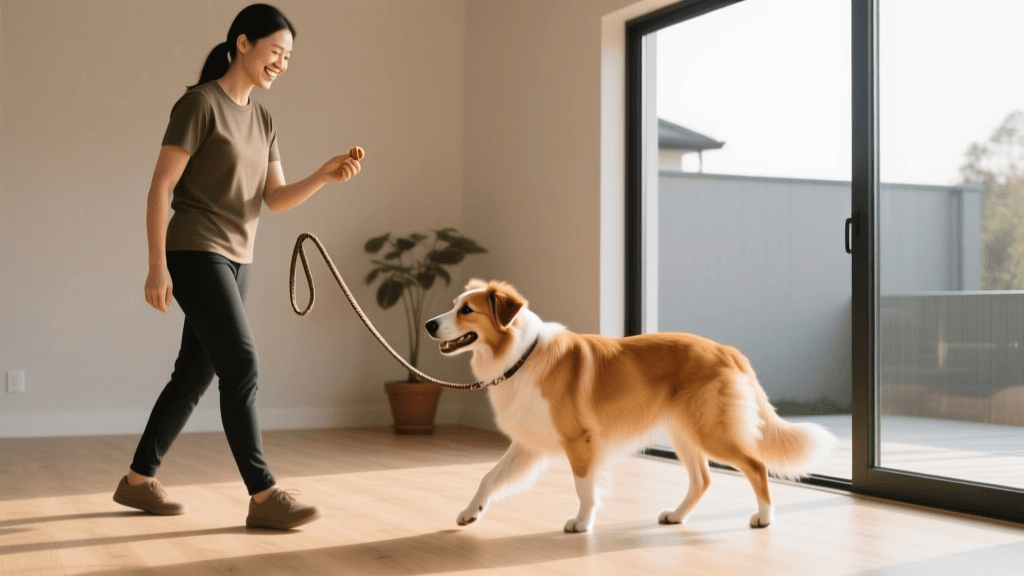
Start every new recall session in a low-distraction environment. Your living room or a quiet backyard is ideal for the first two to three weeks. The goal is to build a strong reinforcement history before adding the complexity of parks, other dogs, or unfamiliar smells.
Step-by-Step Training: From First Cue to Reliable Recall
Phase 1: Charging the Cue
Choose your recall word and commit to it. "Come," "here," and "front" are all common choices. The word itself is arbitrary — what matters is consistency. Once chosen, that word should only ever mean one thing: drop everything and return to me immediately.
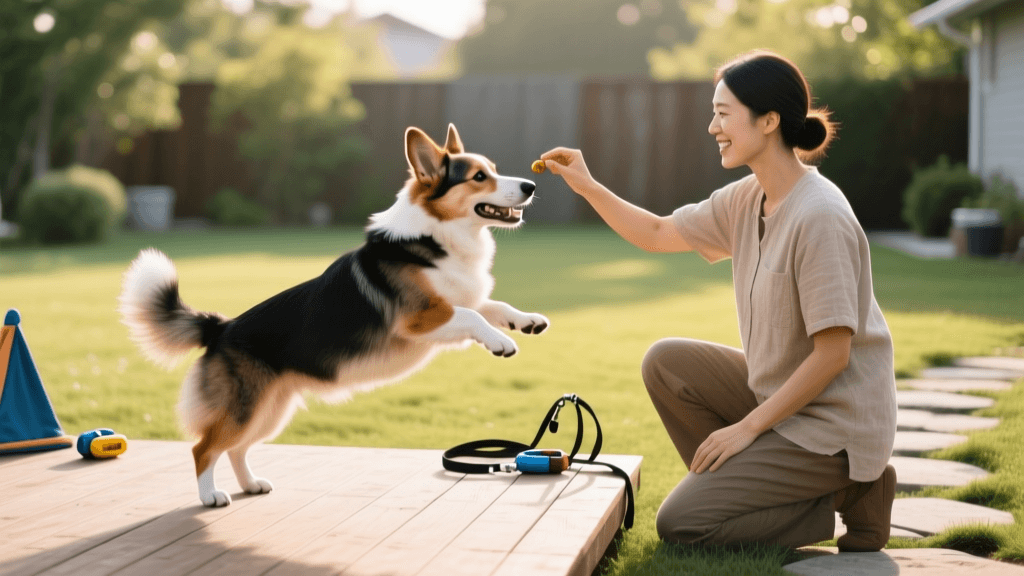
Begin by saying the cue once in a happy, upbeat tone while your dog is already moving toward you — during play, after a meal, or when they naturally wander close. Mark the moment they arrive and deliver three to five small treats in rapid succession. This "jackpot" approach, recommended by certified trainer and author Patricia McConnell of the University of Wisconsin–Madison, signals to the dog that this particular behavior pays exceptionally well.
Repeat this 10 to 15 times per session, two to three sessions per day, for the first week. You are not yet testing the recall — you are building a positive emotional response to the sound of the cue itself.
Phase 2: Adding Distance and Mild Distraction
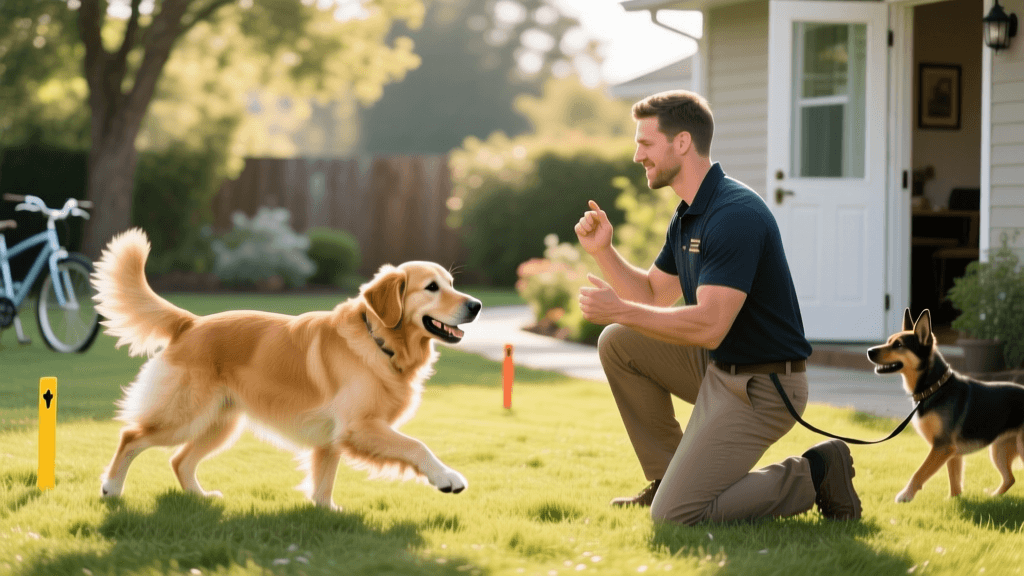
Once your dog reliably orients and moves toward you in a quiet space, begin increasing distance in small increments. Start at 5 feet, then 10, then 20. Attach the long line to their harness so you can gently guide them toward you if they hesitate — but avoid pulling hard, which can create negative associations with the cue.
Introduce mild distractions gradually: a toy on the floor, another person in the room, training near a window. Each new distraction effectively resets the difficulty level, so drop back to shorter distances when the environment becomes more complex. A study from the Companion Animal Welfare Council (CAWC, 2021) found that dogs trained in progressively more distracting environments over 6 weeks achieved reliable recall in 89% of real-world test scenarios, compared to 41% for dogs trained exclusively in controlled settings.
Phase 3: Proofing in Real-World Environments
Proofing means practicing the behavior in the actual contexts where you need it to work. This phase takes the longest and requires the most patience. Move training to a fenced park, a friend's yard, a quiet trail. Keep the long line attached until your dog's success rate in the new environment reaches approximately 90% across multiple sessions.
Vary your rewards unpredictably. Sometimes deliver one treat, sometimes five, sometimes a brief game of tug. Variable reinforcement schedules — where the dog cannot predict exactly when or how much they will be rewarded — produce the most persistent behavior, a principle well-documented in B.F. Skinner's operant conditioning research and applied extensively in modern dog training curricula.
Common Mistakes That Undermine the Recall
Even well-intentioned owners make errors that quietly erode the recall over time. Recognizing these patterns is the first step to correcting them.
Calling the dog for unpleasant things. If "come" reliably predicts a bath, nail trim, or the end of playtime, the dog learns to avoid the cue. Pair the recall with good things at least 80% of the time. When you must call your dog for something they dislike, reward them generously first, then proceed.
Repeating the cue. Saying "come, come, COME" teaches the dog that the first repetition is optional. Say it once, then use the long line to guide them if needed, and reward the arrival regardless. The cue should always mean "the first time, every time."
Punishing a slow return. A dog that eventually comes back and receives a scolding has learned that returning to you leads to something unpleasant. No matter how long it took, no matter how frustrated you are, reward every recall. Save corrections for other contexts.
Practicing only on leash. Dogs are highly context-specific learners. A recall trained exclusively on leash may not transfer to off-leash situations. Use the long line as a transitional tool, not a permanent crutch.
Reinforcement Schedules: Keeping the Recall Strong Over Time
Once your dog has a reliable recall, many owners make the mistake of stopping rewards entirely. This is called extinction, and it gradually weakens the behavior. Instead, shift to an intermittent reinforcement schedule: reward approximately every third to fifth recall with a high-value treat, and use praise or brief play for the others.
"The recall is not a behavior you train once and check off a list. It is a relationship you maintain. Every time your dog comes to you and something good happens, you are making a deposit in an account that pays out when it matters most." — Sarah Stremming, certified behavior consultant and host of The Cog Dog Radio podcast
Monthly "recall tune-up" sessions — returning to basics in a low-distraction environment with high-value rewards — help maintain the behavior's strength even in dogs with years of training history. Think of it as maintenance rather than remediation.
Training Benchmarks: What Progress Should Look Like
Having concrete benchmarks helps you assess whether training is on track or whether you need to adjust your approach.
| Training Week | Expected Distance | Distraction Level | Target Success Rate |
|---|---|---|---|
| 1–2 | 5–10 feet | None (indoor) | 95%+ |
| 3–4 | 15–25 feet | Low (quiet yard) | 85–90% |
| 5–8 | 30–50 feet | Moderate (park, other people) | 75–85% |
| 9–12 | 50+ feet | High (other dogs, wildlife) | 70–80% |
If your dog's success rate drops below 60% at any stage, the environment is too distracting or the distance too great. Step back one level and rebuild confidence before progressing. There is no timeline that matters more than the dog in front of you.
Breed and individual temperament also play a role. Scent hounds like Beagles and Bloodhounds are neurologically wired to follow their noses, which can override even well-trained recalls in high-odor environments. Herding breeds like Border Collies often respond quickly to movement-based cues. Knowing your dog's drives helps you anticipate challenges and choose the most motivating rewards for their specific profile.
With consistent practice, clear communication, and a genuine commitment to making the recall the best thing that happens in your dog's day, you will build a behavior that holds up when it counts — not just in the backyard, but in the moments that matter most.
Robin Maitland
All our authors care for dogs every day — read more of their work on the authors page.