How To Build A Daily Routine With Your Dog
Learn about how to build a daily routine with your dog with expert tips and data-backed advice.
The Case for Structure in Your Dog's Day
Dogs are creatures of habit. Their brains are wired to anticipate patterns — the jingle of a leash, the sound of a food scoop, the moment you reach for your shoes. When those patterns are consistent, dogs feel safe. When they're unpredictable, anxiety, destructive behaviour, and sleep disruption often follow. Building a daily routine with your dog isn't about rigid scheduling; it's about giving your animal a reliable framework within which they can relax and thrive.
Research published by the American Veterinary Medical Association (AVMA, 2022) found that dogs in households with consistent daily schedules showed significantly lower cortisol levels — a key stress hormone — compared to dogs in unpredictable environments. That single finding has practical implications for everything from how your dog greets strangers to how well they sleep through the night.
The good news is that a solid routine doesn't require a dramatic lifestyle overhaul. Most people find that small, intentional adjustments to their existing schedule are enough to make a meaningful difference for their dog.
Morning: Setting the Tone for the Day
The first 60 to 90 minutes of your dog's day carry disproportionate weight. A calm, structured morning reduces reactivity on walks, improves focus during training, and sets a relaxed baseline that carries through the afternoon. Rushing your dog out the door or skipping the morning walk entirely tends to compound into behavioural issues by evening.
The Morning Walk
Aim for a morning walk of at least 20 to 30 minutes for small breeds and 45 to 60 minutes for medium to large breeds. This isn't just about physical exercise — the sniffing that happens during a walk is mentally exhausting in the best possible way. According to the Royal Society for the Prevention of Cruelty to Animals (RSPCA, 2023), allowing dogs to sniff freely during walks reduces overall stress indicators and improves post-walk calm by up to 40% compared to walks where sniffing is restricted.
A long-line leash — typically 5 to 10 metres — is one of the most underrated tools for morning walks. Products like the Ruffwear Knot-a-Hitch or the Flexi Explore retractable lead give your dog the freedom to sniff and explore while keeping you in control. Pair this with a well-fitted harness such as the Julius-K9 IDC or the Ruffwear Front Range, both of which distribute pressure evenly and reduce strain on the trachea.
Morning Feeding
Feed your dog within 30 minutes of returning from the morning walk, not before. Feeding after exercise rather than before reduces the risk of bloat (gastric dilatation-volvulus) in deep-chested breeds like German Shepherds, Great Danes, and Standard Poodles. Use a slow-feeder bowl or a snuffle mat to extend mealtime to at least 5 to 10 minutes — this aids digestion and provides additional mental stimulation.
Portion sizes matter. The British Veterinary Association recommends calculating your dog's daily caloric needs based on their ideal body weight, not their current weight, and dividing that into two meals. For a 20 kg adult Labrador with moderate activity, that typically means around 400 to 500 kcal per meal, depending on the food's energy density.
Midday: Managing the Quiet Hours
For working dog owners, the middle of the day is often the hardest stretch to manage. Dogs left alone for more than 4 to 6 hours without stimulation are at higher risk of separation anxiety, excessive barking, and destructive chewing. The Dogs Trust, one of the UK's largest dog welfare charities, recommends that dogs are not left alone for more than 4 hours at a stretch as a general guideline.
If your schedule doesn't allow for a midday check-in, consider the following options:
- Dog walkers or pet sitters: Services like Rover or local independent walkers can provide a 30-minute midday walk. Budget approximately £12 to £20 per visit in most UK cities, or $18 to $30 in major US cities.
- Doggy daycare: Full-day or half-day options at facilities like Barking Mad or local licensed daycares provide socialisation and exercise. Expect to pay £25 to £45 per day in the UK.
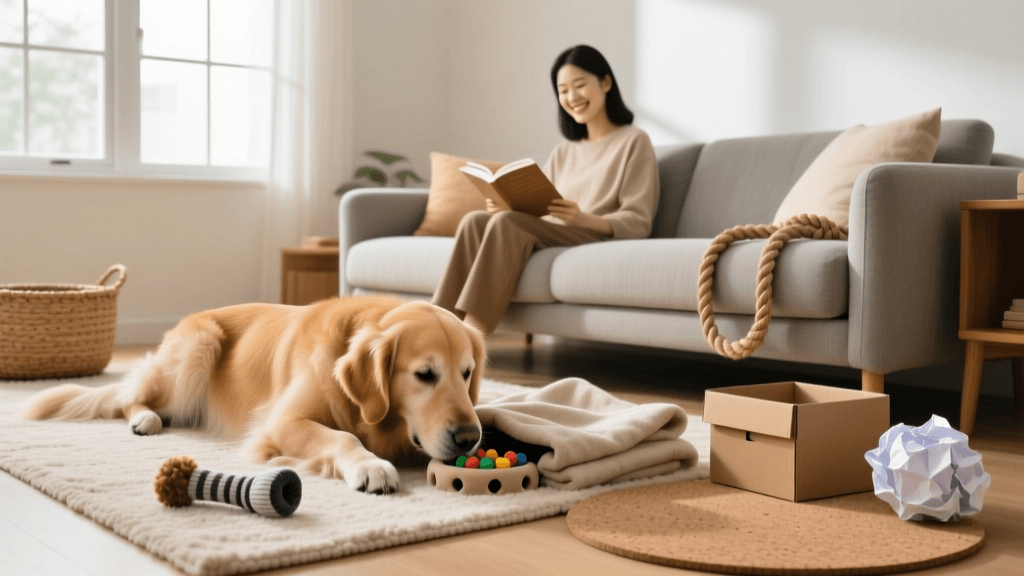
- Enrichment toys: A frozen Kong stuffed with peanut butter and kibble, a Licki Mat with wet food, or a puzzle feeder like the Nina Ottosson Dog Tornado can occupy a dog for 20 to 40 minutes and reduce boredom-related behaviour.
- Calming aids: For dogs with mild anxiety, an Adaptil diffuser (which releases a synthetic version of the calming pheromone mother dogs produce) can reduce stress during alone time. Clinical trials cited by the manufacturer show a 70% reduction in anxiety-related behaviours in treated dogs.
Rest and Sleep
Adult dogs sleep between 12 and 14 hours per day. Puppies and senior dogs sleep even more — up to 18 to 20 hours. Midday rest is not laziness; it's biological necessity. Ensure your dog has a dedicated sleep space away from high-traffic areas of the home. Orthopedic beds like the Big Barker or the Casper Dog Bed are worth the investment for dogs over 5 years old or any breed prone to joint issues.
Afternoon and Evening: Exercise, Training, and Wind-Down
The late afternoon walk — ideally between 4:00 and 6:00 PM — is your second major exercise window. For high-energy breeds like Border Collies, Vizslas, or Siberian Huskies, this walk should be more vigorous than the morning outing: think 45 to 75 minutes with opportunities for off-lead running if your dog has reliable recall. For lower-energy breeds or senior dogs, 20 to 30 minutes at a comfortable pace is sufficient.
Training sessions fit naturally into the post-walk window when your dog is physically tired but mentally alert. Keep sessions short — 5 to 10 minutes is optimal for most dogs. The Association of Professional Dog Trainers (APDT) recommends ending every session on a success, even if that means stepping back to a skill your dog already knows confidently. Consistency over intensity is the principle that produces lasting results.
Evening Feeding and the Pre-Bed Routine
Evening meals should be served at least 2 hours before your dog's final toilet break of the night. This gives the digestive system time to process food and reduces the likelihood of overnight accidents or discomfort. After the evening meal, a short 10 to 15 minute decompression walk or garden sniff session signals to your dog that the active part of the day is ending.
A consistent pre-bed cue — the same phrase, the same sequence of actions — helps dogs transition into sleep mode. Many owners use a combination of a calming chew (look for products containing L-theanine or chamomile, such as Zesty Paws Calming Bites), a brief grooming session, and a specific verbal cue like "bedtime" or "settle." Within two to three weeks of consistent use, most dogs begin responding to the cue alone.
A Sample Weekly Schedule
The table below outlines a practical daily framework for a working adult with a medium-energy adult dog. Times are approximate and should be adjusted to your specific breed, age, and lifestyle.
| Time | Activity | Duration | Notes |
|---|---|---|---|
| 7:00 AM | Morning walk | 30–45 min | Allow free sniffing; use long line if possible |
| 7:45 AM | Breakfast | 10 min | Slow feeder or snuffle mat |
| 8:00 AM – 12:00 PM | Rest / alone time | 4 hrs | Enrichment toy if needed |
| 12:30 PM | Midday walk or dog walker | 20–30 min | Optional; recommended for high-energy breeds |
| 1:00 PM – 5:00 PM | Rest | 4 hrs | Quiet space, orthopedic bed |
| 5:30 PM | Afternoon walk | 45–60 min | More vigorous; off-lead if recall is reliable |
| 6:30 PM | Training session | 5–10 min | Positive reinforcement; end on success |
| 7:00 PM | Evening meal | 10 min | 2 hrs before final toilet break |
| 9:00 PM | Short decompression walk | 10–15 min | Low stimulation; final toilet opportunity |
| 9:30 PM | Bedtime routine | 5–10 min | Consistent cue, grooming, settle |
Adapting the Routine as Your Dog Ages
A routine that works for a 2-year-old Spaniel will need adjustment by the time that dog reaches 8 or 9. Senior dogs experience reduced stamina, increased joint sensitivity, and sometimes cognitive changes that affect their sleep-wake cycles. The American Animal Hospital Association (AAHA) recommends transitioning dogs to senior wellness protocols from age 7 for large breeds and age 10 for small breeds, which includes reassessing exercise duration, meal frequency, and enrichment type.
For senior dogs, consider splitting the daily exercise into three shorter walks rather than two longer ones. Replace high-impact activities like fetch on hard surfaces with low-impact alternatives: swimming, gentle sniff walks, or hydrotherapy sessions at a certified canine rehabilitation centre. In the UK, the Canine Hydrotherapy Association maintains a directory of accredited practitioners, and in the US, the Canine Rehabilitation Institute certifies therapists across the country.
Puppies, on the other end of the spectrum, require a different kind of structure. The general guideline — 5 minutes of formal exercise per month of age, twice daily — is a useful starting point, but mental stimulation through training and socialisation is equally important. The Battersea Dogs & Cats Home in London publishes free puppy socialisation guides that outline the critical window between 3 and 14 weeks, during which positive exposure to new experiences has the greatest long-term impact on temperament.
"A dog that knows what to expect from its day is a dog that can relax. Predictability is not a constraint on a dog's life — it is the foundation of their confidence." — Dr. Karen Overall, veterinary behaviourist and author of Manual of Clinical Behavioral Medicine for Dogs and Cats
Building a daily routine with your dog is one of the highest-return investments you can make in the relationship. The time spent on consistent walks, structured meals, and intentional training pays dividends in a calmer, more confident animal — and in a household that runs more smoothly for everyone in it. Start with one or two anchor points in the day, keep them consistent for two weeks, and build from there. Your dog will notice before you do.
marcus-aldridge
All our authors care for dogs every day — read more of their work on the authors page.