Dog enrichment ideas for rainy-day boredom
Twelve low-effort indoor enrichment activities that meet your dog's sniffing, chewing and problem-solving needs without leaving the house.
When the Rain Hits and the Walks Stop
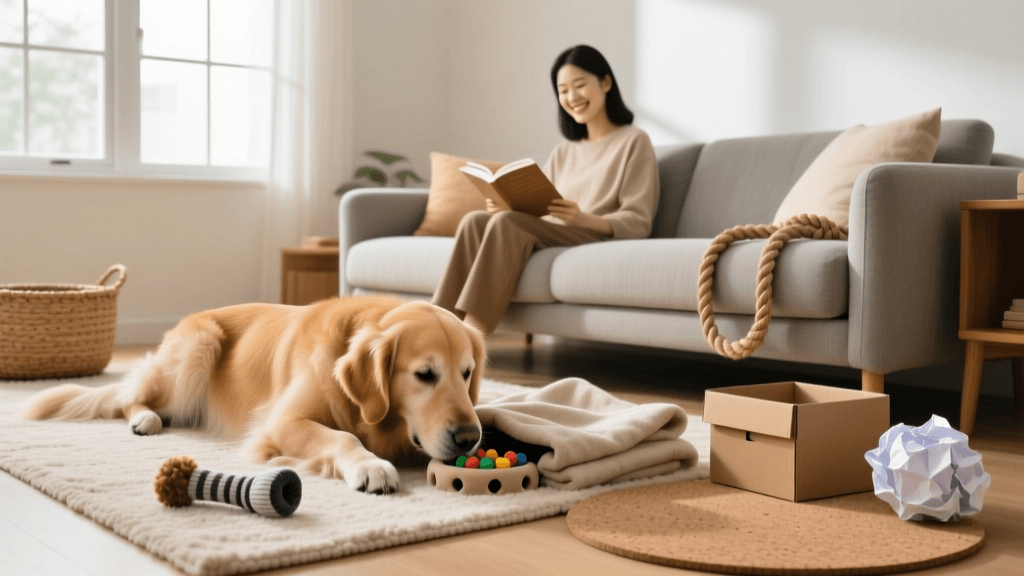
There's a particular kind of chaos that descends on a household when a high-energy dog hasn't had a proper walk in two days. Shoes get chewed. Cushions get rearranged. The dog stares at you with an intensity that borders on accusatory. Rainy days are a reality for dog owners everywhere, and while a quick toilet trip in the drizzle is manageable, a full outdoor session in a downpour often isn't. The good news is that mental stimulation can tire a dog out just as effectively as physical exercise — sometimes more so.
Research from the University of Bristol's School of Veterinary Sciences found that dogs who engage in regular cognitive enrichment show measurably lower cortisol levels and fewer stress-related behaviours than dogs who receive physical exercise alone. That means puzzle feeders, scent games, and training sessions aren't just rainy-day fillers — they're genuinely valuable tools for your dog's wellbeing year-round.
Feeding Time as a Mental Workout
One of the simplest shifts you can make is to stop feeding your dog from a bowl. A dog that wolfs down 400 calories in 45 seconds has missed an opportunity for 20 minutes of focused mental engagement. Scatter feeding — spreading kibble across a snuffle mat or even a patch of grass — activates a dog's foraging instincts and can take a motivated dog 15 to 25 minutes to complete.
The Kong Classic remains one of the most recommended tools by veterinary behaviourists. Stuffed with a mixture of wet food, peanut butter (xylitol-free), and kibble, then frozen overnight, a large Kong can occupy a medium-sized dog for 30 to 45 minutes. The Dogs Trust, one of the UK's largest dog welfare charities, includes Kong stuffing in their standard enrichment guidance for dogs in rehoming centres, noting it as particularly effective for reducing anxiety during high-stress periods (Dogs Trust, 2023).
Snuffle Mats and Licki Mats
Snuffle mats — rubber or fabric mats with fibres that hide small pieces of food — tap into a dog's natural scenting behaviour. Brands like Paw5 and Ruffle Snuffle offer mats in various difficulty levels. For dogs new to the concept, start with larger kibble pieces and fewer hiding spots. As your dog gets faster, increase the challenge by using smaller treats and more densely packed fibres.
Licki mats work differently, using repetitive licking to release calming hormones. Spreading a thin layer of plain Greek yoghurt, mashed banana, or dog-safe peanut butter across a textured silicone mat gives your dog a soothing, low-intensity activity. The American Kennel Club recommends licki mats specifically for dogs who show signs of anxiety during thunderstorms — a scenario that often coincides with those same rainy days keeping you both indoors (AKC, 2022).
Scent Work: The Indoor Sport Your Dog Was Born For
A dog's nose contains approximately 300 million olfactory receptors, compared to about 6 million in humans. Their brain's olfactory cortex is proportionally 40 times larger than ours. Scent work doesn't just entertain dogs — it engages the part of their brain that is most developed and most hungry for stimulation.
You don't need formal nose work classes to get started, though organisations like the UK's Scentwork UK and the American Kennel Club's AKC Scent Work programme offer structured progressions if you want to go further. At home, the basics are straightforward:
- Hide a high-value treat under one of three upturned cups and let your dog sniff out the right one.
- Place treats inside cardboard boxes of varying sizes and let your dog work through a room to find them all.
- Introduce a specific scent — birch oil is the standard in competitive nose work — on a cotton swab, pair it with a reward, and gradually teach your dog to alert when they find it.
- Use a muffin tin with tennis balls covering each cup, hiding treats under some but not all of them.
- Run a "find it" game through multiple rooms, increasing the number of hiding spots as your dog's confidence grows.
Most dogs show visible signs of satisfaction after a 20-minute scent session — slower movement, relaxed body posture, and a tendency to settle down for a nap. That's the cognitive fatigue you're aiming for.
Real Owner Experience: Scent Work With a Rescue Greyhound
"Mabel came to us from a racing background and had no idea what to do with herself indoors. She'd pace for hours on wet days. We started hiding treats in egg cartons around the living room, and within a week she was actively seeking them out before we'd even finished setting up. Now she sleeps for two hours after a scent session. It's been genuinely life-changing for both of us." — Sarah T., greyhound owner, Manchester
Greyhounds, whippets, and other sighthounds are often assumed to be low-energy dogs, but their need for mental stimulation is just as high as working breeds. Scent work is particularly well-suited to them because it doesn't require the sustained physical movement that can be hard to achieve indoors.
Training Sessions That Go Beyond Sit and Stay
Short, focused training sessions are one of the most underused enrichment tools available to dog owners. A 10-minute session of learning a new behaviour requires more concentration from a dog than a 30-minute walk on a familiar route. The key is keeping sessions short — most dogs hit a point of diminishing returns after 5 to 10 minutes — and ending on a success.
Trick training is an excellent rainy-day activity because it requires no equipment beyond treats and a small amount of floor space. Dogs can learn to spin, bow, back up, identify named toys, or even tidy their own toys into a basket. The latter, popularised by border collie Chaser at Wofford College in South Carolina — who learned the names of over 1,000 individual objects — demonstrates the remarkable capacity dogs have for language-like learning when given consistent, positive reinforcement.
Structured Play That Builds Skills
Tug is one of the most beneficial games you can play with a dog indoors, provided it has clear rules. Teaching a reliable "drop it" or "leave it" cue within the game builds impulse control while giving your dog an outlet for predatory play behaviour. The RSPCA recommends structured tug as a positive outlet for dogs with high prey drive, noting that contrary to old training myths, it does not increase aggression when played with consistent rules (RSPCA, 2021).
Hide and seek — where you hide yourself rather than treats — is another option that many dogs find deeply engaging. Ask your dog to sit and stay, hide somewhere in the house, then call them. The combination of scent tracking and the reward of finding you makes this a surprisingly tiring game for most dogs.
Choosing the Right Enrichment for Your Dog
Not every activity suits every dog. A nervous rescue may find a complex puzzle feeder frustrating rather than stimulating. A senior dog with arthritis needs activities that don't require sustained standing or jumping. Matching the enrichment to the individual dog matters more than following any single recommendation.
| Dog Profile | Best Rainy-Day Activities | Activities to Avoid |
|---|---|---|
| High-energy working breed (Border Collie, Malinois) | Advanced scent work, trick training, puzzle feeders at Level 3+ | Passive licki mats alone — insufficient stimulation |
| Senior dog (7+ years) | Snuffle mats, gentle licki mats, short 5-minute training sessions | High-impact tug, games requiring sustained jumping |
| Anxious or reactive dog | Licki mats, frozen Kongs, calm scatter feeding | Overly complex puzzles that cause frustration |
| Puppy (under 6 months) | Simple cup games, short training sessions (3–5 minutes), soft snuffle mats | Long sessions of any kind — puppies fatigue quickly |
| Brachycephalic breed (Bulldog, Pug) | Licki mats, gentle scent games, calm training | Vigorous tug or any activity that elevates breathing significantly |
If your dog consistently shows frustration — pawing at a puzzle, walking away, or vocalising — the activity is likely too difficult. Step back to an easier version and build up gradually. Enrichment should be engaging, not stressful.
Building a Rainy-Day Routine That Sticks
The most effective enrichment isn't a single activity but a rotation that keeps things novel. Dogs habituate quickly to the same puzzle or game, so varying the activities across the week maintains engagement. A simple weekly rotation might look like this:
- Monday: Frozen Kong or stuffed toppl at breakfast, 10-minute training session in the afternoon.
- Tuesday: Snuffle mat for both meals, hide-and-seek game in the evening.
- Wednesday: Scent work with cardboard boxes, licki mat as a wind-down before bed.
- Thursday: Muffin tin puzzle, tug session with structured rules.
- Friday: New trick introduction, scatter feeding across two rooms.
This kind of structure also benefits owners. Knowing you have a plan removes the low-level stress of watching your dog deteriorate into boredom-driven mischief. Several dog trainers at the Battersea Dogs & Cats Home in London recommend building enrichment into a daily schedule rather than treating it as an emergency measure — the same way you'd schedule walks rather than fitting them in when convenient.
Rainy days don't have to mean a frustrated dog and a frazzled owner. With a snuffle mat, a frozen Kong, and fifteen minutes of scent games, you can give your dog a genuinely satisfying day — even without leaving the house. The investment in a few pieces of equipment and some basic training knowledge pays back in a calmer, more settled dog and a household that weathers bad weather considerably better.
Aaron Whyte
All our authors care for dogs every day — read more of their work on the authors page.