How Dogs Smell Time and Emotion: Canine Olfaction Science
Discover the science behind canine olfaction. Learn how dogs smell time, detect human emotions, and use scent enrichment to boost their mental health.
The Hidden World of Canine Olfaction
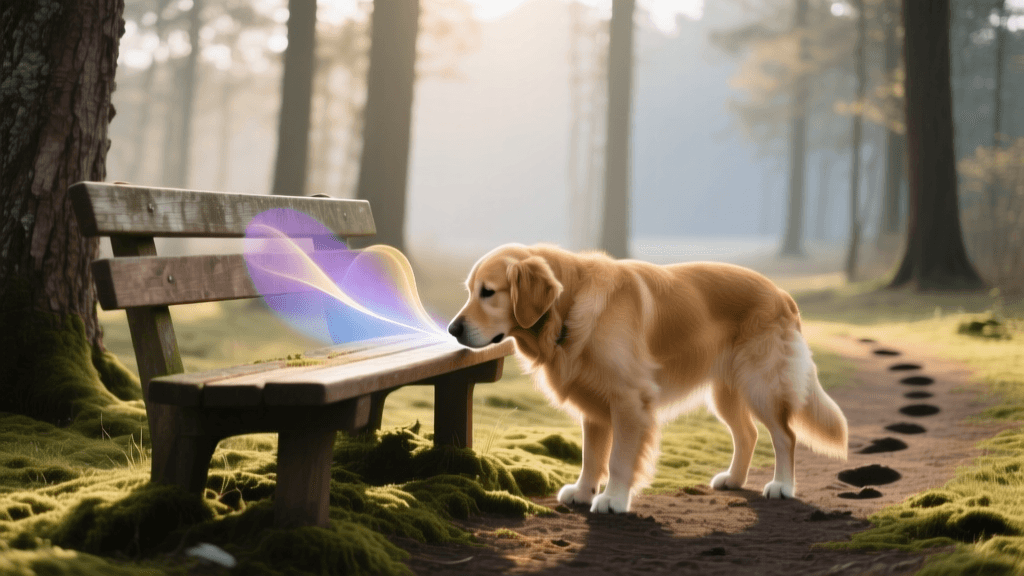
When we walk into a room, we primarily rely on our eyes to understand our environment. We look for familiar faces, check the lighting, and observe the layout. But when a dog walks into that same room, they are reading a complex, invisible tapestry of chemical information. To a dog, the world is not just seen; it is smelled. The science of canine olfaction reveals that a dog's nose is not merely a tool for finding dropped food or tracking wildlife. It is a highly sophisticated biological instrument capable of perceiving time, detecting human emotional states, and navigating the world in ways that humans are only just beginning to understand.
For dog owners, understanding the science behind how dogs smell is not just an academic exercise. It is the key to unlocking better behavioral health, reducing anxiety, and building a deeper bond with your pet. By shifting our perspective from a visual world to an olfactory one, we can drastically improve how we care for, train, and enrich our canine companions.
The Anatomy of a Super Sniffer
To understand how dogs process scent, we must first look at the remarkable anatomy of their nasal cavity. According to the American Kennel Club (AKC), a dog's sense of smell is estimated to be 10,000 to 100,000 times more sensitive than a human's. This is not an exaggeration; it is a biological fact rooted in their physical anatomy.
While humans have about 6 million olfactory receptors in our noses, dogs possess up to 300 million, depending on the breed. Bloodhounds, the champions of the scent world, sit at the very top of this scale. Furthermore, the part of a dog's brain that is devoted to analyzing smells is proportionally 40 times larger than ours.
Human vs. Dog Olfaction: A Comparative Breakdown
| Biological Feature | Humans | Dogs |
|---|---|---|
| Olfactory Receptors | Approx. 6 Million | Up to 300 Million |
| Olfactory Brain Area | Small fraction of the brain | 40x larger (proportionally) |
| Breathing Mechanism | Inhale and exhale share the same airway | Separate airways for smelling and breathing |
| Jacobson's Organ | Vestigial and non-functional | Highly active (detects pheromones) |
| Nasal Slits | None | Lateral slits allow continuous sniffing |
One of the most fascinating anatomical features is the lateral nasal slits. When humans exhale, the outgoing air disrupts the incoming scent molecules. Dogs, however, have slits on the sides of their noses that allow them to exhale without disturbing the scent cone they are currently inhaling. This means a dog can sample the air continuously, creating an uninterrupted stream of olfactory data. Additionally, as highlighted by Smithsonian Magazine's breakdown of canine nasal anatomy, dogs possess a secondary olfactory system known as the vomeronasal organ, or Jacobson's organ. Located at the base of the nasal cavity, this organ is specifically dedicated to detecting pheromones, allowing dogs to gather crucial social and reproductive information about other animals.
How Dogs Literally 'Smell' Time
Perhaps the most mind-bending discovery in canine cognition is the concept that dogs can smell time. But how is this physically possible? The answer lies in the physics of scent molecules and the environment.
Scent is not static; it is a living, breathing entity that changes as the hours pass. When you leave your home in the morning, you leave behind a concentrated cloud of your unique odor molecules. As the day progresses, these molecules begin to decay, disperse, and fade. Hot air rises, carrying the lighter scent molecules up toward the ceiling, while cooler air pushes the heavier molecules down toward the floor.
Dr. Alexandra Horowitz, a leading canine cognition researcher at Barnard College, has extensively studied this phenomenon. She explains that a dog's ability to smell time is essentially their ability to measure the concentration and location of odor molecules in a room. By the time you are due to return home from work, your morning scent has faded to a specific, predictable baseline. Your dog recognizes this specific olfactory baseline as the exact marker that precedes your arrival. They are not checking a clock; they are reading the fading scent of your departure.
'To a dog, time has a smell. The past is in the fading odors, the present is in the current scents, and the future is in the approaching breeze.' - Adapted from the research of Dr. Alexandra Horowitz.
This scientific insight explains why dogs often seem to 'know' when their owners are coming home, or why they become anxious when a routine is broken. If you come home later than usual, the scent of your morning departure has faded past the usual baseline, creating a state of cognitive dissonance and anxiety for the dog.
Sniffing Out Human Emotion and Stress
For years, dog owners have anecdotally claimed that their dogs know when they are sad, angry, or stressed. Science has now definitively proven that dogs are not just reading our facial expressions or body language; they are literally smelling our emotional states.
In a groundbreaking 2022 PLOS ONE study on canine stress detection, researchers tested whether dogs could identify human stress through breath and sweat samples. The researchers collected samples from human participants before and after they were subjected to a stressful, high-pressure math task. The dogs were then trained to alert their handlers to the 'stress' samples.
The results were astonishing. The dogs successfully identified the stress samples with an accuracy rate of 93.75%. When humans experience stress, our bodies undergo a cascade of physiological changes, releasing cortisol and adrenaline. These hormones alter the Volatile Organic Compounds (VOCs) present in our sweat and breath. Dogs, with their hyper-sensitive olfactory systems, can detect these microscopic chemical shifts instantly. This means that when you are feeling overwhelmed, your dog smells the biological reality of your stress before you even have the chance to speak or exhibit physical signs of distress.
Actionable Science: Olfactory Enrichment at Home
Understanding that a dog's primary interface with the world is olfactory means we must adapt our care routines to accommodate this biological need. A dog that is not allowed to sniff is like a human forced to walk through a museum blindfolded. Here is how you can implement science-backed olfactory enrichment into your daily routine, complete with specific products, timings, and costs.
1. The 'Sniffari' Decompression Walk
Traditional heel-walking is great for obedience, but it does little for a dog's mental health. A 'Sniffari' is a walk where the dog is allowed to lead and sniff to their heart's content.
- Equipment: Use a 15-foot Biothane long line (approximate cost: $25-$35) and a well-fitted Y-harness to prevent tracheal damage.
- Timing: Allow 2 to 3 minutes of continuous sniffing per interesting spot. A 20-minute Sniffari provides the same amount of cognitive fatigue and mental enrichment as a 60-minute brisk physical walk.
- Location: Choose quiet, grassy areas or nature trails with diverse foliage, which holds a wider variety of scent molecules than concrete sidewalks.
2. Indoor Scent Work and Foraging
Ditch the standard stainless steel food bowl. In the wild, canines spend up to 80% of their waking hours foraging and hunting for food. We can replicate this biological drive indoors.
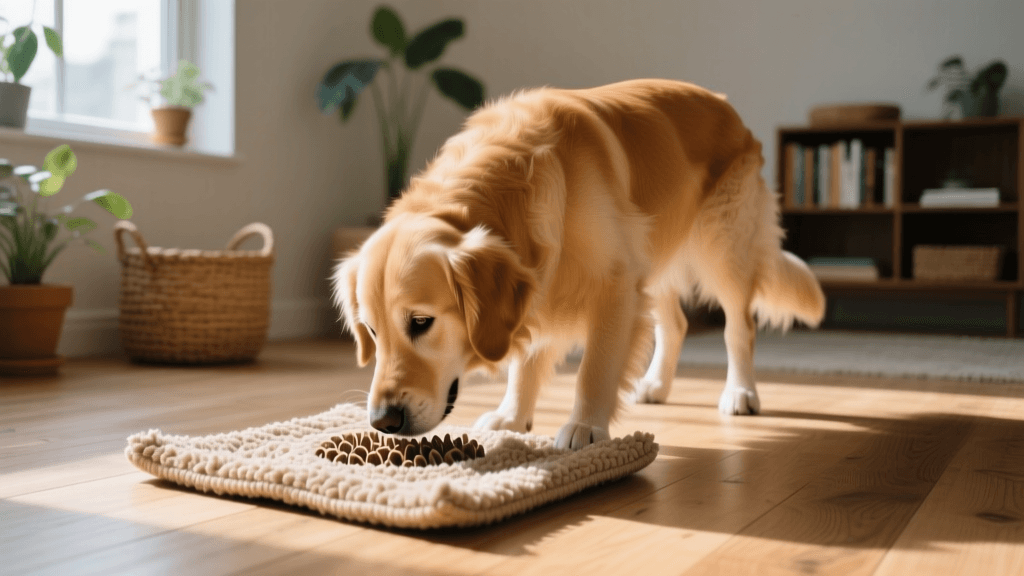
- Snuffle Mats: These fabric mats mimic grass and allow you to hide dry kibble or small treats. (Cost: $15-$30). It can take a dog 10-15 minutes to extract a single meal from a snuffle mat, drastically slowing down fast eaters and reducing bloat risk.
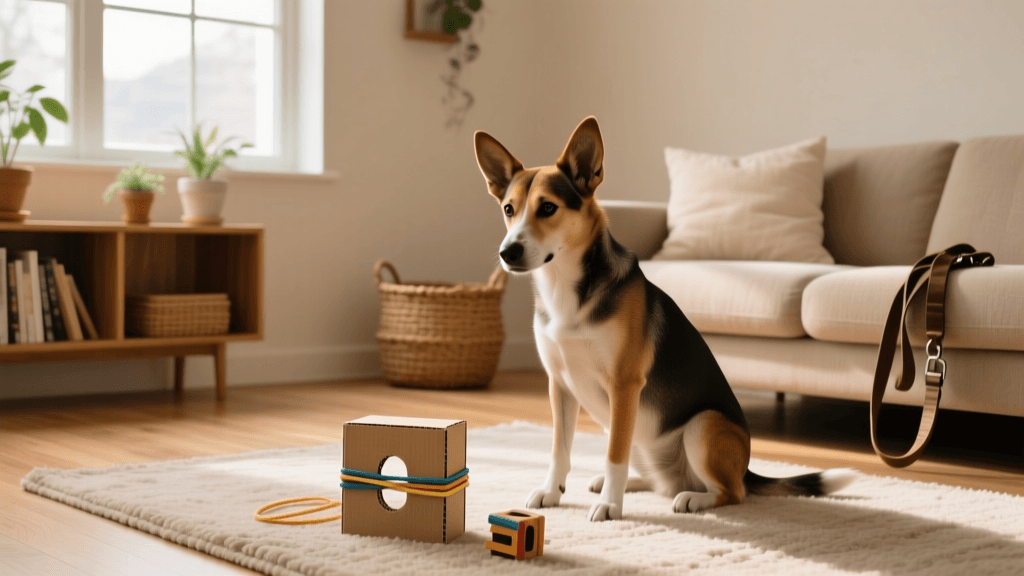
- Cardboard Box Puzzles: Save your delivery boxes. Place high-value treats (like Zuke's Mini Naturals, approx. $8/bag) inside crumpled paper within the boxes. Let your dog tear into the boxes to find the reward. This satisfies both their olfactory drive and their natural shredding instincts.
- LickiMat Soothers: Spread wet food, plain pumpkin puree, or dog-safe peanut butter on a textured silicone LickiMat (Cost: $10-$15). The repetitive licking action releases endorphins in the dog's brain, acting as a natural anxiety reducer, especially useful during thunderstorms or when guests arrive.
3. Managing Your Scent Profile for Separation Anxiety
Because dogs use your scent to track time, you can use this to your advantage if your dog suffers from mild separation anxiety. Leave an unwashed t-shirt that you wore to bed in your dog's sleeping area. The concentrated, slowly fading scent of your skin will provide a comforting olfactory anchor that helps regulate their stress levels while you are away.
Conclusion
The science of canine olfaction fundamentally shifts how we should view our dogs. They are not just furry companions; they are highly evolved biological sensors capable of reading the chemical history of a room, tracking the passage of time, and smelling the very emotions we try to hide. By respecting and nurturing their sense of smell through targeted enrichment, decompression walks, and scent-based games, we do more than just tire them out. We validate their biology, reduce their stress, and open up a profound, invisible channel of communication between human and hound.
tom-renshaw
All our authors care for dogs every day — read more of their work on the authors page.