DIY Scent Games: Understanding Your Dog's Olfactory Brain
Discover how DIY scent games and snuffle mats tap into your dog's olfactory psychology to reduce anxiety, curb boredom, and fulfill natural foraging instincts.
The Psychology of a Dog's Nose: Why Scent Matters
When we think about exercising our dogs, we usually picture long walks, games of fetch, or trips to the dog park. However, understanding your dog requires looking beyond their physical needs and diving into their cognitive and psychological requirements. Dogs are macrosmatic creatures, meaning they experience and interpret the world primarily through their sense of smell. While humans have roughly six million olfactory receptors, dogs possess up to 300 million, depending on the breed. Furthermore, the part of a dog's brain dedicated to analyzing odors is proportionally 40 times larger than ours.
This incredible biological hardware means that sniffing is not just a passive activity; it is intense mental work. According to the American Kennel Club's guide to Nose Work, engaging a dog's olfactory system can tire them out just as effectively as rigorous physical exercise, if not more so. When a dog sniffs, they are processing complex chemical signatures, determining the direction of the wind, and piecing together a timeline of who or what has passed through an area. By creating DIY homemade scent games, you can tap into these deep-seated foraging and tracking instincts, providing profound psychological enrichment right in your living room.
Physical Exercise vs. Mental Enrichment
Many dog owners mistakenly believe that a physically exhausted dog is a well-behaved dog. While physical health is crucial, a dog that only receives physical exercise without mental stimulation may develop hyperactivity, anxiety, or destructive behaviors. Mental enrichment, particularly scent work, builds confidence and reduces stress by allowing the dog to perform the natural behaviors they were bred for. The ASPCA's resources on dog enrichment highlight that foraging and scent-based puzzles are among the most effective ways to prevent boredom-induced behavioral issues.
| Activity Type | Duration | Primary Benefit | Estimated Caloric Burn | Mental Fatigue Level |
|---|---|---|---|---|
| Neighborhood Walk | 30 Minutes | Physical health, bathroom breaks | ~100-150 kcal | Low to Moderate |
| DIY Scent Work | 15 Minutes | Cognitive engagement, instinct fulfillment | ~30-50 kcal | Very High |
| Fetch / Running | 20 Minutes | Cardiovascular health, prey drive | ~150-200 kcal | Low |
DIY Project 1: The Classic Fleece Snuffle Mat
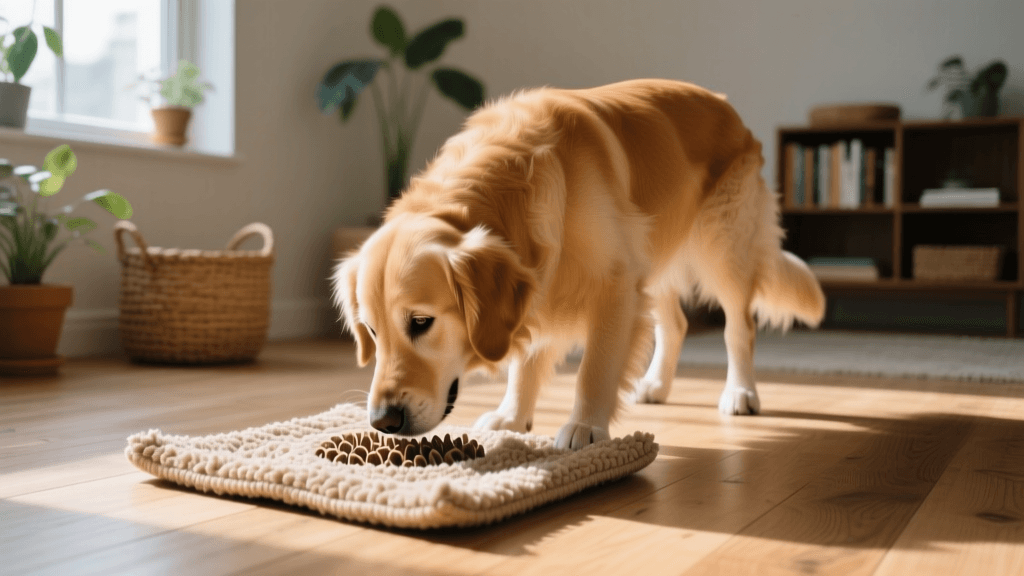
A snuffle mat is a homemade foraging toy that mimics the experience of rooting through tall grass for food. It is an excellent introductory project for DIY dog enrichment and is particularly beneficial for fast eaters, anxious dogs, or senior dogs with limited mobility.
Materials and Cost Breakdown
- Anti-pill fleece fabric: 2 to 3 yards in varying colors. (Cost: $12 - $18)
- Rubber sink mat: A standard rectangular mat with a grid of holes. (Cost: $5 - $8)
- Fabric scissors: For clean cuts. (Cost: Already owned or ~$5)
Total Estimated Cost: Under $25
Step-by-Step Instructions
- Cut the Fleece: Cut your fleece into long strips, approximately 1 inch wide and 8 inches long. You will need roughly 150 to 200 strips depending on the size of your rubber mat.
- Thread the First Layer: Push one end of a fleece strip through a hole in the rubber mat from the bottom up, and pull it back through an adjacent hole. Tie a simple overhand knot to secure it to the mat.
- Build Density: Continue tying strips into every available hole. For a more challenging mat, tie multiple strips into the same hole or use longer strips to create deeper layers where kibble can hide.
- Fluff and Hide: Once the mat is fully covered and fluffy, scatter your dog's daily ration of kibble or small training treats across the surface. Massage the treats down into the base of the fleece strips so your dog must use their nose, rather than their eyes, to locate the food.
DIY Project 2: Upcycled Cardboard Foraging Boxes
If your dog destroys their toys or you are looking for a zero-cost, eco-friendly enrichment option, the cardboard foraging box is a brilliant solution. This taps into a dog's natural desire to shred and dissect, which is a component of the predatory sequence. As noted by Fear Free Happy Homes' advice on food puzzles, allowing dogs to engage in safe, controlled destruction can be incredibly cathartic and stress-relieving.
How to Build a Foraging Box
- Gather several clean cardboard boxes of varying sizes (cereal boxes, shoe boxes, shipping boxes).
- Collect empty toilet paper rolls and egg cartons.
- Place a few high-value treats inside the toilet paper rolls and fold the ends inward to trap the scent.
- Place the rolls, along with crumpled balls of paper or old, clean towels, into the larger boxes.
- Nest the smaller boxes inside the larger ones, leaving the flaps open or loosely closed.
- Present the box to your dog and encourage them to 'find it.' They will have to push, paw, sniff, and tear through the cardboard layers to reach their rewards.
Note: Always supervise your dog during cardboard shredding to ensure they are spitting out the paper and only consuming the treats.
Reading Your Dog's Body Language During Scent Work
Understanding your dog means learning to read their subtle communication signals, especially during high-focus activities like scent work. Observing your dog while they interact with your homemade puzzles will tell you if the game is appropriately challenging or if they are becoming frustrated.
- The Scent Cone and Head Snaps: When a dog catches the edge of a scent trail (the 'scent cone'), you will often see a sudden change in behavior. Their head may snap toward the source, their ears will prick forward, and their breathing pattern will change to rapid, shallow sniffs. This indicates they have locked onto the target.
- Tail Carriage: A relaxed, sweeping wag at mid-height shows happy engagement and confidence. A stiff, high, and rapidly vibrating tail can indicate over-arousal or frustration, suggesting the puzzle might be too difficult.
- Displacement Behaviors: If your dog suddenly stops sniffing and begins to yawn, lick their lips, scratch intensely, or look away from the puzzle, these are 'displacement behaviors.' They are canine signals of stress or frustration. If you see this, immediately make the game easier by tossing a treat directly on top of the mat or box to give them an 'easy win' and rebuild their confidence.
- Sneezing: Dogs will sometimes sneeze repeatedly during intense sniffing sessions. This is a natural mechanism to clear their nasal passages of dust and debris, but it can also be a 'calming signal' indicating they are excited but trying to keep their arousal levels in check.
Advanced DIY: Scent Discrimination Kits
Once your dog has mastered finding food, you can elevate their psychological enrichment by teaching scent discrimination. This involves teaching your dog to find a specific, non-food odor. You can create a homemade scent kit using cotton balls, small glass jars, and dog-safe dried herbs like chamomile or lavender.
- Place a pinch of dried chamomile into a small glass jar and add a few cotton balls. Let it sit for 24 hours so the cotton absorbs the scent.
- Hide the scented cotton ball (inside the jar, for safety) in a room while your dog is in a sit-stay.
- Release your dog and reward them heavily with a high-value food treat the moment their nose touches the jar.
- This game shifts the dog's psychology from 'foraging for survival' to 'working as a team with their handler,' deeply strengthening your bond and providing immense cognitive satisfaction.
Safety and Supervision
While DIY solutions are fantastic, safety must always be the priority. Never use toxic materials, small plastic pieces that could be swallowed, or essential oils that are harmful to canines (such as tea tree or eucalyptus). Always supervise your dog when they are interacting with homemade cardboard or fabric puzzles to prevent accidental ingestion of non-food items. Wash your fleece snuffle mats weekly in a pet-safe, unscented detergent to prevent the buildup of bacteria and old food odors, which can confuse your dog's sensitive nose during future games.
Conclusion
By integrating DIY scent games into your daily routine, you are doing much more than just keeping your dog busy. You are speaking their native language. You are acknowledging their evolutionary biology, respecting their psychological needs, and providing an outlet for their natural instincts. The next time you reach for the leash, consider reaching for the snuffle mat instead—your dog's brain will thank you for it.
hannah-wickes
All our authors care for dogs every day — read more of their work on the authors page.