Moving to an Apartment? Dog Balcony Potty & Elevator Training 2026
Moving to a high-rise? Learn 2026 balcony potty training and elevator etiquette tips to help your dog adjust smoothly to apartment life.
The Great Shift: House to High-Rise in 2026
Relocating is universally recognized as one of the most stressful life events, and for our canine companions, a change in environment can trigger significant behavioral regression. In 2026, urbanization trends show more dog owners transitioning from suburban homes with private yards to high-rise apartments. This specific life transition demands a complete overhaul of your dog's daily routine, spatial awareness, and potty habits. According to the ASPCA guidelines on moving with pets, maintaining consistent training routines and proactively addressing environmental stressors are critical to preventing anxiety and destructive behaviors during a move.
Transitioning from a grassy backyard to a concrete balcony, and from a quiet driveway to a bustling elevator bank, requires targeted behavioral conditioning. This guide focuses on the specific obedience training, desensitization techniques, and environmental management strategies required to successfully transition your dog to high-rise apartment living.
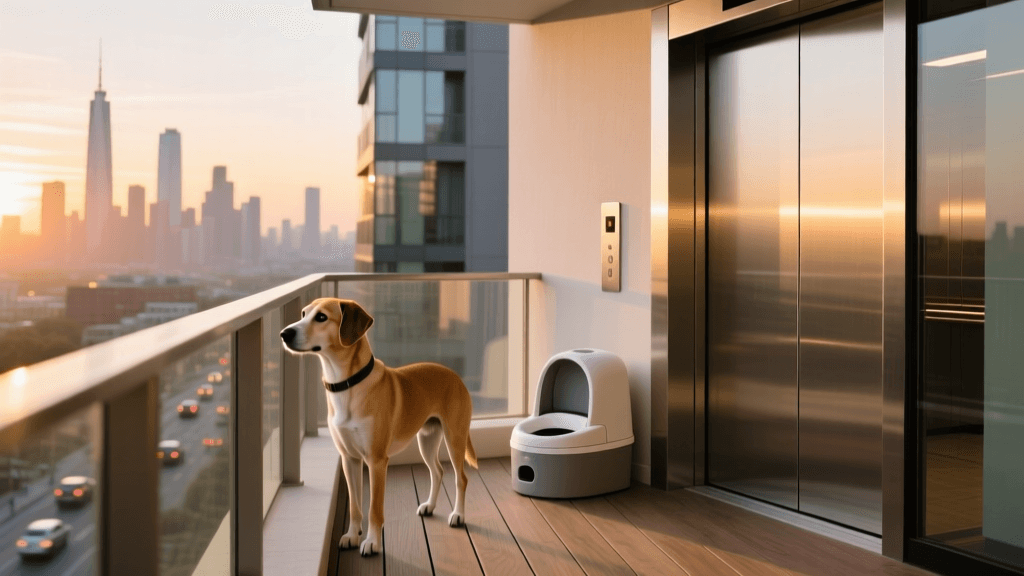
Retraining Surface Preferences: The Balcony Potty Station
Dogs develop strong surface preferences for elimination during their early socialization periods. A dog accustomed to the soft, yielding texture of natural grass will often refuse to use a concrete balcony or indoor pee pads. To bridge this gap, you must utilize surface preference shaping and scent transfer techniques.
Step 1: Selecting the Right Transition Surface
Do not expect your dog to simply figure out how to use bare concrete. Invest in a high-quality synthetic turf system designed specifically for canine drainage, such as the K9Grass Synthetic Turf or a subscription-based real grass service like Doggielawn. These provide the tactile feedback your dog expects while accommodating the spatial limitations of a balcony.
Step 2: Scent Transfer and Operant Conditioning
To encourage your dog to use the new balcony station, you must transfer familiar scents. Take a clean paper towel, dab it in your dog's urine from their previous yard (or their first morning accident in the new apartment), and place it on the new balcony turf. When you take them out to the balcony, use a specific cue word like "Go Potty." The moment they eliminate on the new surface, immediately mark the behavior with a clicker or a verbal "Yes!" and reward with a high-value treat, such as freeze-dried liver. The American Kennel Club emphasizes that immediate positive reinforcement is the most effective way to cement new potty habits and overwrite previous surface preferences.
Step 3: Balcony Boundary Training
High-rise balconies present severe safety risks. You must train a strict "Leave It" and "Back" command to keep your dog away from the railing. Practice this indoors first using a baby gate, rewarding your dog for retreating when they approach the barrier, before ever introducing them to the actual balcony edge.
Elevator Etiquette and Threshold Impulse Control
Elevators are essentially metal boxes filled with unfamiliar scents, sudden movements, and unpredictable strangers. For a dog transitioning from a house, the elevator can be a massive trigger for fear-based reactivity or over-excitement. Training elevator etiquette relies heavily on threshold desensitization and impulse control.
The "Wait" and "Release" Protocol
Before stepping into the elevator, your dog must master the "Wait" command at thresholds. 1. Approach the elevator doors and ask your dog to "Sit" and "Wait." 2. Press the call button. If your dog breaks the sit, reset them. 3. When the doors open, maintain the "Wait." 4. Step in first, then give your release cue ("Okay" or "Free") to invite them in. This protocol establishes you as the guide and prevents your dog from bolting into a crowded cab or darting out into a busy hallway.
Desensitizing to the Elevator Environment
Spend time in the elevator without actually riding it. Walk in, feed a handful of treats, and walk out. Do this during off-peak hours (usually mid-morning in most residential buildings) to minimize stress. Gradually increase the duration of the doors being closed while you feed high-value rewards, effectively counter-conditioning the dog to associate the enclosed space with positive outcomes.
Managing Hallway Noise and Proximity Barking
In a house, the distance between you and your neighbors provides a natural sound buffer. In an apartment, the sound of a neighbor's dog barking, a cart rolling down the hall, or the ding of the elevator can trigger territorial barking. This not only strains your relationship with your neighbors but also keeps your dog in a state of chronic hyper-arousal.
Environmental Masking
Utilize a high-fidelity white noise machine, such as the LectroFan Evo, placed near the front door to mask hallway frequencies. This simple environmental management technique reduces the sudden auditory spikes that trigger alert barking.
The "Quiet" Command and Counter-Conditioning
When your dog barks at a hallway noise, do not yell. Yelling only adds to the chaotic noise and validates their concern. Instead, teach the "Quiet" command using the following method: 1. Wait for a pause in the barking (even just to take a breath). 2. Say "Quiet" in a calm, firm tone. 3. Immediately toss a high-value treat away from the door. Over time, your dog will learn that alerting you to the noise is their job, but once they hear the "Quiet" cue, they should disengage and look to you for a reward. You can also proactively play recordings of hallway sounds at a very low volume while feeding meals, gradually increasing the volume over several weeks to build tolerance.
Enrichment Replacements for Yard Time
Losing a backyard means losing the ability to let the dog out for a quick, off-leash romp. To prevent pent-up energy from manifesting as destructive chewing or pacing, you must replace physical yard time with intense mental enrichment and structured indoor play.
- Scent Work and Snuffle Mats: Hide your dog's daily kibble ration in an Outward Hound Snuffle Mat. Foraging engages their olfactory system, and 15 minutes of intense sniffing is proven to be as mentally exhausting as an hour of physical walking.
- Flirt Poles: If your living room space permits, a flirt pole provides excellent high-intensity interval training (HIIT) for dogs, satisfying their prey drive without requiring a large open field.
- Structured Decompression Walks: Replace backyard time with "sniffaris"—long-leash walks in local parks where the dog is allowed to dictate the pace and direction, focusing entirely on environmental enrichment rather than heel training.
4-Week Apartment Transition Training Schedule
Consistency is the bedrock of any successful life transition. Use this structured 4-week training schedule to systematically acclimate your dog to their new high-rise environment.
| Week | Primary Training Focus | Daily Action Items | Expected Milestones |
|---|---|---|---|
| Week 1 | Decompression & Potty Shaping | Leash-led balcony potty trips every 2 hours. White noise machine active 24/7. No off-leash indoor time. | Dog begins to reliably eliminate on balcony turf. Alert barking at hallway noises decreases. |
| Week 2 | Threshold & Elevator Desensitization | Practice "Wait" at the front door. Take 3 off-peak elevator trips daily (treats only, no riding). | Dog sits calmly when elevator doors open. No pulling toward the hallway. |
| Week 3 | Impulse Control & Enrichment | Introduce daily snuffle mat feeding. Practice "Leave It" with dropped food in the kitchen. | Dog ignores dropped food until released. Destructive chewing behaviors subside. |
| Week 4 | Integration & Real-World Testing | Ride the elevator during moderate traffic. Transition to 4-hour balcony potty intervals. | Dog remains calm around strangers in the elevator. Reliable balcony potty habits established. |
Tracking Exercise Without a Backyard
Without a yard to run in, it is easy to underestimate how much physical activity your dog is actually getting. In 2026, utilizing advanced wearable technology is highly recommended for apartment dwellers. Devices like the Fi Series 3 GPS Collar allow you to track your dog's daily step count and active minutes directly from your smartphone. By setting a daily step goal tailored to your dog's breed and age, you can ensure that the loss of the backyard is being adequately compensated for by structured, leashed exercise and park visits.
Conclusion
Moving from a house to an apartment is a major life transition that tests the bond between you and your dog. By approaching the move not just as a change of address, but as a new training curriculum, you set your dog up for success. Through proactive balcony potty shaping, strict elevator impulse control, and dedicated mental enrichment, your dog will quickly learn that their new high-rise home is just as safe, comfortable, and rewarding as the one they left behind.
aaron-whyte
All our authors care for dogs every day — read more of their work on the authors page.