Herding vs Guardian Dogs: Understanding Canine Instincts
Discover the psychological differences between herding and guardian dog breeds. Learn how canine instincts impact behavior, training, and breed selection.
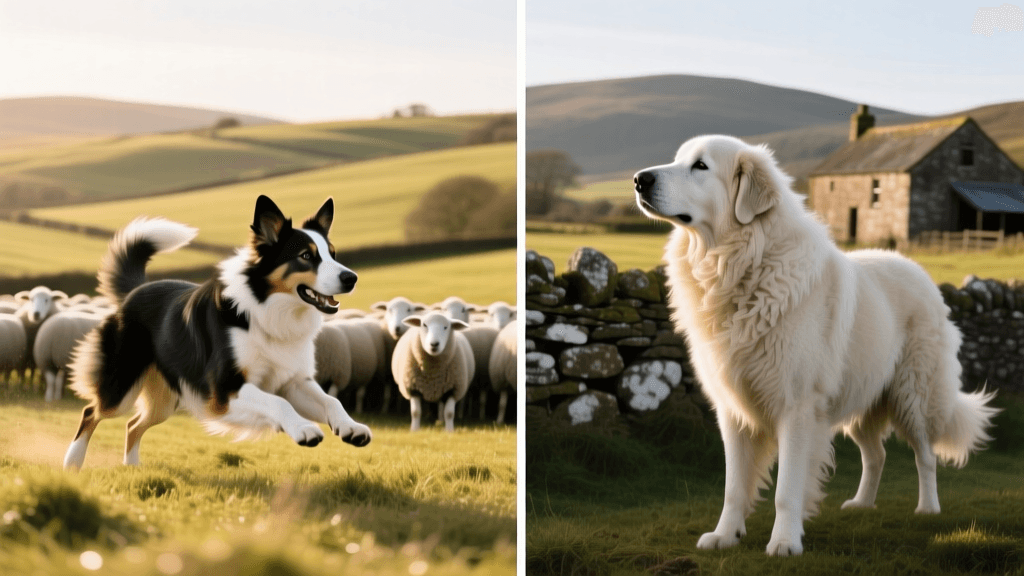
When selecting a dog, many prospective owners fall into the trap of choosing a breed based purely on aesthetics, coat color, or pop-culture popularity. However, true harmony between human and canine comes from understanding the deep-seated psychological drives and breed instincts that dictate behavior. In the realm of working dogs, few groups are as fundamentally misunderstood as the Herding breeds and the Livestock Guardian breeds. While both were developed to work alongside sheep, goats, and cattle, their psychological profiles, behavioral outputs, and environmental needs are polar opposites. Understanding the 'why' behind their actions is critical for successful breed selection and long-term behavioral health.
The Psychology of the Herding Dog: Movement and Control
Herding breeds, such as the Border Collie, Australian Shepherd, and Australian Cattle Dog, are essentially predators with a modified predatory motor sequence. According to the American Kennel Club (AKC), these dogs were selectively bred over centuries to exaggerate the 'eye,' 'stalk,' and 'chase' phases of the hunt, while completely suppressing the final 'kill' and 'dissect' phases. This creates a dog that is hyper-vigilant to movement and possesses an intense psychological need to control its environment.
Because their brains are hardwired to detect and manipulate movement, herding dogs exhibit intense visual reactivity. In a modern suburban environment, this instinct often misfires in problematic ways. A Border Collie might attempt to herd running children by nipping at their heels, chase passing cars with dangerous fixation, or stalk neighborhood cats. Their intelligence is vast, but it is entirely channeled toward motion-based problem solving.
Actionable Advice for Herding Breeds
To manage these intense drives, owners must provide structured, high-intensity outlets that mimic the psychological reward of herding without the liability.
- Timing: Begin impulse control training and 'leave it' commands at 8 to 10 weeks of age. The window for teaching a herder to ignore movement closes rapidly as their neurological pathways solidify.
- Equipment: Invest in a 14-inch Jolly Ball or a heavy-duty flirt pole to satisfy the chase instinct safely in a controlled environment. For mental feeding, use the Kong Wobbler to force them to use their nose and paws to 'herd' their food out.
- Costs: Budget $100 to $150 monthly for advanced mental stimulation. This includes puzzle feeders, weekly agility classes, or enrollment in Treibball (urban herding) clubs.
- Environment: A standard fenced yard is not enough; they require 'job-based' engagement. Without it, they will invent their own jobs, often resulting in destructive neuroses, shadow-chasing, or severe separation anxiety.
The Mind of the Livestock Guardian: Independence and Protection
Conversely, Livestock Guardian Dogs (LGDs) like the Great Pyrenees, Anatolian Shepherd, and Maremma Sheepdog possess a completely different psychological makeup. Bred to blend in with the flock and protect it from apex predators, LGDs were selected for independence, low prey drive toward their charges, and high territorial suspicion. Unlike herders, who look to the human handler for constant direction and cues, LGDs are bred to make autonomous life-or-death decisions in the dead of night while the shepherd sleeps.
This evolutionary divergence makes LGDs incredibly intelligent but notoriously difficult to train using traditional, repetitive obedience methods. They do not lack the intelligence to understand a 'sit' or 'down' command; rather, they lack the psychological 'pack drive' that makes a Border Collie eager to please. An LGD will often evaluate a command, decide it serves no immediate protective purpose, and simply ignore it.
Actionable Advice for Guardian Breeds
Living with an LGD requires shifting your training philosophy from 'obedience' to 'boundary management and socialization.'
- Timing: The critical socialization window for LGDs closes rapidly. You must expose them to diverse, non-threatening human stimuli, strange surfaces, and unusual sounds between 8 and 14 weeks to prevent severe stranger-danger aggression later in life.
- Equipment: Standard 4-foot residential fences are useless. LGDs are roamers by nature and will expand their territory if allowed. You must invest in a minimum 6-foot agricultural fence equipped with coyote rollers or an inward-leaning extension to prevent climbing. A GPS tracking collar, such as the Fi Series 3 or Garmin Astro, is highly recommended for recall failures.
- Costs: Expect to spend $2,000 to $4,000 upfront on specialized, predator-proof fencing and secure gate latches that outsmart canine problem-solving.
- Behavior Quirks: Be prepared for nocturnal barking. An LGD's instinct is to bark at perceived threats in the dark to warn off predators. As noted by researchers at Penn State Extension, this deep, resonant barking is a primary deterrent mechanism and cannot be entirely trained out of the dog without suppressing its core protective instincts.
Breed Comparison Chart: Herding vs. Guardian Instincts
Understanding the baseline differences between these two groups can save prospective owners years of frustration. Below is a structured comparison of their core behavioral traits.
| Trait | Herding Breeds (e.g., Border Collie) | Guardian Breeds (e.g., Great Pyrenees) |
|---|---|---|
| Primary Drive | Movement control and handler focus | Territorial protection and independence |
| Trainability | Extremely high; eager to please | Moderate; autonomous and stubborn |
| Prey Drive | High (directed toward movement) | Low toward flock; high toward predators |
| Vocalization | Reactive barking at play or work | Deep, nocturnal warning barking |
| Space Needs | High mental space; active engagement | High physical territory; roaming space |
| Stranger Reaction | Often friendly or aloof; focused on owner | Highly suspicious; territorial guarding |
| Est. Monthly Cost | $150+ (classes, toys, agility) | $120+ (giant-breed food, joint care) |
Matching the Breed to Your Lifestyle
Choosing between a herder and a guardian requires an honest assessment of your daily routine, living situation, and training philosophy. If you are an active individual who enjoys dog sports, hiking, and interactive training sessions, a herding breed will be a deeply rewarding partner. Their high 'pack drive' means they want to work with you, viewing you as the center of their universe.
However, if you live on a rural property, value an independent companion, and do not mind a dog that is aloof with strangers and prone to nighttime vocalization, an LGD may be the right fit. They do not want to play fetch; they want to observe their territory from a high vantage point. According to the AKC Working Group guidelines, prospective owners of large guardian breeds must also account for the physical costs of giant breeds, including higher volumes of high-quality joint-support food ($80-$120 per month) and elevated veterinary costs for orthopedic screenings like OFA hip and elbow evaluations.
'A dog's breed is its psychological blueprint. Attempting to force a Livestock Guardian into the life of a hyperactive agility partner, or expecting a Border Collie to lounge calmly on a couch while ignoring the neighborhood squirrels, is a recipe for mutual frustration.' — Canine Behavioral Psychology Principles
Conclusion: Respect the Instinct
Ultimately, understanding your dog means respecting the centuries of selective breeding that shaped their brain. Herding dogs need a job that involves movement and partnership, while guardian dogs need a territory to watch and the autonomy to make their own assessments. By understanding the profound behavioral differences between herding and guarding instincts, you can select a companion whose natural drives align seamlessly with your lifestyle, ensuring a lifetime of mutual understanding, safety, and respect.
jonas-cole
All our authors care for dogs every day — read more of their work on the authors page.