Working vs Companion Breeds: Match Dog Instincts to Lifestyle
Discover how to match working and companion dog breeds to your lifestyle. Learn about canine instincts, energy needs, and avoiding behavioral mismatches.
The Hidden Psychology Behind Breed Selection
Every year, millions of dogs end up in shelters, and a significant percentage of these surrenders stem from a fundamental misunderstanding of canine psychology and breed-specific instincts. When selecting a dog, many prospective owners are captivated by a breed's physical appearance or a viral video of a dog performing a clever trick. However, understanding your dog requires looking far beyond the coat color and size. It demands a deep dive into the genetic blueprint and historical purpose of the breed.
The American Kennel Club categorizes breeds into distinct groups based on their historical functions. While a Border Collie and a Cavalier King Charles Spaniel may both be domesticated canines sharing the same basic anatomy, their psychological needs, energy thresholds, and behavioral instincts are worlds apart. Choosing between high-drive working breeds and low-key companion breeds is not merely a matter of preference; it is a critical decision that will dictate the harmony of your household for the next decade or more.
Herding and Working Breeds: The Psychological Need for a 'Job'
Dogs in the Herding and Working groups—such as the Border Collie, Belgian Malinois, German Shepherd, and Australian Shepherd—were selectively bred over centuries to perform physically and mentally demanding tasks. A Border Collie, for instance, was bred to control the movement of sheep across rugged terrain. This required intense focus, high stamina, independent problem-solving, and a psychological trait known as 'the eye' (a hard, unblinking stare used to intimidate livestock).
When you bring a herding breed into a modern suburban home, those instincts do not simply vanish. Without sheep to herd, these dogs will find a 'job' on their own. This often manifests as neurotic behaviors: nipping at the heels of running children, obsessively chasing shadows or laser pointers, or herding family cats. Psychologically, these breeds require structured mental stimulation just as much as physical exercise. A 90-minute walk around the neighborhood is rarely sufficient. They require 15 to 30 minutes of daily cognitive work, such as advanced obedience training, agility courses, or interactive puzzle toys like the Outward Hound Nina Ottosson Dog Brick.
Companion Breeds: Bred for Emotional Attunement
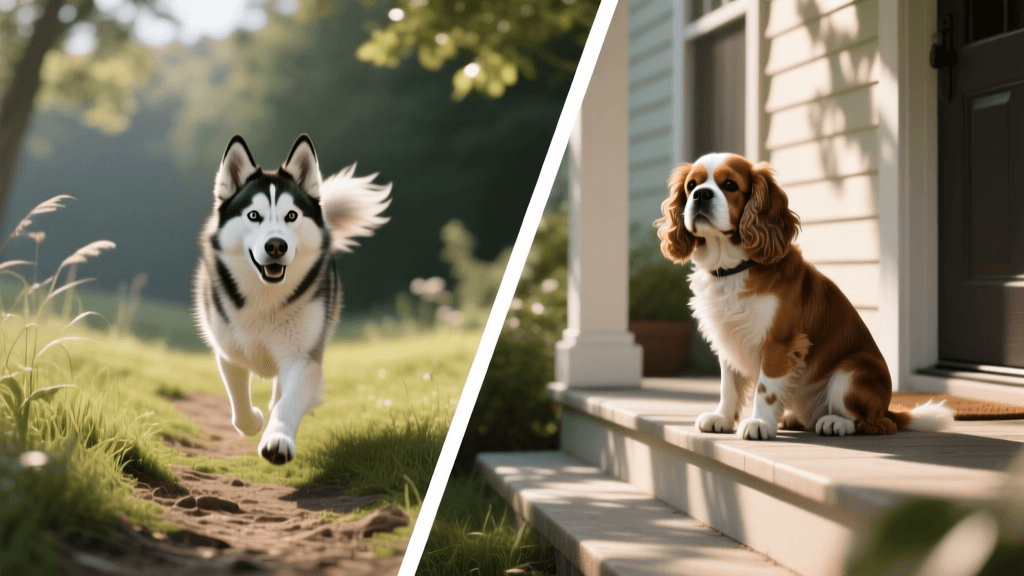
Conversely, breeds in the Toy and Companion groups—such as the Cavalier King Charles Spaniel, Pug, Bichon Frise, and Shih Tzu—were selectively bred for a completely different purpose: human companionship. Their historical 'job' was to sit on the laps of royalty, provide warmth, and offer emotional comfort. As a result, their psychology is heavily wired for social bonding and proximity to their owners.
While they may lack the physical stamina to run beside you on a 10-mile hike, companion breeds possess a high degree of emotional attunement. They are highly sensitive to human body language and vocal tones. However, this intense selective breeding for closeness comes with a psychological caveat: a high predisposition to separation anxiety. Understanding your companion dog means recognizing that their distress when left alone is not 'bad behavior,' but a manifestation of their genetic imperative to be near their flock. According to the Humane Society of the United States, matching a dog's social needs to your daily schedule is one of the most vital steps in preventing behavioral relinquishment.
Breed Comparison Chart: Instincts vs. Reality
To help visualize the stark differences in daily requirements, review the comparison table below. This chart contrasts the typical needs of a high-drive Herding breed against a typical Companion breed.
| Trait / Requirement | Herding/Working (e.g., Border Collie) | Companion/Toy (e.g., Cavalier) |
|---|---|---|
| Daily Aerobic Exercise | 90 - 120+ minutes (running, fetching) | 30 - 45 minutes (leisurely walking) |
| Mental Stimulation | High (Agility, advanced tricks, scent work) | Moderate (Basic training, snuffle mats, socialization) |
| Social Independence | Low to Moderate (Can work independently) | Very Low (Velcro dogs, prone to separation anxiety) |
| Destructive Risk if Bored | Extreme (Chewing drywall, digging, escaping) | Moderate (Excessive barking, indoor accidents) |
| Space Requirements | Large fenced yard highly recommended | Adaptable to apartments and small condos |
The True Cost of a Breed Mismatch
Failing to align a breed's psychological instincts with your lifestyle can lead to severe financial and emotional costs. Many owners adopt a working breed, underestimate the exercise requirements, and subsequently face the consequences of canine frustration. A bored Malinois or Husky will not simply sleep on the couch; they will dismantle it.
Consider the financial ramifications of a mismatch. If a working breed develops destructive habits or severe leash reactivity due to pent-up energy, you may need to hire a certified veterinary behaviorist or an advanced obedience trainer. These professionals typically charge between $150 and $250 per hour, and a full behavioral modification package can easily exceed $1,500. Furthermore, if your work schedule keeps you away from home for 8 to 10 hours a day, a high-energy dog will require mid-day dog walking services ($25 to $40 per walk) or doggy daycare ($40 to $60 per day) to safely burn off energy. In contrast, a companion breed may require less physical outsourcing but might need pet-sitting or daycare specifically to prevent isolation distress, rather than for physical exhaustion.
The ASPCA emphasizes that adequate exercise and mental enrichment are foundational to preventing behavioral issues, noting that many perceived 'behavioral problems' are simply symptoms of unmet biological and psychological needs.
Actionable Steps for Selecting Your Ideal Match
To ensure you select a breed that aligns with your psychological and lifestyle capacity, follow this actionable audit before bringing a dog home:
- Conduct a Time Audit: Track your actual free time for one week. Subtract work, commuting, chores, and sleep. If you have less than 2 hours of dedicated, active free time per day, a working or herding breed is likely a mismatch. Opt for a companion or low-energy hound breed.
- Calculate the 'Boredom Budget': If you work long hours but are set on an intelligent, active breed, budget for a KONG Classic stuffed with frozen peanut butter ($15), a Furbo dog camera ($150) for remote treat tossing, and a minimum of three days a week at a reputable doggy daycare to fulfill their social and physical needs.
- Assess Your Environment: Apartment dwellers should be highly cautious of vocal herding breeds and guardian breeds, whose instinct to alert-bark at hallway noises will quickly lead to noise complaints. Companion breeds or quiet sighthounds (like Greyhounds) are psychologically better suited to shared-wall living.
- Evaluate Your Handling Style: Working breeds require firm, consistent, and engaging leadership. If you prefer a more relaxed, permissive household dynamic, a eager-to-please companion breed or a mellow retriever mix will be much happier and less confused by your boundaries.
Conclusion: Honoring the Canine Blueprint
Understanding your dog begins long before you sign the adoption papers or breeder contract. It begins with a respectful acknowledgment of the centuries of selective breeding that shaped the animal sitting in front of you. By objectively comparing the intense, job-oriented psychology of working breeds against the deeply affectionate, proximity-seeking nature of companion breeds, you can make a selection based on reality rather than fantasy. When a dog's genetic instincts are honored and properly channeled, the result is not just a well-behaved pet, but a deeply fulfilled canine companion and a harmonious home.
marcus-aldridge
All our authors care for dogs every day — read more of their work on the authors page.