Essential Harnesses and Long Lines for Recall Training
Discover the best harnesses and long lines for effective recall training. Compare gear, learn proper sizing, and master safe outdoor obedience.

The Foundation of Reliable Recall
Teaching a dog to come when called is arguably the most critical obedience skill you will ever instill in your canine companion. A reliable recall not only enhances your dog's freedom and quality of life but also serves as a vital safety mechanism that can prevent accidents, wildlife encounters, and dangerous traffic situations. However, transitioning a dog from a standard six-foot leash to off-leash reliability requires an intermediate phase of training. This is where specialized gear—specifically, the right harness and long line—becomes indispensable.
Many dog owners attempt to train recall using standard walking equipment, only to find that their dog becomes distracted, overstimulated, or physically uncomfortable when the leash reaches its limit. To bridge the gap between on-leash control and off-leash freedom, you must invest in equipment designed specifically for the unique biomechanical and behavioral demands of long-distance training. In this comprehensive gear guide, we will break down exactly what you need, how to choose the right materials, and how to handle your equipment safely to ensure a successful training journey.
Why You Must Ditch the Collar for Long Line Work
Before you ever attach a fifteen-foot training line to your dog, you must evaluate where that line will be clipped. Attaching a long line to a standard flat collar or a slip lead is a recipe for severe physical injury. When a dog is on a long line, they have enough momentum to build up significant speed before hitting the end of the line. If that sudden stop is absorbed entirely by the dog's neck, the force is concentrated directly on the trachea, the cervical spine, and the delicate blood vessels in the neck.
According to the ASPCA's guide on dog walking equipment, harnesses are vastly superior to collars for dogs that pull or for any training that involves sudden changes in momentum. A well-fitted harness distributes the kinetic energy of a sudden stop across the dog's chest, shoulders, and ribcage, entirely bypassing the vulnerable neck area. For long line work, a harness is not just a recommendation; it is an absolute safety requirement. Using a collar for recall training on a long line risks tracheal collapse, especially in small breeds, and can cause long-term spinal misalignment in larger, more powerful dogs.
Front-Clip vs. Back-Clip Harnesses for Training
When selecting a harness for recall training, you will generally encounter two main styles: front-clip and back-clip. Both have their place in a trainer's toolkit, but they serve slightly different purposes during the conditioning process.
Back-Clip Harnesses
A back-clip harness features the D-ring for leash attachment located between the dog's shoulder blades. This is the preferred choice for long line recall training. Because the line trails behind the dog, it mimics the feeling of being off-leash and prevents the line from tangling between the dog's front legs. When the dog turns to run back to you, the back-clip allows for a natural, unencumbered range of motion.
Front-Clip Harnesses
Front-clip harnesses have the attachment point on the chest. While these are excellent for loose-leash walking and discouraging pulling, they are less ideal for long line work. A long line dragging from the chest can easily tangle around the dog's front legs, causing tripping or rope burn. Reserve front-clip harnesses for urban walking and use back-clip harnesses for open-field recall training.
The Long Line: Your Bridge to Off-Leash Freedom
A long line is essentially a very long leash, typically ranging from 10 to 50 feet in length. It provides your dog with the illusion of freedom while ensuring you maintain ultimate control. If your dog ignores a recall cue and decides to chase a squirrel, the long line allows you to gently stop them and guide them back, preventing the self-rewarding behavior of running away.
When shopping for a long line, the sheer variety of materials can be overwhelming. The right choice depends heavily on your training environment, your dog's size, and your willingness to perform gear maintenance. Below is a detailed comparison of the most common long line materials used by professional dog trainers.
Material Comparison: Which Long Line is Right for You?
| Material | Durability | Weight | Best Environment | Maintenance |
|---|---|---|---|---|
| Biothane | Extremely High | Medium to Heavy | Wet, muddy, or brush-heavy areas | Wipe clean with a damp cloth |
| Nylon | High | Lightweight | Dry parks, indoor facilities, suburban yards | Machine washable, but tangles easily |
| Cotton | Low to Medium | Lightweight | Short-distance indoor or dry grass training | Hand wash, prone to rot if left wet |
| Paracord | High | Very Lightweight | Small dogs, precise agility or trick training | Hand wash, melts if exposed to high heat |
The Verdict: For most owners engaging in outdoor recall training, Biothane is the gold standard. It is waterproof, dirt-proof, and does not absorb odors. While it is slightly heavier than nylon, it glides through grass and brush without knotting, saving you immense frustration during training sessions. Nylon is a close second for budget-conscious owners, provided you are training in dry conditions and take the time to carefully coil it to prevent bird-nest tangles.
Proper Sizing and Weight Ratios
A common mistake novice trainers make is purchasing a long line that is too heavy for their dog. A thick, heavy Biothane line meant for a 90-pound Labrador Retriever will act as an anchor on a 20-pound Terrier mix, pulling their head down and inhibiting their natural movement. As a general rule, the hardware (the snap hook) and the line itself should not weigh more than 5% of your dog's total body weight. For toy and small breeds, seek out 'micro' or 'lightweight' long lines that use smaller brass or aluminum snaps and 3/8-inch wide webbing. For large and giant breeds, opt for 5/8-inch or 3/4-inch widths with heavy-duty stainless steel hardware to withstand sudden, high-impact forces.
Safe Handling Techniques to Prevent Rope Burn
Handling a long line requires practice. If you wrap the line tightly around your hand or wrist, a sudden lunge from your dog can result in severe friction burns, or worse, drag you to the ground. The American Kennel Club's recall training guide emphasizes the importance of maintaining a safe, loose grip that allows you to manage the line without anchoring it to your body.
Use the 'accordion method' to gather the line. As your dog moves closer to you, gather the loops of the line in one hand, holding them loosely like a bouquet of flowers. Never step on the long line to stop your dog; the sudden jerk can cause injury to the dog's spine and can easily trip you. Instead, apply gentle, steady pressure by closing your hand over the loops, allowing the harness to absorb the braking force.
'A long line is not a restraint; it is a communication tool. It should remain slack 95% of the time, only engaging when safety requires intervention.'
Step-by-Step Recall Practice with Gear
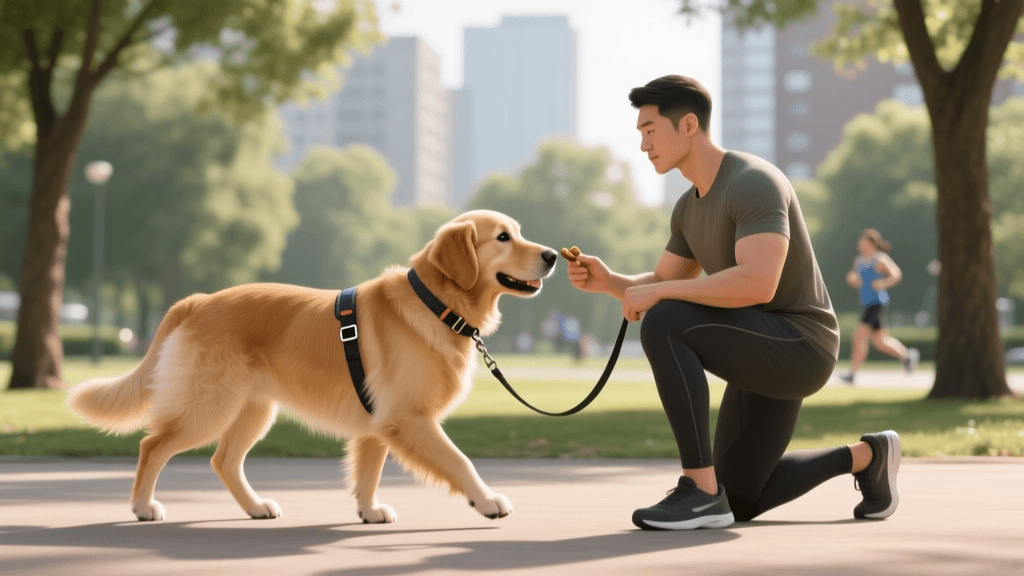
Once you have fitted your dog with a back-clip harness and attached your long line, head to a low-distraction environment. Here is a structured drill to build reliability:
- The Engagement Game: Let your dog wander to the end of the line. Say their name. The moment they look at you, mark the behavior with a clicker or a verbal 'Yes!' and reel them in gently for a high-value treat.
- The Restrained Recall: Have a partner gently hold your dog's harness. Walk away 15 feet, turn, and excitedly call your dog using your recall cue ('Come!' or 'Here!'). Your partner releases the harness, and you reward the dog lavishly when they arrive.
- The Distraction Proofing: Toss a low-value toy or treat a few feet away. As your dog moves toward it, call them back. If they ignore you, use the long line to gently guide them back to you—do not yank. When they return, reward with something far better than the item they left behind.
Cleaning and Maintenance of Training Gear
To ensure your gear lasts through hundreds of training sessions, proper maintenance is required. Biothane lines should be wiped down with a damp cloth after muddy outings and occasionally soaked in a mild vinegar-water solution to eliminate odors. Nylon and cotton lines should be placed inside a mesh laundry bag before being run through a washing machine to prevent the snap hooks from damaging the drum or the line itself. Always inspect the D-ring on your harness and the snap hook on your long line for signs of metal fatigue, rust, or fraying webbing before every single use.
Conclusion
Investing in the right harness and long line is an investment in your dog's safety and your peace of mind. By prioritizing biomechanical safety through a back-clip harness and selecting a long line material that suits your environment, you set the stage for frustration-free training. Remember that the gear is simply a conduit for your communication. With patience, high-value rewards, and consistent practice, your dog will learn that returning to you is always the best choice they can make, eventually paving the way for true, off-leash freedom.
aaron-whyte
All our authors care for dogs every day — read more of their work on the authors page.