Puppy Hand-Feeding Bonding Protocols for 2026: Build Trust Fast
Discover 2026 hand-feeding protocols to build deep trust and bond with your new puppy. Learn step-by-step engagement routines and mealtime strategies.
The Science of Connection: Why Hand-Feeding is the Ultimate Bonding Tool in 2026
Bringing a new puppy into your home is one of the most rewarding experiences a dog owner can have. However, building a deep, unshakeable bond requires more than just cuddles on the couch; it requires intentional, science-based relationship building. Leading up to 2026, modern canine behavioral science has increasingly highlighted the profound psychological impact of resource-based trust exercises. Among these, hand-feeding remains the gold standard for establishing yourself as a source of security, guidance, and positive reinforcement.
When a puppy is born, their primary focus is survival and resource acquisition. By taking control of their most vital resource—their daily food—and dispensing it contingently through positive interactions, you fundamentally alter how the puppy perceives you. You are no longer just a roommate who opens a bag of kibble; you become the center of their universe, the provider of all good things, and a safe haven in an overwhelming world. According to the ASPCA Puppy Care Guidelines, early positive associations with human hands are critical for preventing resource guarding and fostering a confident, well-adjusted adult dog.
Preparing for the 14-Day Hand-Feeding Trust Protocol
Before you begin this protocol, you must calculate your puppy’s daily caloric needs to ensure they receive their full nutritional requirement without overfeeding. A typical 15-pound growing puppy may require between 500 and 700 calories per day, depending on their breed, metabolism, and activity level. Instead of placing this food in a bowl, you will divide their daily kibble allowance into three to four separate portions, stored in easily accessible treat pouches or airtight containers around your home.
This protocol is designed for puppies between 8 and 16 weeks of age, though it can be adapted for older rescue puppies who need to build foundational trust. The goal is to replace passive bowl-feeding with active engagement sessions that last between 5 and 10 minutes each. This prevents the puppy from becoming satiated too quickly and keeps their focus sharp. The AKC Puppy Care Expert Advice hub emphasizes that short, frequent training sessions are vastly superior to long, exhausting ones when it comes to puppy cognitive development and attention spans.
Phase 1: Days 1-4 — The Foundation of Focus and Eye Contact
The first four days of the protocol are dedicated to teaching the puppy that looking at you is the key to unlocking rewards. Puppies are naturally easily distracted, so begin these sessions in a quiet, low-distraction environment like a carpeted living room or a quiet bedroom.
- The Name Game: Say your puppy’s name exactly once in a cheerful, upbeat tone. The moment they turn their head or make eye contact, mark the behavior with a verbal 'Yes!' and immediately deliver a piece of kibble from your hand.
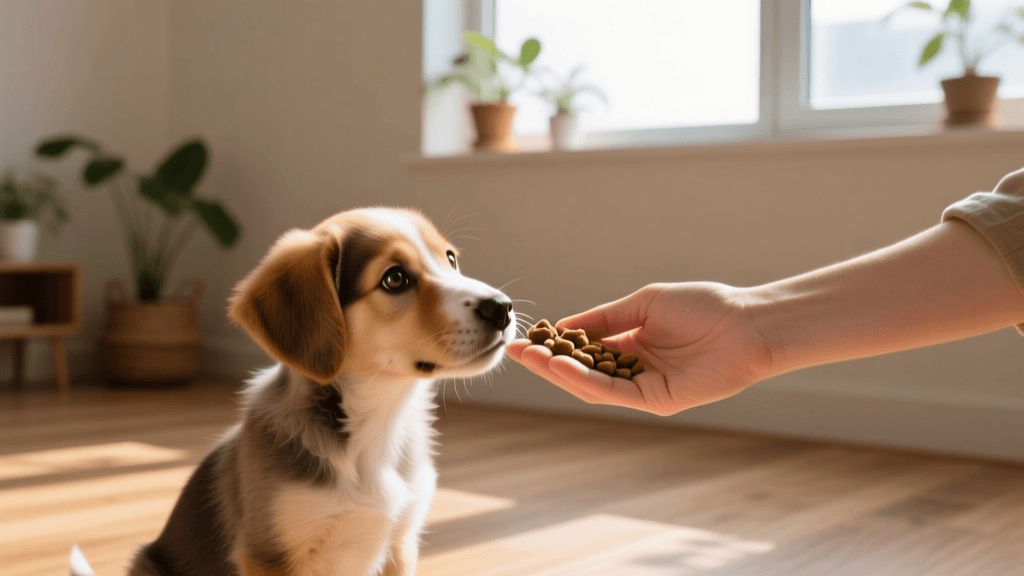
- The Magnet Hand: Hold a piece of kibble between your thumb and index finger. Slowly move your hand from the puppy’s nose up toward your own eyes. When the puppy’s gaze follows your hand and meets your eyes, release the kibble.
- Proximity Feeding: Sit on the floor with your puppy. Toss a piece of kibble a short distance away. When the puppy eats it and turns back to you, reward them with another piece directly from your hand. This builds the habit of checking in with you after completing an action.
During this phase, do not worry about formal obedience commands like 'sit' or 'down'. Your sole objective is to build a magnetic attraction to your face and your hands. If the puppy loses interest or wanders off, simply put the food away and try again in ten minutes. Never force engagement; let the puppy choose to return to you.
Phase 2: Days 5-9 — Adding Movement and Engagement
Once your puppy is reliably offering eye contact and checking in with you, it is time to introduce movement. This phase transforms the hand-feeding sessions into dynamic play and basic obedience training, reinforcing the bond through shared activity.
- Luring Basic Positions: Use a piece of kibble to lure the puppy into a sit, a down, and eventually a stand. The physical proximity required for luring builds comfort with human hands moving near the puppy's face and body.
- The Recall Game: Partner with a family member or friend. Sit on opposite sides of the room. Take turns calling the puppy’s name and rewarding them with a handful of kibble when they arrive. This teaches the puppy that coming to you is always a highly rewarding experience.
- Handling Exercises: Feed the puppy kibble while gently touching their paws, ears, and tail. This classical conditioning exercise pairs potentially sensitive handling with high-value rewards, building deep trust and making future veterinary visits much less stressful.
The AVMA Puppy Care Resources strongly recommend early, positive handling exercises to ensure puppies grow into adult dogs that are comfortable with routine medical care and grooming. Hand-feeding during these handling sessions accelerates this desensitization process.
Phase 3: Days 10-14 — Impulse Control and Real-World Distractions
In the final phase of the protocol, you will test and strengthen the bond by introducing mild distractions and teaching impulse control. A dog that trusts you will look to you for guidance when faced with temptation.
- The 'Zen Hand' Exercise: Place a piece of kibble in your open palm. If the puppy dives for it, close your hand into a fist. Wait for the puppy to back away or offer eye contact. The moment they stop pushing against your hand, open your palm and let them eat the kibble. This teaches them that patience and polite behavior yield rewards.
- Environmental Engagement: Move your hand-feeding sessions to more distracting environments, such as the backyard or a quiet patio. Ask for eye contact and simple behaviors while birds, wind, and distant noises compete for the puppy's attention.
- Drop It and Trade: Offer the puppy a low-value toy. Once they pick it up, present a high-value piece of kibble right at their nose. When they drop the toy to eat the food, praise them enthusiastically. This builds a lifelong trust that giving up an item will always result in something equally good or better.
Recommended High-Value Kibble and Toppers for 2026
Not all kibble is created equal when it comes to training value. For hand-feeding protocols, you want a food that is highly palatable, appropriately sized for tiny puppy mouths, and nutritionally dense. Below is a comparison of top-rated puppy foods and toppers widely recommended by behaviorists in 2026 for engagement training.
| Product Name | Main Protein Source | Kcal/Cup | Best Bonding Use |
|---|---|---|---|
| Orijen Puppy | Free-Run Chicken & Turkey | 430 | High-drive luring and recall games |
| Ziwi Peak Puppy | Air-Dried New Zealand Lamb | 560 | High-distraction environments and handling |
| Stella & Chewy's Raw Coated | Cage-Free Chicken | 410 | Everyday 'Zen Hand' impulse control |
| Purina Pro Plan Puppy Sensitive | Salmon & Barley | 439 | Puppies with sensitive digestion during stress |
Note: Always consult your veterinarian before changing your puppy's diet, especially when introducing rich proteins or air-dried foods that may alter their daily caloric intake requirements.
Managing Puppy Biting and Teething During Hand-Feeding
One of the most common challenges new owners face during hand-feeding is the inevitable encounter with 'puppy shark teeth.' Puppies explore the world with their mouths, and when they are excited about food, they may accidentally scrape your skin. It is vital to handle these moments without damaging the trust you are building.
If your puppy bites your hand while taking a piece of kibble, do not yell, jerk your hand away violently, or punish the puppy. Instead, use the 'Statue Method.' The exact millisecond you feel teeth on skin, freeze completely and become entirely uninteresting. Withdraw your attention by looking away. Once the puppy backs off and offers a calm behavior, such as sitting or making eye contact, resume the session. This teaches the puppy that gentle mouths yield food, while hard mouths cause the fun to stop.
Pro Tip for 2026: If your puppy is in the peak teething window (usually between 12 and 16 weeks), their gums may be sore, making them more prone to biting. Lightly moistening the kibble with warm water or a sodium-free bone broth before the session can soften the food and reduce the puppy's need to gnaw on your fingers.
Transitioning Back to the Bowl Without Losing the Bond
After the 14-day protocol, you do not need to hand-feed every single meal for the rest of the dog's life. However, you should never entirely abandon the practice. Transitioning back to bowl feeding should be done gradually to maintain the strong psychological bond you have established.
Begin by feeding 50% of the daily ration from the bowl and 50% through hand-feeding training sessions. Implement a 'Say Please' protocol where the puppy must offer a sit and eye contact before the bowl is placed on the floor. Furthermore, make it a habit to occasionally approach your puppy while they are eating from their bowl and drop a high-value treat, like a piece of freeze-dried liver or a spoonful of plain yogurt, into the bowl. This reinforces the concept that human hands approaching their food bowl always bring wonderful surprises, effectively inoculating your dog against resource guarding behaviors.
By dedicating just two weeks to this intensive hand-feeding protocol, you are investing in a lifetime of mutual trust, focus, and deep emotional connection with your puppy. The bond forged through these deliberate, positive interactions will serve as the bedrock for all future training and companionship.
aaron-whyte
All our authors care for dogs every day — read more of their work on the authors page.