Greyhound vs French Bulldog: Ultimate Apartment Guide
Discover whether a Greyhound or French Bulldog is the better apartment dog. Compare exercise needs, costs, and daily routines for city living.
The Great Apartment Dog Debate
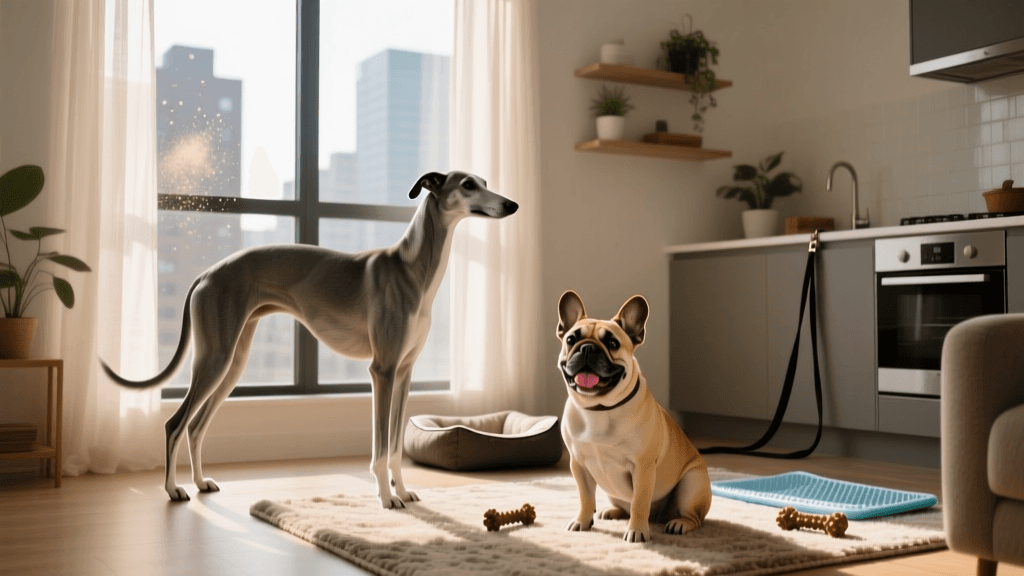
When searching for the perfect apartment dog, most prospective pet parents immediately gravitate toward small breeds. The French Bulldog consistently ranks as one of the most popular city-dwelling dogs, thanks to its compact size, charming personality, and low exercise requirements. However, a massive, sleek Greyhound might seem entirely out of place in a 700-square-foot apartment. Surprisingly, retired racing Greyhounds are famously known as '45-mph couch potatoes' and make exceptional indoor companions. In this comprehensive guide, we compare the Greyhound and the French Bulldog across daily routines, space requirements, health needs, and financial costs to help you select the ultimate apartment dog for your lifestyle.
Space Requirements and Indoor Living
At first glance, the French Bulldog seems like the obvious winner for small spaces. Weighing in at under 28 pounds, they require minimal floor space and can easily navigate tight hallways or studio apartments. However, what they lack in physical footprint, they make up for in environmental demands. Frenchies require strict climate control; their small stature and compromised airways mean that an apartment without reliable air conditioning can quickly become a life-threatening environment during the summer months.
Conversely, Greyhounds are large dogs, typically weighing between 60 and 70 pounds, but they are remarkably well-suited to indoor living. According to the AKC Greyhound breed standard, these dogs are naturally quiet, rarely bark, and sleep up to 18 hours a day. They do not pace nervously or destroy furniture out of boredom like some high-energy working breeds. The primary spatial requirement for a Greyhound is a large, high-quality orthopedic bed. Because they have incredibly low body fat and lack a thick undercoat, they cannot sleep on hard floors. Investing in a large, supportive bed (such as a Big Barker or a Kuranda elevated cot with a fleece pad) is mandatory. While their bed takes up significant visual space, their calm indoor demeanor makes them excellent neighbors in buildings with shared walls.
Exercise Needs and Daily Routines
A common misconception is that Greyhounds require hours of rigorous daily exercise. In reality, they are sprinters, not marathon runners. A single 45-minute brisk walk in the morning and a 20-minute stroll in the evening are usually more than enough to keep a retired Greyhound happy. If you have access to a securely fenced dog park, allowing them to sprint off-leash once or twice a week will fulfill their need for speed.
French Bulldogs, on the other hand, require much less physical exertion but more frequent, shorter outings. Their exercise routine is heavily dictated by the weather. Here is a comparison of a typical weekday routine for both breeds in an apartment setting:
Greyhound Daily Routine
- 7:00 AM: 45-minute brisk neighborhood walk on a secure harness.
- 7:45 AM: Breakfast and settling onto the orthopedic bed for a morning nap.
- 12:30 PM: Quick 15-minute potty break.
- 1:00 PM - 5:00 PM: Deep sleep (Greyhounds are notorious for sleeping through the entire workday).
- 5:30 PM: 30-minute evening walk and mental enrichment (snuffle mats or lick mats).
French Bulldog Daily Routine
- 7:30 AM: 20-minute leisurely morning stroll (avoiding direct sunlight if warm).
- 8:00 AM: Breakfast and indoor play session with soft toys.
- 1:00 PM: 15-minute potty break and light indoor training.
- 5:00 PM: 20-minute evening walk in a cooler, shaded area.
- 6:00 PM: Couch cuddles and relaxation.
Pro Tip: Never use a retractable leash for either breed in a city environment. Greyhounds can accelerate to 45 mph in seconds and can easily slip standard collars, requiring a specialized martingale collar. Frenchies should always be walked on a well-fitted harness to avoid putting pressure on their delicate tracheas.
Health Considerations and Climate Control
Health profiles drastically impact the daily life and stress levels of apartment dwellers. French Bulldogs are a brachycephalic (flat-faced) breed. As noted by the Cornell University College of Veterinary Medicine, Brachycephalic Airway Syndrome is a major concern, leading to noisy breathing, exercise intolerance, and severe heatstroke risks. Apartment living with a Frenchie means you must be hyper-vigilant about indoor temperatures, avoid staircases if your building lacks an elevator (as they are prone to spinal issues like IVDD), and be prepared for potential veterinary emergencies related to breathing.
Greyhounds have a completely different set of health considerations. They are incredibly sensitive to anesthesia due to their low body fat, meaning any required surgeries (like dental cleanings, which they frequently need) must be performed by a veterinarian experienced with sighthounds. They are also prone to osteosarcoma and bloat. However, they do not suffer from the chronic, daily breathing issues that plague many French Bulldogs, making them a lower-stress companion for owners who work long hours and worry about their dog's breathing while they are away.
Cost of Living: Greyhound vs. French Bulldog
Financial planning is a crucial aspect of sharing your life with a dog. While the initial adoption fee for a retired racing Greyhound is remarkably low, their large size means higher ongoing costs for food and medications. French Bulldogs carry a massive initial price tag and notoriously high insurance premiums due to their breed-specific health risks.
| Expense Category | French Bulldog | Greyhound |
|---|---|---|
| Initial Adoption/Purchase | $1,500 - $4,000+ | $300 - $500 (Rescue) |
| Monthly Food Cost | $40 - $60 | $80 - $120 |
| Pet Insurance (Monthly) | $70 - $120 | $40 - $70 |
| Annual Vet & Preventatives | $800 - $1,500 | $500 - $800 |
| Specialty Gear Required | Cooling mats, harnesses, wrinkle wipes | Martingale collars, orthopedic beds, winter coats |
| Estimated Annual Total | $2,500 - $4,500 | $1,800 - $2,800 |
As highlighted in the American Kennel Club's French Bulldog profile, their popularity has unfortunately led to overbreeding, which exacerbates health issues and drives up veterinary and insurance costs. Greyhounds, primarily sourced from dedicated retired racing rescues, are generally robust, though their large size means heartworm prevention and joint supplements will cost more than they would for a small dog.
Travel, Commuting, and Multi-Pet Homes
If your apartment life involves taking public transit, the French Bulldog is the undisputed champion. Most city transit systems allow small dogs in carriers, and a Frenchie can easily fit into an under-seat pet carrier. Taking a 70-pound Greyhound on a crowded subway is generally prohibited and logistically impractical. Greyhounds are strictly walking-and-cab companions.
When it comes to multi-pet households, caution is required. Many retired Greyhounds have a high prey drive and may not be safe to live with cats or small dogs. Rescues usually perform 'cat testing' before placement, but introductions must be managed carefully. French Bulldogs, conversely, are highly sociable, thrive in packs, and generally integrate seamlessly into homes with other dogs or cats, provided they are properly socialized.
Final Verdict: Which Breed Fits Your Apartment?
Choosing between a Greyhound and a French Bulldog ultimately depends on your specific daily routine, budget, and living environment. If you live in a walk-up apartment, frequently use public transit, have other small pets, and have the financial buffer to handle potential brachycephalic health issues, the French Bulldog is a loving, compact, and entertaining companion.
However, if you have a ground-floor apartment or an elevator building, prefer a quiet and independent dog, want to avoid the ethical and health complications of flat-faced breeding, and enjoy long, brisk neighborhood walks, the Greyhound is an astonishingly adaptable, gentle, and low-maintenance roommate. Both breeds prove that apartment living is less about the square footage and more about matching the dog's energy and environmental needs to your personal lifestyle.
robin-maitland
All our authors care for dogs every day — read more of their work on the authors page.