Furbo Dog Camera: Separation Anxiety Training Protocol 2026
Discover how to use the Furbo dog camera with a 2026 systematic desensitization protocol to cure your dog's separation anxiety and alone time stress.
The Evolution of Canine Alone Time in 2026
As hybrid work models and flexible schedules continue to solidify in 2026, our dogs are experiencing more fragmented routines than ever before. While spending more time at home has deepened the human-animal bond, it has also inadvertently amplified a critical behavioral issue: canine separation anxiety. When dogs become entirely unaccustomed to being left alone, even brief departures can trigger severe stress responses. Managing this requires more than just leaving the television on; it demands a structured, technology-assisted behavioral modification plan.
In this comprehensive guide, we will explore how to integrate the Furbo Dog Camera into a systematic desensitization protocol. By combining real-time remote monitoring with interactive treat-tossing mechanics, you can help your dog build confidence, rewrite their emotional response to solitude, and transform alone time into a positive, enriching experience.
Understanding Separation Anxiety vs. Isolation Distress
Before initiating any training protocol, it is vital to distinguish between true separation anxiety and general isolation distress. According to the American Society for the Prevention of Cruelty to Animals (ASPCA), separation anxiety is a panic response triggered specifically by the absence of a primary attachment figure. Isolation distress, on the other hand, occurs when a dog is simply unhappy about being left alone but will typically settle down once the initial novelty of the owner's departure wears off.
True separation anxiety manifests through intense physiological and behavioral symptoms, including:
- Destructive behavior directed at exit points (doors, windows, door frames).
- Inappropriate elimination (urination or defecation) despite being fully house-trained.
- Excessive, continuous vocalization (howling, barking, crying) that does not subside.
- Pacing, drooling, and panting that begins the moment pre-departure cues are triggered.
If your dog exhibits severe self-injurious behavior or extreme panic, consult a board-certified veterinary behaviorist before attempting DIY desensitization, as pushing a dog past their stress threshold can worsen the condition.
Why the Furbo Dog Camera is Essential for Behavioral Modification
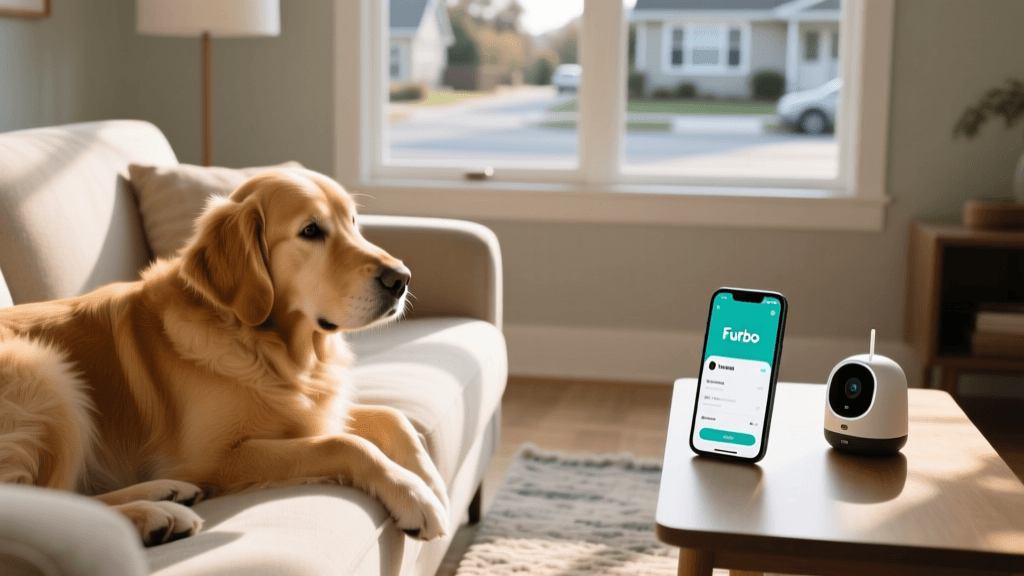
The Furbo Dog Camera has remained a cornerstone of remote pet care through 2026 due to its specialized feature set designed specifically for canine behavior. Unlike standard home security cameras, the Furbo offers a 360-degree rotating view, 1080p HD video with night vision, and, most importantly, a two-way audio and treat-tossing mechanism.
For separation anxiety training, the camera serves three critical functions:
- Baseline Assessment: It allows you to observe your dog's exact stress threshold and identify the precise moment panic sets in.
- Counter-Conditioning: The treat-tossing feature enables you to pair your absence with high-value rewards, altering the dog's emotional response to being alone.
- Threshold Management: By monitoring your dog in real-time, you can return home or interact before the dog crosses the threshold from mild anxiety into full-blown panic.
The 4-Week Systematic Desensitization Protocol
Systematic desensitization involves exposing your dog to their trigger (your departure) at an intensity so low that it does not provoke a fear response, gradually increasing the intensity over time. Here is how to execute this using your Furbo camera in 2026.
Week 1: Neutralizing Pre-Departure Cues
Dogs are masters of pattern recognition. Picking up your keys, putting on your coat, or tying your shoes are all "pre-departure cues" that signal your imminent exit, often triggering anxiety before you even touch the doorknob.
The Exercise: Throughout the week, perform these cues randomly without actually leaving. Put your coat on and sit on the couch to read a book. Pick up your keys and immediately put them back down. Do this 10 to 15 times a day until your dog stops reacting (e.g., panting, following you closely, whining) to these specific actions. The goal is to make these cues entirely meaningless.
Week 2: Micro-Departures and Remote Treat Tossing
Now that the pre-departure cues are neutralized, it is time to introduce actual departures, starting with "micro-departures."
The Exercise: Set up your Furbo camera in the room where your dog usually stays. Give your dog a long-lasting enrichment item, such as a frozen lick mat or a snuffle mat. Walk out the front door, close it, and immediately use the Furbo app to toss a high-value treat (like a pea-sized piece of freeze-dried liver or Zuke's Mini Naturals). Wait exactly three seconds, then re-enter the house calmly. Repeat this 5 times per session, twice a day. The treat toss from the camera creates a positive association with the sound of the door closing.
Week 3: Extending the Threshold
Once your dog is comfortably accepting micro-departures without showing signs of stress on the Furbo feed, begin extending the time you are outside.
The Exercise: Increase the duration of your absence in small increments: 10 seconds, 30 seconds, 1 minute, and eventually 5 minutes. Use the Furbo app to monitor their body language. If your dog begins to pace or whine, you have pushed past their threshold. Immediately toss a treat to interrupt the behavior, wait for a moment of calm, and then re-enter. Never re-enter the house while the dog is actively panicking, as this inadvertently rewards the anxious behavior.
Week 4: Real-World Simulation
In the final week, simulate real-world departures. Get into your car, start the engine, and drive around the block. Use the Furbo camera to check in on your dog at the 5-minute, 10-minute, and 15-minute marks. Toss treats intermittently to maintain the positive association. By the end of this week, your dog should be able to handle a 20-to-30-minute absence with minimal stress.
Week-by-Week Desensitization & Furbo Integration Schedule
Consistency is the most critical factor in behavioral modification. Use the following table to track your progress and ensure you are not advancing too quickly.
| Week | Focus Area | Departure Duration | Furbo Action & Treat Frequency |
|---|---|---|---|
| Week 1 | Pre-Departure Cues | 0 seconds (No actual exit) | Camera off; focus on desensitizing to keys/coat. |
| Week 2 | Micro-Departures | 3 to 10 seconds | Toss 1 treat immediately upon door closing. |
| Week 3 | Threshold Extension | 30 seconds to 5 minutes | Toss treats every 1-2 minutes if dog remains calm. |
| Week 4 | Real-World Simulation | 10 to 30 minutes | Intermittent treat tossing; random intervals. |
Calibrating the Treat Tossing Mechanics
To ensure the Furbo camera works effectively as a training tool rather than a source of frustration, proper calibration is required. In 2026, the Furbo app allows for precise calibration of the tossing distance and volume. Ensure the treat size is strictly between 0.4 and 0.5 inches in diameter. Treats that are too large will jam the mechanism, while treats that are too small or crumbly will result in the machine dispensing "dust" rather than a rewarding snack. Furthermore, turn down the audio volume on the treat-tossing mechanism if your dog is sound-sensitive; the sudden mechanical whirring can startle an already anxious dog.
Environmental Enrichment: Beyond the Camera
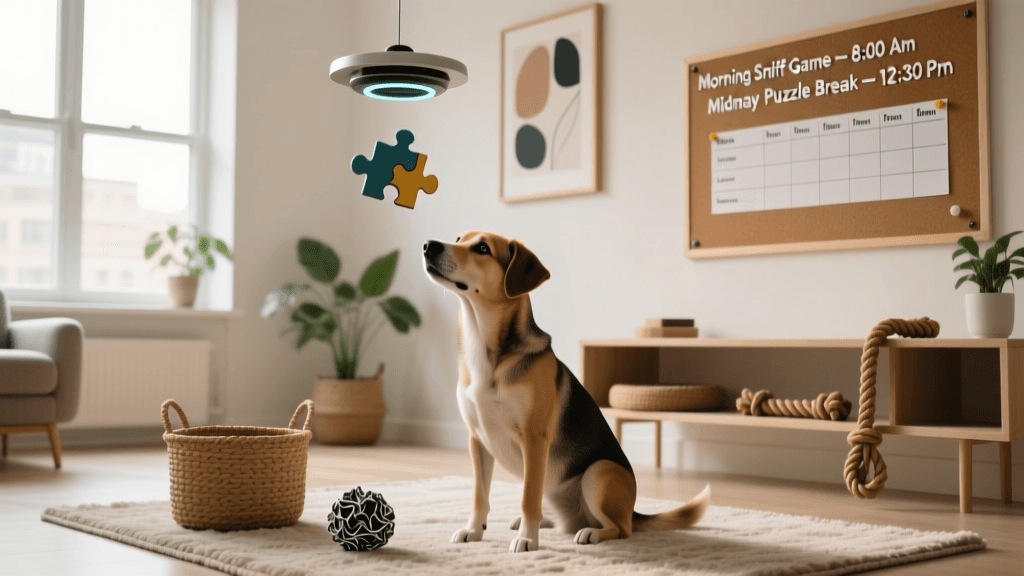
While the Furbo camera is a powerful tool, it must be paired with environmental enrichment to truly combat alone-time boredom. According to experts at Fear Free Pets, providing cognitive stimulation before and during your absence helps lower baseline cortisol levels. Before initiating your desensitization protocol, engage your dog in 15 minutes of vigorous physical exercise and 10 minutes of scent-work or puzzle-solving. A mentally and physically fatigued dog is far more likely to rest calmly while you are away, making the camera-based counter-conditioning significantly more effective.
When Behavioral Modification Requires Pharmacological Support
It is crucial to recognize that behavioral modification has its limits. If your dog's heart rate remains elevated, or if they refuse to eat the high-value treats tossed by the Furbo camera while you are gone, they are likely operating in a state of sympathetic nervous system arousal (fight-or-flight). In this state, the brain is incapable of learning or forming new positive associations. If you observe these signs after two weeks of consistent training, consult your veterinarian. In 2026, veterinary behaviorists frequently utilize a combination of SSRIs (like fluoxetine) and fast-acting situational medications (like trazodone or gabapentin) to lower the dog's anxiety threshold enough for the desensitization protocol to actually work.
Final Thoughts on Canine Alone Time
Helping your dog overcome separation anxiety is a marathon, not a sprint. The integration of smart technology like the Furbo Dog Camera into a structured, science-backed desensitization protocol offers a modern, effective pathway to healing. By respecting your dog's stress thresholds, neutralizing pre-departure triggers, and consistently pairing your absence with positive outcomes, you can help your canine companion find peace and security, even when they are home alone.
anouk-beaumont
All our authors care for dogs every day — read more of their work on the authors page.