Functional Analysis of Leash Reactivity: A Behaviorist's Guide
Discover how expert behaviorists use functional analysis to decode and modify leash reactivity in dogs using ABC tracking and threshold management.
The Science of Leash Reactivity: Beyond 'Bad Behavior'
Leash reactivity is one of the most common and frustrating challenges in modern dog ownership. However, from an expert behavior analysis perspective, reactivity is not a character flaw or a display of stubborn disobedience. It is a maladaptive coping strategy driven by underlying emotional states, typically fear, frustration, or over-arousal. When a dog barks, lunges, or snaps at the end of a leash, they are communicating that their threshold for stress has been exceeded and they lack the behavioral tools to cope with the environmental stimulus. According to the ASPCA, reactivity is often exacerbated by the physical restriction of a leash, which removes the dog's natural flight response, leaving them with a 'fight' or 'freeze' reaction.
To effectively modify this behavior, certified behaviorists move away from punitive suppression and instead utilize Functional Behavior Assessments (FBA). This empirical approach allows us to identify the precise environmental variables maintaining the reactive behavior and systematically alter them through operant and classical conditioning protocols.
The ABC Model: Decoding the Reactive Episode
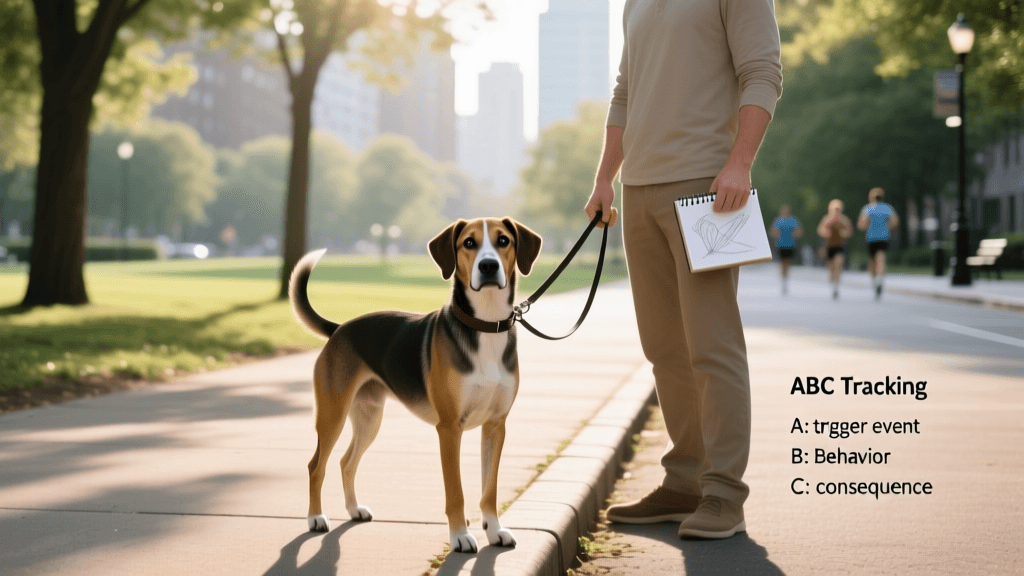
At the core of applied behavior analysis is the ABC model. Every reactive outburst is part of a three-term contingency. Understanding this sequence is critical for developing a successful modification plan.
- Antecedent (A): The environmental trigger or event that occurs immediately before the behavior. In leash reactivity, this might be the sight of an unfamiliar dog at a distance of 40 feet, or the feeling of leash tension.
- Behavior (B): The observable, measurable action the dog takes. This includes barking, piloerection (raised hackles), lunging, and snarling.
- Consequence (C): What happens immediately after the behavior. If a dog lunges and the approaching dog turns away, the consequence is an increase in distance. This negatively reinforces the lunging behavior, making it more likely to occur in the future.
By tracking these three components, we can determine the function of the behavior. Is the dog reacting to make the scary thing go away (distance-increasing)? Or are they reacting out of barrier frustration because they want to greet the other dog but the leash is holding them back (distance-decreasing)?
Conducting a Functional Assessment at Home
Before implementing a training protocol, an owner must act as a data collector. Purchase a dedicated notebook or use a spreadsheet to log every reactive episode for one week. Record the time of day, the exact antecedent, the intensity of the behavior (on a scale of 1-10), and the consequence. This data often reveals hidden patterns, such as trigger stacking or environmental sensitivities.
Behaviorist Insight: Trigger stacking occurs when multiple minor stressors accumulate over a short period, causing a dog's baseline cortisol levels to spike. A dog might ignore a bicycle in the morning, but lunge at a pedestrian in the afternoon because their 'stress bucket' is already full.
Data Table: Common Antecedents and Functional Interventions
The following table outlines how behaviorists categorize common antecedents and pair them with targeted, function-based interventions.
| Antecedent (Trigger) | Identified Behavioral Function | Expert Intervention Strategy |
|---|---|---|
| Unknown dog approaches head-on | Distance-increasing (Fear/Insecurity) | Emergency U-Turn protocol; create visual barriers using parked cars or foliage. |
| Squirrel darts up a nearby tree | Prey drive / Barrier Frustration | 'Look at That' (LAT) protocol; reinforce disengagement and eye contact with high-value food. |
| Owner tightens the leash upon seeing a trigger | Conditioned emotional response to leash pressure | Desensitize leash pressure; switch to a front-clip harness to eliminate neck tension. |
| Stranger reaches toward the dog's head | Distance-increasing (Social discomfort) | Advocate for the dog; implement the 'Petting Consent Test' and reward voluntary proximity. |
Threshold Management and Spatial Geometry
In behavior modification, working 'under threshold' is non-negotiable. If a dog is reacting, they are over threshold, and their sympathetic nervous system (fight or flight) has hijacked their brain. At this point, operant learning is biologically impossible. The American Veterinary Society of Animal Behavior (AVSAB) strongly advocates for humane, reward-based methods that prioritize the animal's emotional state over forced compliance.
Threshold management requires strict attention to spatial geometry. You must identify the exact distance at which your dog notices a trigger but remains capable of taking treats and responding to cues. For some dogs, this distance is 50 feet; for others, it may be 150 feet. Furthermore, consider the angle of approach. A dog walking parallel at a distance is often far less triggering than a dog approaching head-on. Utilize the environment to your advantage by utilizing visual barriers like brick walls, hedges, or parked vehicles to break the line of sight.
Counter-Conditioning and Desensitization (CC&D) Protocols
Once the functional assessment is complete and thresholds are mapped, we implement Counter-Conditioning and Desensitization (CC&D). The goal is to change the dog's underlying emotional response to the antecedent from 'threat' to 'predictor of good things.'
The 'Open Bar / Closed Bar' Technique
- Spot the Trigger: The moment the dog sees the trigger at a sub-threshold distance, the 'bar opens.' Begin feeding high-value treats continuously.
- Timing is Critical: Treat delivery must occur within 0.5 seconds of the dog noticing the trigger. This ensures classical conditioning pairs the sight of the trigger with the taste of the food.
- Trigger Disappears: The moment the trigger moves out of sight or turns away, the 'bar closes.' Treat delivery stops immediately.
For CC&D to be effective, the treats must possess high biological value. Standard kibble or dry biscuits are insufficient for altering deep-seated emotional responses. Utilize novel, high-value proteins such as freeze-dried beef liver, boiled chicken breast, or Ziwi Peak venison. The cost of premium treats (approximately $25-$40 per pound) is a necessary investment in your dog's behavioral rehabilitation.
Equipment Recommendations for Safety and Clarity
The tools you use dictate the clarity of your communication and the safety of your dog. Aversive equipment, such as prong collars, choke chains, or electronic shock collars, are contraindicated for reactivity. As noted by the International Association of Animal Behavior Consultants (IAABC), suppressing the outward symptoms of fear with pain or intimidation does not resolve the underlying emotional distress and often leads to 'behavioral fallout,' such as sudden, unprovoked biting without warning signs.
Essential Behavior Modification Gear
- Front-Clip Harness: The Freedom No-Pull Harness (approx. $30) or the Blue-9 Balance Harness (approx. $45) are industry standards. A front-clip attachment point gently redirects the dog's momentum toward the handler if they lunge, preventing tracheal damage and avoiding the opposition reflex triggered by neck pressure.
- Biothane Long Line: Ditch the standard 4-foot nylon lead. A 15-foot to 20-foot Biothane long line ($35-$55) provides the dog with the autonomy to explore and sniff, which naturally lowers baseline arousal levels. Biothane is waterproof, easy to clean, and does not cause rope burn if it slips through your hands.
- Treat Pouch: A high-capacity, easy-access treat pouch (like the Ruffwear Treat Trader, $35) worn on the waist ensures your hands remain free for leash management while keeping reinforcement instantly accessible.
Conclusion: Patience and Professional Guidance
Modifying leash reactivity through functional analysis is a marathon, not a sprint. It requires meticulous data tracking, strict environmental management, and unwavering consistency. Because cortisol (the primary stress hormone) can remain elevated in a dog's bloodstream for up to 72 hours after a severe reactive episode, providing your dog with 'decompression days'—where they are not exposed to any triggers and engage only in sniffing and enrichment activities—is vital for neurological recovery.
If your dog's reactivity poses a safety risk, or if you find yourself struggling to manage the ABC contingencies, seek out a certified professional. A credentialed behavior consultant can provide real-time mechanical feedback, help you accurately read canine body language, and tailor a functional modification plan that ensures safety and long-term behavioral welfare for both you and your dog.
jonas-cole
All our authors care for dogs every day — read more of their work on the authors page.