Understanding Leash Reactivity: Force-Free Methods 2026
Discover force-free, positive reinforcement methods to understand and resolve leash reactivity in dogs using the Look At That game and thresholds.
The Psychology Behind Leash Reactivity
Leash reactivity is one of the most common behavioral challenges reported by dog owners in 2026. Whether your dog barks, lunges, or whines at the sight of other dogs, strangers, or passing bicycles, the underlying emotion is rarely 'dominance' or 'stubbornness.' Instead, reactivity is a complex emotional response driven by the canine amygdala—the brain's fear and threat-detection center. When a dog feels trapped or overwhelmed by a trigger, their sympathetic nervous system initiates a fight-or-flight response.
Because the leash physically removes the 'flight' option, the dog defaults to 'fight' behaviors to increase the distance between themselves and the perceived threat. Understanding this psychological baseline is the first step in force-free training. By shifting our perspective from 'correcting bad behavior' to 'changing an emotional response,' we can utilize positive reinforcement and desensitization to help our dogs feel safe, confident, and relaxed on walks.
Identifying Your Dog's Unique Threshold
In force-free behavior modification, the concept of 'threshold' is paramount. A dog's threshold is the invisible bubble around a trigger within which they can notice the stimulus but remain under cognitive control. When a dog is sub-threshold, they can observe the trigger, take treats, and respond to cues. When a dog goes over-threshold, their prefrontal cortex (the learning center) essentially shuts down, and the amygdala takes over. At this point, no learning can occur, and offering treats or demanding obedience will be ineffective.
Recognizing early stress signals is crucial to keeping your dog sub-threshold. Before the explosive barking begins, your dog will likely display subtle calming signals or distance-increasing body language. These include:
- Lip licking or yawning when not tired
- Whale eye (showing the whites of the eyes)
- Stiffening of the body or freezing in place
- Pinned ears or a tightly clamped tail
- Refusing high-value treats they normally love
As soon as you notice these micro-signals, you must increase the distance from the trigger immediately to bring your dog back into a learning state.
Essential Force-Free Gear for 2026
Setting up your dog for success requires equipment that ensures safety without causing pain or physical restriction. In 2026, the market offers excellent, ergonomically designed force-free harnesses that prevent tracheal damage and provide secure handling.
Recommended Harnesses
The Ruffwear Front Range Harness (retailing around $45 in 2026) remains a top choice for its dual leash attachment points. The front chest ring gently redirects a pulling dog's momentum back toward the handler, while the back ring is ideal for relaxed sniffaris. For dogs with unique body shapes, the Perfect Fit Harness (approximately $75) offers a modular, three-piece custom fit that prevents chafing and escape attempts.
Treat Delivery Systems
Timing is everything in positive reinforcement. Fumbling in plastic grocery bags will ruin your training mechanics. Invest in a dedicated treat pouch like the Dog Gone Smart Pooch Pouch or the Ruffwear Treat Trader ($25-$35). These feature magnetic closures or quick-access silicone lips, allowing you to deliver rewards within the critical one-second marking window.
The Dangers of Aversive Equipment
Historically, some trainers recommended prong collars, choke chains, or electronic shock collars to 'correct' leash reactivity. Modern veterinary science strongly advises against these tools. Aversive equipment works via positive punishment—adding a painful stimulus to decrease a behavior. While it may suppress the outward barking temporarily, it does nothing to change the underlying fear. In fact, it often exacerbates the problem through 'fallout,' where the dog begins to associate the pain of the collar with the passing dog, thereby increasing their fear and aggression.
The American Veterinary Society of Animal Behavior (AVSAB) explicitly states in their position guidelines that punishment should not be used as a first-line treatment for behavior issues, noting the severe risks of worsened aggression and damaged human-animal bonds. Force-free methods prioritize the dog's emotional well-being and build trust rather than fear.
The 'Look At That' (LAT) Protocol
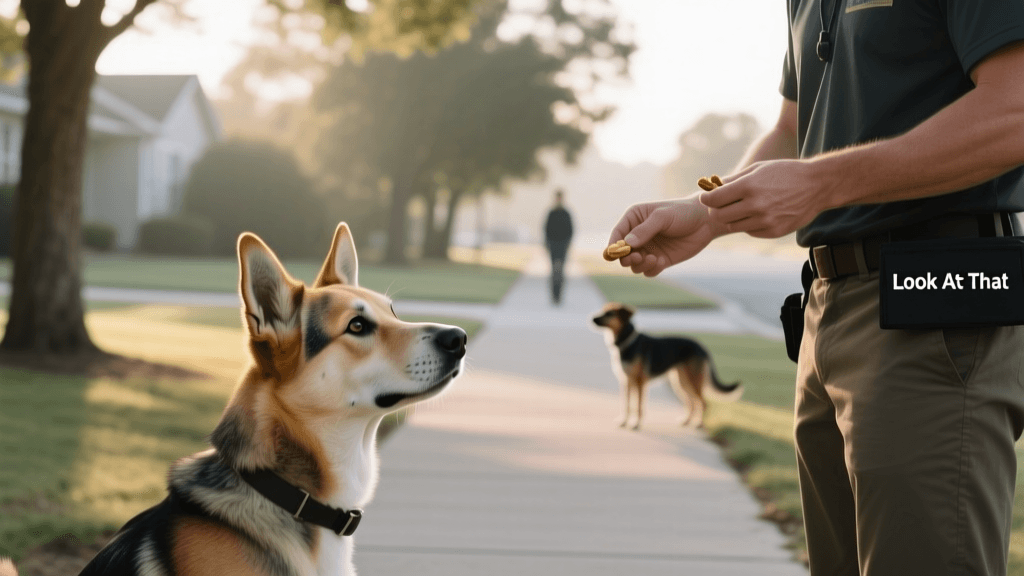
Developed by canine behavior expert Leslie McDevitt, the 'Look At That' (LAT) game is a cornerstone of force-free reactivity training. It blends classical counter-conditioning with operant behavior, teaching the dog that looking at a trigger predicts a wonderful outcome, rather than a threat.
Step 1: Setup and Baseline
Find a location where your dog can see their trigger (e.g., other dogs) but remains comfortably sub-threshold. This might be 50 yards away in a park, or sitting in a parked car. Have your clicker (such as the $8 i-Click by Karen Pryor Clicker Training) and high-value treats ready.
Step 2: Mark the Look
The moment your dog looks at the trigger, click the clicker. The click marks the exact behavior of 'looking.' Do not wait for them to bark; click while they are simply observing.
Step 3: Deliver the Reward
Immediately after the click, present a high-value treat. The dog will turn away from the trigger to get the food. This naturally breaks their fixation and reinforces the behavior of disengaging.
Step 4: Repeat and Build Positive Associations
Repeat this process. Dog looks at trigger -> Click -> Treat. Over time, the dog's emotional response shifts. Instead of thinking, 'There is a scary dog, I need to bark,' they think, 'There is a dog! That means my human is going to give me roast beef!' Eventually, the dog will begin to voluntarily look at the trigger and then immediately look back at you, expecting their reward.
Threshold Distance and Treat Value Matrix
Matching your reward value to the intensity of the environment is critical for maintaining focus. Use the matrix below to determine the appropriate treat based on your dog's distance from the trigger.
| Distance to Trigger | Dog's Cognitive State | Recommended Action | Treat Value Required | Examples (2026 Pricing) |
|---|---|---|---|---|
| Far (50+ ft) | Relaxed / Sub-Threshold | Standard LAT Game, basic obedience cues | Low to Medium | Kibble, Zuke's Mini Naturals ($12/16oz) |
| Medium (20-50 ft) | Alert / Mild Arousal | Rapid-fire LAT, scatter feeding on grass | High | Boiled chicken, string cheese, hot dogs |
| Close (Under 20 ft) | Over-Threshold / Stressed | Emergency U-Turn, create distance immediately | Jackpot / Premium | Freeze-dried beef liver ($25/bag), real meat tubes |
Troubleshooting and Long-Term Success
Behavior modification is not linear. You will experience 'extinction bursts' where the behavior temporarily worsens, or setbacks due to environmental stressors (like loud noises or bad weather). If your dog refuses a high-value treat, they are over-threshold. Do not force them to engage. Simply increase your distance, advocate for your dog by asking strangers not to approach, and end the session on a positive note.
Consistency and patience are your greatest tools. According to the ASPCA's guidelines on canine reactivity, managing the environment to prevent rehearsed reactions is just as important as the active training sessions. By utilizing force-free methods, respecting your dog's thresholds, and changing their emotional baseline through positive reinforcement, you can transform your stressful walks into enjoyable bonding experiences in 2026 and beyond.
aaron-whyte
All our authors care for dogs every day — read more of their work on the authors page.