Senior Dog Relocation: 2026 Spatial Anxiety Guide
Learn how to manage spatial anxiety and cognitive decline when relocating with a senior dog in 2026. Expert tips, safe room setups, and calming aids.
The Psychology of Spatial Anxiety in Aging Dogs
Relocating to a new home is universally recognized as one of the most stressful life events for humans, but for our canine companions, it represents a complete upheaval of their known universe. When we view this transition through the lens of the 'Understanding Your Dog' category, we must recognize that dogs experience the world primarily through olfactory mapping and spatial routines. For senior dogs—typically those aged eight and older—this disruption is magnified exponentially due to age-related cognitive changes.
As dogs age, their hippocampus, the brain region responsible for spatial memory and navigation, naturally undergoes structural changes. This can lead to a phenomenon known as spatial anxiety. In a familiar environment, a senior dog relies on a deeply ingrained 'cognitive map' to navigate around furniture, find their water bowl, and locate their sleeping area without expending significant mental energy. When you move to a new home, that map is instantly rendered obsolete. The dog is forced to build a new cognitive map while simultaneously dealing with diminished sensory acuity, such as fading eyesight or hearing loss.
According to the American Kennel Club, older dogs are also at a higher risk for Canine Cognitive Dysfunction (CCD), a condition similar to dementia in humans. A sudden change in environment can exacerbate CCD symptoms, leading to increased pacing, nighttime waking, staring at walls, and temporary forgetfulness of house-training rules. Understanding these psychological and neurological factors is the first step in ensuring a compassionate, successful transition for your aging companion.
Pre-Move Scent Mapping and Preparation
Because a dog's olfactory bulb is proportionally much larger than a human's, scent is their primary anchor to reality. In 2026, veterinary behaviorists heavily emphasize 'scent mapping' as a critical pre-move strategy for senior dogs. The goal is to transfer the familiar olfactory signature of your old home into the new environment before the dog even crosses the threshold.
Start this process at least two weeks before moving day. Do not wash your senior dog's primary bedding, crate mats, or favorite plush toys. Instead, take clean, unscented cotton cloths and gently rub them along your dog's cheeks and flanks, where they naturally secrete calming pheromones. Wipe these cloths on the baseboards, door frames, and furniture in your new home. This creates an invisible 'scent bridge' that signals to your dog's brain that this new territory is already claimed and safe.
Additionally, maintain strict adherence to your dog's daily routine in the weeks leading up to the move. Feed them at the exact same times, walk the same routes, and engage in the same low-impact enrichment activities. Predictability in routine lowers baseline cortisol levels, giving your senior dog a larger emotional buffer to handle the inevitable chaos of packing boxes and moving crews.
Designing the 2026 'Safe Haven' Room
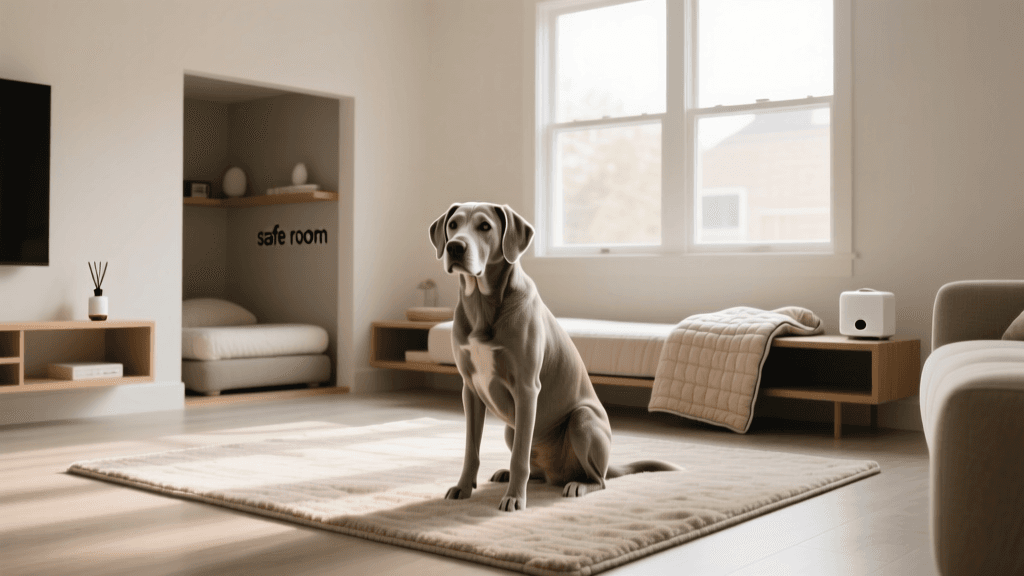
When you arrive at your new home, do not give your senior dog free roam of the house. A vast, empty, and unfamiliar space will trigger immediate sensory overload and spatial panic. Instead, designate a 'Safe Haven' room. This should be a quiet, interior room (like a spare bedroom or a large walk-in closet) measuring at least 10x10 feet, away from the street noise and the foot traffic of the moving process.
Set this room up before bringing your dog inside. Place their unwashed bed, familiar water bowl, and a few favorite toys in the exact spatial arrangement they had in your previous home. If they are used to their bed being in the corner with the water bowl two feet to the right, replicate that geometry. This spatial familiarity reduces the cognitive load required to navigate the room.
To further support their nervous system, utilize modern environmental modifications. Plug in an Adaptil Calm Home Diffuser at least 24 hours prior to their arrival. For senior dogs with diminished vision, place low-level, motion-sensor LED nightlights along the baseboards to help them navigate the room without tripping or feeling disoriented in the dark.
Comparison of Calming Aids for Senior Relocations
Managing acute stress during the physical move and the first few days in a new home often requires a multi-modal approach. Below is a comparison of highly recommended, veterinarian-approved calming interventions available in 2026, tailored specifically for the fragile physiology of senior dogs.
| Intervention | Mechanism of Action | Best For | Estimated 2026 Cost |
|---|---|---|---|
| Adaptil Calm Home Diffuser | Synthetic dog-appeasing pheromones (DAP) | General environmental anxiety and safe room setup | $55 - $65 |
| Zylkene Capsules | Alpha-casozepine (milk protein derivative) | Acute stress, travel days, and moving truck noise | $30 - $40 |
| Thundershirt Classic | Constant, gentle torso pressure | Transport anxiety and loud moving environments | $45 - $55 |
| Solliquin Soft Chews | L-theanine, Magnolia, and Phellodendron extracts | Long-term daily support for cognitive health and mild anxiety | $35 - $45 |
Note: Always consult your primary veterinarian before introducing new supplements, especially if your senior dog is currently taking NSAIDs or cardiac medications.
The First 72 Hours: A Step-by-Step Protocol
The initial three days in a new home are critical for establishing a new baseline of security. Follow this structured protocol to guide your senior dog through the transition.
Hours 1 to 12: Decompression
- Leash Guidance: Keep your dog on a short, lightweight leash when moving them from the car to the Safe Haven room. This prevents them from bolting if they are startled by a neighbor or a sudden noise.
- Low Stimulation: Keep voices low, avoid unpacking in the Safe Haven room, and limit visitors. The goal is sensory deprivation, allowing their nervous system to down-regulate.
- Frequent, Short Potty Breaks: Senior dogs may forget their house training in a new environment due to stress. Take them out on a leash every 2-3 hours to a designated, quiet spot in the new yard. Reward heavily with high-value treats (like boiled chicken or freeze-dried liver) for successful elimination.
Hours 12 to 48: Scent Exploration
- Controlled Sniffaris: Allow your dog to explore one additional room of the house at a time, always on a long line (15-foot leash). Let them sniff baseboards and corners extensively. Sniffing is a natural calming behavior that lowers a dog's heart rate.
- Scatter Feeding: Instead of feeding from a bowl, scatter their kibble or use a snuffle mat in the Safe Haven room. This engages their foraging instincts and builds positive associations with the new space.
Hours 48 to 72: Routine Integration
- Expand Boundaries: Gradually open up the rest of the house. Use baby gates to block off hazardous areas like staircases or rooms with unsecured balconies, which are particularly dangerous for senior dogs with poor depth perception.
- Re-establish Cues: Practice basic obedience cues (sit, touch, look at me) in different rooms to rebuild their confidence and reinforce your communication bond in the new environment.
Nighttime Wandering and CCD Management
Nighttime is often when spatial anxiety and Canine Cognitive Dysfunction become most apparent. In a dark, unfamiliar house, shadows and strange acoustics can confuse an aging dog, leading to pacing, whining, or getting trapped in corners. The Humane Society of the United States emphasizes the importance of creating a secure, confined sleeping area for pets during a move to prevent nighttime injuries and reduce stress.
If your senior dog is prone to nighttime wandering, do not allow them to roam the house freely at night. Set up a comfortable playpen or use baby gates to confine them to a safe, padded area adjacent to your bedroom. Being able to hear and smell you will provide immense comfort. Place a white noise machine near their bed to drown out unfamiliar neighborhood sounds, such as new traffic patterns or local wildlife. If your dog is used to sleeping in your bed, ensure you have a set of dog stairs with a non-slip surface, as aging joints and diminished spatial awareness make jumping onto unfamiliar bed heights a significant injury risk.
When to Consult a Veterinary Behaviorist
While some stress is normal during a life transition, certain behavioral red flags indicate that your senior dog is struggling to cope and requires professional intervention. If you observe any of the following signs persisting beyond the first week, contact a certified veterinary behaviorist:
- Complete refusal to eat or drink for more than 24 hours.
- Compulsive pacing or circling that prevents the dog from settling or sleeping.
- Sudden, uncharacteristic aggression or extreme fear-based reactivity toward family members.
- Getting 'stuck' in corners or behind furniture and being unable to figure out how to back up or turn around.
Life transitions are inevitable, but with a deep understanding of your senior dog's psychological needs, spatial limitations, and cognitive health, you can transform a potentially traumatic move into a smooth, supportive journey into their new home.
hannah-wickes
All our authors care for dogs every day — read more of their work on the authors page.