Force-Free Dog Nail Trimming 2026: Scratch Boards & Quiet Dremels
Discover force-free dog nail trimming methods for 2026. Learn how to use scratch boards and whisper-quiet Dremels to keep anxious pups stress-free.
The Evolution of Canine Grooming: Cooperative Care in 2026
If you share your life with a dog, you already know that nail trimming is often the most dreaded item on the grooming checklist. For decades, the standard approach involved physical restraint, towel wraps, and a battle of wills that left both dogs and humans stressed. However, as we navigate through 2026, the dog care industry has fully embraced cooperative care and positive reinforcement (R+) methodologies. Force-free grooming is no longer a niche concept; it is the gold standard for maintaining your dog's physical health and psychological well-being.
Cooperative care means giving your dog a voice in their own handling. Instead of pinning a dog down to clip their nails, we teach them to actively participate in the process. According to the Pet Professional Guild, force-free training methods significantly reduce canine anxiety, prevent the onset of defensive aggression, and build a deeper bond of trust between pet and owner. By utilizing modern tools like nail scratch boards and ultra-quiet Dremels, we can transform nail care from a traumatic event into an enriching, reward-based game.
The Hidden Stress of Traditional Nail Clipping
Traditional guillotine or scissor-style clippers require the handler to squeeze the nail before cutting. This pressure can be uncomfortable, especially if the dog has sensitive quicks or arthritis in their toe joints. Furthermore, the loud 'crunch' sound of the nail snapping can trigger a startle response in noise-sensitive breeds. When a dog is restrained for clipping, their cortisol levels spike, creating a negative emotional association with the sight of the clippers. The ASPCA notes that regular nail maintenance is vital for proper canine posture and joint health, but emphasizes that the process should be as stress-free as possible to ensure compliance and safety.
Tool Spotlight: The Nail Scratch Board
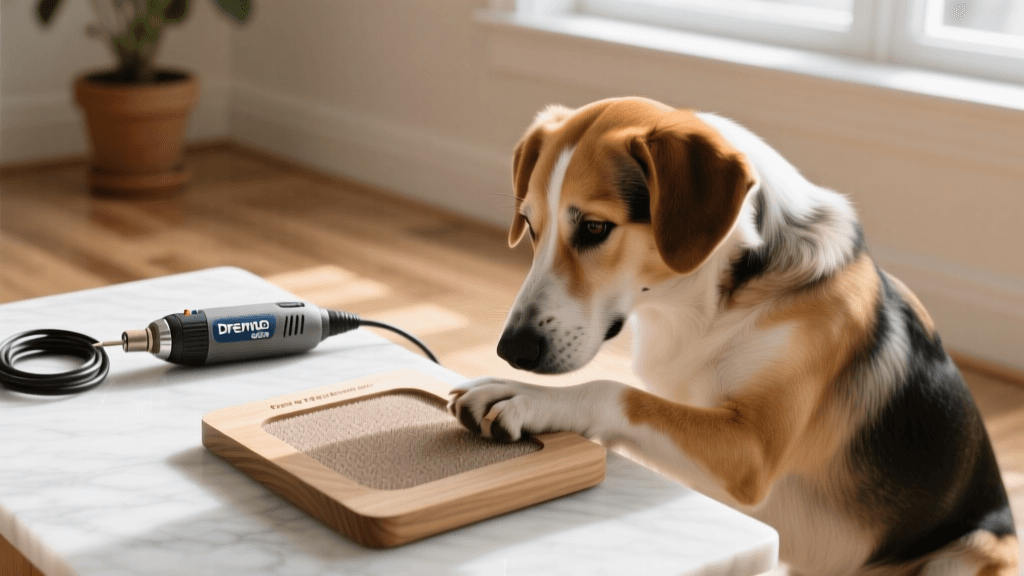
The nail scratch board is arguably the most brilliant force-free invention for canine grooming. It consists of a wooden board covered in coarse sandpaper (typically 40-grit or 60-grit). Through the magic of operant conditioning and shaping, you can teach your dog to swipe their front paws across the board, filing down their own nails while they earn high-value treats. This method completely removes the need for the handler to restrain the paw or guess where the quick ends.
Step-by-Step Scratch Board Shaping Protocol
- Step 1: Introduce the Board. Place the scratch board on the floor. The moment your dog looks at it or sniffs it, mark the behavior with a clicker or a verbal 'Yes!' and toss a treat away from the board to reset them.
- Step 2: Capture the Paw Lift. Wait for your dog to offer a paw swipe or a step onto the board. Mark and reward heavily. At this stage, any contact with the abrasive surface is a win.
- Step 3: Shape the Forward Motion. Once they are comfortable placing their paw on the board, withhold the click for simple placement and wait for a slight forward or backward dragging motion. Mark and reward the friction.
- Step 4: Add a Cue and Duration. Attach a verbal cue like 'Scratch' or 'File'. Gradually increase the number of swipes required before delivering the reward, building up to 10-15 continuous swipes per paw.
Because dogs naturally use their front paws to dig and interact with the world, scratch boards are incredibly easy to train for front nails. Hind nails, however, require a different approach, which brings us to our second tool.
Tool Spotlight: Whisper-Quiet Dremels for 2026
For hind nails, dewclaws, or dogs who prefer a different tactile sensation, rotary nail grinders (commonly referred to by the brand name Dremel) are the force-free tool of choice. In the past, the primary barrier to using Dremels was the high-pitched whine of the motor, which caused severe noise phobia in many dogs. Fortunately, the 2026 market is dominated by ultra-quiet, brushless motor pet grinders that operate at less than 45 decibels—roughly the volume of a quiet library.
Models like the latest iterations of the Dremel PawControl and the Casfuy Whisper-Quiet series feature built-in LED lights to help you spot the quick in dark nails, as well as adjustable speed dials that allow you to start at a barely perceptible vibration.
Desensitization and Counter-Conditioning (DS/CC) for Dremels
You cannot simply turn on a Dremel and touch it to a dog's nail. A successful force-free routine requires a systematic desensitization protocol over several weeks.
- Phase 1: Visual and Olfactory Introduction. Leave the turned-off Dremel on the floor next to your dog's food bowl or a lick mat. Let them investigate it on their own terms. Reward any calm interaction.
- Phase 2: Sound at a Distance. Turn the Dremel on in another room while feeding your dog high-value treats like boiled chicken or freeze-dried liver. Gradually, over multiple sessions, move closer to the dog while the Dremel is running, always ensuring the dog remains under their stress threshold.
- Phase 3: Vibration without Contact. Hold the running Dremel near the dog's paw so they can feel the subtle vibration in the air. Mark and reward calm behavior.
- Phase 4: The 'Touch and Treat'. Gently touch the side of the Dremel (not the grinding head) to the dog's nail for one second, mark, and reward. Slowly work up to using the grinding port for two-second intervals.
Comparison Chart: Force-Free Nail Care Tools
Choosing the right tool depends on your dog's temperament, nail thickness, and your training goals. Below is a comparison of the primary tools used in modern R+ grooming routines.
| Tool Type | Noise Level | R+ Compatibility | Best Used For | 2026 Est. Cost |
|---|---|---|---|---|
| Nail Scratch Board | Silent | Excellent (Dog-led) | Front nails, high-energy dogs, dogs with handling sensitivities | $15 - $35 |
| Whisper-Quiet Dremel | < 45 dB | High (Requires DS/CC) | Hind nails, dewclaws, thick/black nails, precision rounding | $25 - $60 |
| Guillotine Clippers | Silent (Loud crunch) | Low (Often requires restraint) | Not recommended for force-free or anxious dogs | $10 - $20 |
| Scissor-Style Clippers | Silent (Pressure applied) | Moderate (If dog is conditioned) | Quick maintenance on highly cooperative, desensitized dogs | $15 - $30 |
The 'Bucket Game' and High-Value Reinforcement
A core component of force-free grooming is the 'Bucket Game', a concept popularized by force-free educators that teaches dogs they have the power to pause or stop a procedure. By placing a sturdy bucket or a designated mat on the floor, you teach the dog that resting their chin on the bucket is their 'green light' for you to proceed with grooming. If the dog lifts their head or moves away, that is their 'red light,' and you must immediately stop the Dremel or scratch board session.
This autonomy drastically reduces anxiety. According to the Fear Free initiative, giving pets a sense of control over their environment and handling is the most effective way to prevent fear, anxiety, and stress (FAS) during veterinary and grooming procedures.
Selecting the Right Reinforcers
Dry kibble will not cut it for nail trimming. You need high-value, long-lasting reinforcers that keep the dog in a stationary position and promote licking, which naturally releases endorphins and soothes the canine nervous system.
- Frozen Lick Mats: Spread plain, dog-safe Greek yogurt or pureed pumpkin on a silicone lick mat and freeze it overnight. The cold temperature provides soothing relief, and the act of licking keeps the dog's head anchored in one place.
- Bone Broth Popsicles: Freeze low-sodium, onion-free beef or chicken bone broth in ice cube trays. These are excellent for quick resets between paws.
- Scent Work Rewards: For dogs who are more motivated by sniffing than eating, scatter a handful of treats in a snuffle mat on the floor while you work on their hind legs with the Dremel.
Conclusion: Patience Pays Off
Transitioning to a force-free nail trimming routine in 2026 is an investment in your dog's long-term emotional health. While it may take a few weeks to shape a solid scratch board behavior or desensitize your pup to a Dremel, the payoff is a lifetime of stress-free grooming sessions. By utilizing scratch boards, whisper-quiet grinders, and cooperative care protocols like the Bucket Game, you are not just maintaining your dog's nails—you are actively building their confidence, respecting their boundaries, and proving that you are a trusted partner in their care. Ditch the restraints, grab some high-value treats, and let your dog take the lead in their own grooming journey.
anouk-beaumont
All our authors care for dogs every day — read more of their work on the authors page.