Case Study: Fixing Severe Canine Resource Guarding
Discover how we cured severe resource guarding in a rescue dog. Read our step-by-step behavior case study with actionable training protocols and tips.

Introduction to Resource Guarding in Dogs
Resource guarding is a natural but potentially dangerous survival instinct where a dog exhibits aggressive or defensive behaviors to protect valued items such as food, toys, bones, or even specific people and locations. While this behavior is rooted in evolutionary biology, it is entirely unacceptable and unsafe in a modern domestic environment. According to the ASPCA's guide on resource guarding, dogs exhibit this behavior primarily out of fear of losing a valued item, and addressing it requires a structured, empathy-driven approach rather than punitive measures.
In this comprehensive behavior case study, we will break down the rehabilitation of 'Buster,' a 3-year-old Labrador Retriever mix who exhibited severe food and bone guarding. We will detail the exact desensitization and counter-conditioning (DSCC) protocols, environmental management strategies, specific product recommendations, and the timeline that led to his full recovery. Whether you are a professional trainer or a dedicated dog owner, this case study provides actionable, measurable steps to modify guarding behavior safely.
Case Study Background: Meet Buster
Buster was adopted from a local shelter at two years of age. Within the first month, his new owners noticed severe guarding behaviors. If a person walked within 10 feet of Buster while he was eating his standard kibble, he would freeze, exhibit 'whale eye' (showing the whites of his eyes), and emit a low, rumbling growl. If the person continued to approach, Buster would snap and lunge. The behavior escalated to high-value items like raw meaty bones and bully sticks, where his threshold distance increased to 15 feet, and his reaction time was nearly instantaneous.
A veterinary exam ruled out any underlying pain or medical conditions, confirming that the behavior was purely rooted in anxiety and learned defensive conditioning. Our goal was to change Buster's emotional response from 'I must protect this' to 'A human approaching means something even better is coming.'
Phase 1: Environmental Management and Safety
Before any active training could begin, we had to implement strict management protocols to prevent Buster from rehearsing the guarding behavior. Every time a dog successfully guards an item and the human backs away, the dog's brain reinforces that aggression works. To break this cycle, we introduced the following safety measures:
- Muzzle Conditioning: We spent two weeks acclimating Buster to a Baskerville Ultra Muzzle (Cost: $22.00). Using a smear of peanut butter inside the muzzle, we built a positive association so he would voluntarily place his snout inside. This allowed us to safely manage the environment during the initial phases of training.
- Physical Barriers: Buster was fed his meals inside a closed exercise pen (x-pen) in the corner of the kitchen. Humans were strictly instructed never to approach the pen while he was eating.
- High-Value Item Removal: All bones, antlers, and long-lasting chews were removed from the home temporarily. High-value treats were only given during controlled training sessions.
Phase 2: Desensitization and Counter-Conditioning (DSCC)
The core of Buster's rehabilitation relied on Desensitization and Counter-Conditioning (DSCC). The objective was to expose Buster to his trigger (a human approaching) at a sub-threshold distance while simultaneously providing a high-value reward. Timing is critical in this protocol; the reward must be delivered within 0.5 seconds of the dog noticing the trigger.
The Setup and Treat Selection
We used a 10-foot Biothane long line (Cost: $25.00) to give Buster freedom while maintaining control. For the counter-conditioning reward, we utilized Stewart Pro-Treat Freeze-Dried Beef Liver (Cost: $14.00), broken into 1/4-inch cubes. The liver was high-value enough to override his desire to guard his standard kibble.
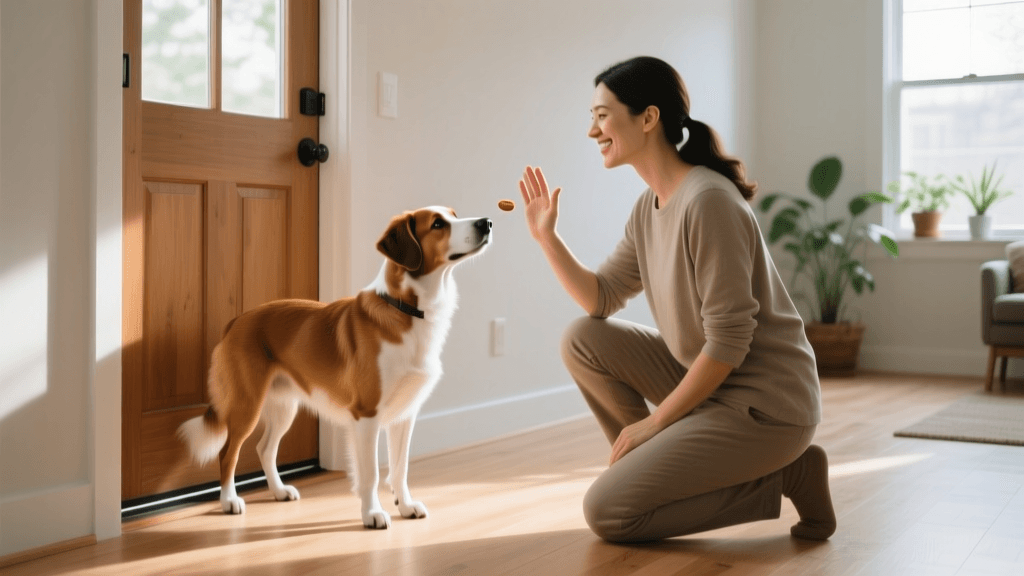
Training sessions were kept strictly to 15 minutes, twice daily, to prevent cognitive fatigue and frustration. The handler would stand at Buster's threshold distance, take one step forward, and immediately toss a piece of liver to Buster, then retreat. This 'approach, toss, retreat' pattern was repeated 20 times per session.
Progress Tracking: Buster's 8-Week Data Table
Tracking data is essential in behavior modification to ensure the dog is actually progressing and not just tolerating the trigger. Below is the structured data log from Buster's 8-week DSCC protocol.
| Week | Starting Distance | Trigger Action | Buster's Response | Intervention & Adjustment |
|---|---|---|---|---|
| 1-2 | 15 Feet | Handler takes 1 step forward | Alert, ears forward, no growling | Toss liver, retreat. Maintain 15ft distance. |
| 3-4 | 10 Feet | Handler walks parallel to food bowl | Relaxed body, wagging tail, eats liver | Decrease distance by 2ft. Introduce 'treat and retreat'. |
| 5-6 | 5 Feet | Handler approaches and drops treat in bowl | Steps back from bowl, looks at handler | Approach, drop high-value treat, walk away immediately. |
| 7-8 | 2 Feet | Handler stands next to bowl, hand-feeds kibble | Sits politely, makes eye contact, no tension | Transition to hand-feeding 50% of daily meals. |
Phase 3: The 'Trade-Up' Protocol
Once Buster was comfortable with humans approaching his standard food bowl, we needed to address high-value items like bones. Punishing a dog for growling over a bone is incredibly dangerous; as the American Kennel Club (AKC) emphasizes, punishment only suppresses the warning signs, leading to a dog that bites without any prior vocalization. Instead, we utilized the 'Trade-Up' game.
Trainer's Note: Never forcefully take an item from a guarding dog's mouth. This destroys trust and escalates aggression. Always trade for an item of significantly higher value.
We introduced a Kong Classic (Cost: $16.00) stuffed with canned pumpkin, plain yogurt, and a dash of low-sodium chicken broth, frozen solid for 4 hours. When Buster was given a low-value chew (like a standard dental stick), the handler would approach with the frozen Kong. The moment Buster dropped the dental stick to investigate the Kong, the handler picked up the dental stick, gave Buster the Kong, and then immediately gave the dental stick back. This taught Buster that giving up an item doesn't mean it's gone forever; it means a 'deposit' is being made into his trust account.
Cost Breakdown and Equipment List
Behavior modification does not necessarily require expensive gadgets, but it does require the right tools. Here is the exact equipment list and cost breakdown used during Buster's 8-week rehabilitation:
- Baskerville Ultra Muzzle (Size 4): $22.00
- Kong Classic (Large, Red): $16.00
- Stewart Pro-Treat Freeze-Dried Beef Liver (5.5 oz): $14.00
- 10-Foot Biothane Long Line: $25.00
- Total Initial Investment: $77.00
Compared to the cost of private behaviorist consultations (which can range from $150 to $300 per hour) or potential veterinary bills from a dog bite incident, this $77.00 investment in proper management and high-value conditioning tools is exceptionally cost-effective.
Long-Term Maintenance and Final Results
By the end of the 8-week protocol, Buster's behavior had transformed completely. He no longer exhibited whale eye, freezing, or growling when humans approached his food bowl. In fact, he began to associate human proximity with the arrival of premium treats, resulting in a relaxed, wagging posture. However, it is vital to understand that resource guarding is a managed behavior, not always 'cured' in the traditional sense.
Buster's owners were instructed to maintain the 'approach and drop a treat' exercise at least twice a week for the rest of his life to prevent spontaneous recovery of the guarding behavior. They were also taught to never leave high-value bones unattended with Buster if children were in the home, ensuring environmental management remained a pillar of their long-term safety strategy. Through patience, precise timing, and a commitment to positive reinforcement, severe resource guarding can be successfully modified, ensuring a safe and harmonious household for both humans and canines.
robin-maitland
All our authors care for dogs every day — read more of their work on the authors page.