Solving First-Week Puppy Sleep and Potty Crises Fast
Struggling with puppy sleep and potty accidents? Diagnose common first-week crises and apply proven solutions, schedules, and gear for a peaceful night.
The First 72 Hours: Diagnosing the 'Puppy Blues'
Bringing a new puppy home is widely celebrated as a joyous milestone, but the reality of the first 72 hours often triggers a phenomenon known as the 'puppy blues.' New owners frequently find themselves severely sleep-deprived, frustrated by constant potty accidents, and questioning their decision to adopt. The clash between the expectation of cuddling a serene pup and the reality of managing a crying, teething, and confused animal can be overwhelming. However, these early crises are not signs of a 'broken' dog; they are predictable developmental hurdles. By shifting into a problem-diagnosis mindset, you can systematically dismantle these challenges. This guide breaks down the three most common first-week crises—midnight potty loops, crate distress, and daytime surface confusion—and provides actionable, product-specific solutions to restore peace to your home.
Problem 1: The Midnight Potty Loop and Sleep Deprivation
Diagnosis
The most exhausting issue new owners face is the midnight potty loop. You take the puppy out at 2:00 AM, they eliminate, and you bring them inside. Ten minutes later, they are crying again. This happens because puppies have incredibly small bladders and lack the neurological maturity to signal a 'full' bladder until the very last second. Furthermore, the overstimulation of waking up, walking outside, and experiencing the cool night air often causes them to eliminate in stages rather than all at once. When owners turn on bright lights or engage in play during these midnight trips, the puppy's circadian rhythm becomes fractured, leading to chronic sleep disruption for the entire household.
Solutions & Gear
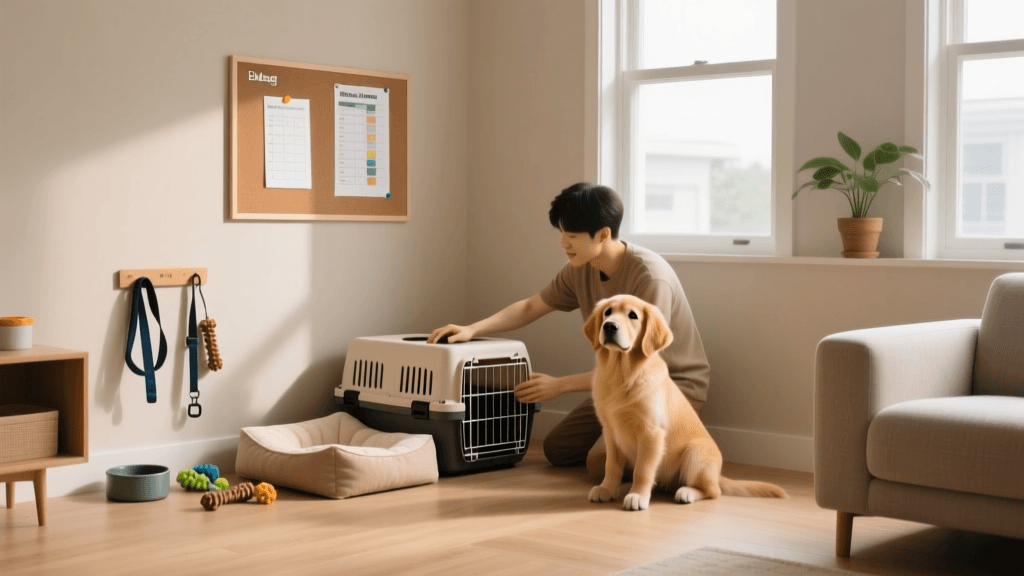
To solve the midnight loop, you must enforce a strict, low-stimulation bathroom protocol. First, invest in a properly sized crate with an adjustable divider, such as the MidWest Homes for Pets iCrate (Approx. $50-$70). For a small breed, a 24x18x19-inch crate is ideal; for a medium breed, opt for 36x23x25 inches. The divider is crucial: a puppy will naturally avoid soiling their sleeping area, but if the crate is too large, they will designate one corner as a bathroom and the other for sleeping. Adjust the divider so the puppy has just enough room to stand up, turn around, and lie down.
During night trips, keep the lights off and use a dim flashlight. Do not speak to the puppy or make eye contact. Use a consistent verbal cue like 'go potty,' wait for them to finish, offer a single high-value treat (like a freeze-dried liver bite), and immediately return them to the crate. If they cry ten minutes later, wait 15 minutes before taking them out again to teach them that crying does not yield instant playtime. According to the American Kennel Club (AKC), maintaining a boring, transactional atmosphere during night trips is essential for teaching puppies to sleep through the night.
Problem 2: Incessant Crate Crying and Separation Distress
Diagnosis
For the first few nights, a puppy is experiencing profound isolation. They have been ripped away from the warmth, scent, and heartbeat of their littermates and mother. When placed in a wire crate in a dark room, their instinctual survival alarm triggers, resulting in hours of whining, howling, or scratching. Owners often misdiagnose this as 'stubbornness' or a dislike of the crate, leading them to either let the puppy into their bed (which ruins crate training) or yell at the puppy (which increases anxiety).
Solutions & Gear
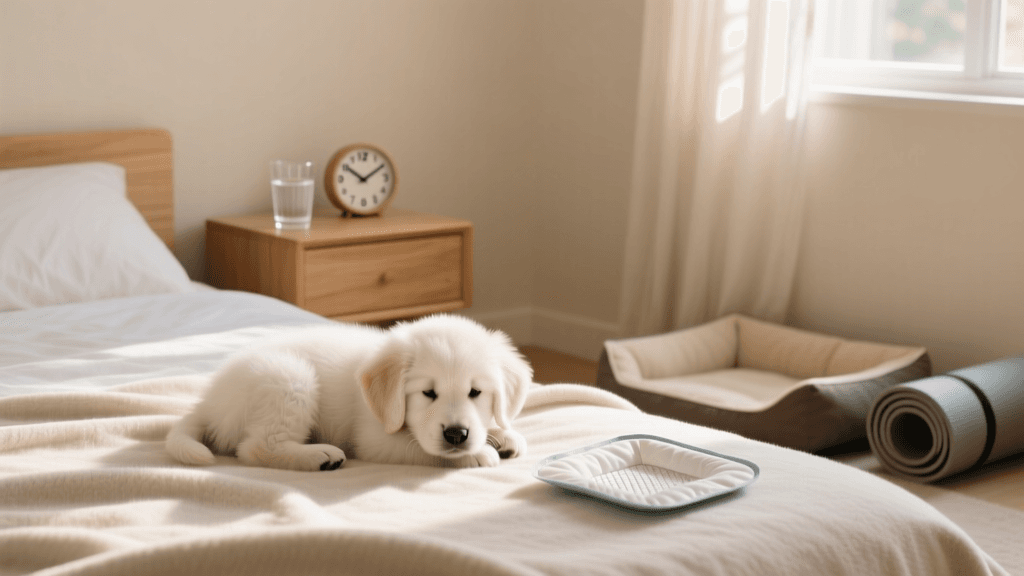
The solution requires simulating the litter environment while maintaining boundaries. You need to address both tactile and auditory deprivation. Purchase a behavioral aid toy like the SmartPetLove Snuggle Puppy (Approx. $40-$45). This plush toy features a pocket for a disposable heat pack and a battery-operated mechanical heart that mimics the physical sensation of a sleeping mother. Place this toy in the back of the crate to give the puppy a comforting anchor.
Additionally, drape a breathable, dark blanket over the top and three sides of the crate to create a den-like atmosphere, which naturally lowers a dog's cortisol levels. You can also use a white noise machine or a ticking analog clock wrapped in a towel to drown out startling household noises. The ASPCA strongly recommends making the crate a positive, den-like space by feeding the puppy their meals inside it with the door open during the day, ensuring they do not associate the crate solely with nighttime isolation.
Problem 3: Daytime Potty Accidents and Surface Confusion
Diagnosis
Daytime accidents often stem from 'surface confusion' and improper cleanup. Puppies are tactile learners; if they urinate on a soft rug once, they will continually return to that texture. A major culprit in recurring accidents is the use of standard household cleaners. Products containing ammonia (like many glass and floor cleaners) actually mimic the scent of urine to a dog's sensitive nose, essentially inviting them to re-mark the spot. Furthermore, owners often give puppies too much freedom too soon, allowing them to wander into hallways and sneak in an accident unnoticed.
Solutions & Gear
First, eliminate surface confusion by rolling up all non-essential area rugs for the first month. When accidents inevitably happen, you must use an enzymatic cleaner specifically designed to break down uric acid crystals. Nature's Miracle Advanced Stain and Odor Eliminator (Approx. $15-$20) is a reliable choice. You must soak the area thoroughly and allow it to air dry; blotting is not enough to reach the subfloor where the scent lingers.
Second, implement 'umbilical cord training' or tethering. Use a lightweight 4-foot nylon leash to attach the puppy to your belt loop or a heavy piece of furniture in the same room as you. This prevents them from sneaking off to have an accident. To build a proactive communication system, hang a set of potty bells, such as the Mighty Paw Smart Bell 2.0 (Approx. $25), on the doorknob you use for potty breaks. Every time you take the puppy outside, gently guide their nose or paw to ring the bell before opening the door. Within a week, most puppies will ring the bell independently to signal their need to go out.
The First-Week Survival Schedule
Puppies thrive on predictability. Below is a diagnostic table to help you set realistic expectations for bladder capacity and schedule intervals based on your puppy's age. Remember the general rule of thumb: a puppy can hold their bladder for roughly one hour per month of age, plus one.
| Puppy Age | Max Bladder Hold Time | Nighttime Alarm Interval | Recommended Crate Size |
|---|---|---|---|
| 8 Weeks | 2 to 3 Hours | Every 2.5 Hours | 24' L x 18' W (with divider) |
| 10 Weeks | 3 to 4 Hours | Every 3.5 Hours | 24' L x 18' W (with divider) |
| 12 Weeks | 4 to 5 Hours | Every 4.5 Hours | 30' L x 21' W (with divider) |
According to the Humane Society of the United States, consistency in scheduling and positive reinforcement are the absolute cornerstones of successful house training. Punishing a puppy for accidents after the fact only creates fear and confusion, teaching them to hide from you when they need to eliminate rather than teaching them where to go.
Overcoming the Psychological Hurdle
Diagnosing and solving these physical problems is only half the battle; managing your own psychological response is the other. The 'puppy blues' are a documented period of grief, stress, and exhaustion that affects a vast majority of new dog owners. It is vital to recognize that your puppy is not acting out of spite. They are essentially infants navigating a completely alien world with entirely different biological imperatives.
Give yourself grace and establish a tag-team system with your partner or family members to ensure everyone gets at least one uninterrupted four-hour block of sleep per night. Keep a journal of your puppy's potty times to identify patterns; you will likely notice they need to go exactly 15 minutes after eating or 20 minutes after a vigorous play session. By treating the first week as a data-gathering mission rather than a test of obedience, you remove the emotional frustration from the equation. Stick to the schedule, utilize the right gear, and remember that this chaotic phase is temporary. Within a few short weeks, the midnight loops will cease, the crate will become a beloved sanctuary, and your bond will solidify into the lifelong companionship you envisioned.
robin-maitland
All our authors care for dogs every day — read more of their work on the authors page.