Diagnosing and Solving Common First-Week Dog Stress Signs
Discover how to diagnose and solve common first-week dog stress signs. Learn actionable tips for potty regression, hiding, and appetite loss.

The Reality of the First Week: Understanding Decompression Stress
Bringing a new dog home is an exhilarating milestone, but the first seven days often present unexpected behavioral hurdles. Many new owners expect immediate bonding and flawless manners, only to be met with hiding, potty accidents, or a refusal to eat. This phenomenon is rooted in decompression stress. According to the ASPCA, dogs transitioning to a new environment undergo a psychological adjustment period widely known as the 3-3-3 rule: three days to decompress, three weeks to learn your routine, and three months to truly feel at home.
During the first 72 hours, a dog's nervous system is in overdrive. Elevated cortisol levels can trigger a host of frustrating behaviors. By shifting your perspective from 'my dog is being bad' to 'my dog is overwhelmed,' you can accurately diagnose these first-week problems and implement targeted, compassionate solutions. Below, we break down the three most common first-week adjustment problems and provide precise, actionable remedies.
Problem 1: Appetite Loss and Refusal to Eat
Diagnosis: Stress-Induced Anorexia vs. Medical Issue
It is incredibly common for a newly adopted dog to skip their first few meals. Stress suppresses the digestive system and dulls the appetite. However, you must differentiate between stress-induced anorexia and an underlying medical condition. If your dog is alert, drinking water, and shows interest in high-value treats (like boiled chicken or freeze-dried liver) but turns their nose up at kibble, the issue is likely environmental stress. If they refuse all food, are lethargic, or show signs of vomiting, consult a veterinarian immediately.
Solution: The 15-Minute Rule and High-Value Lures
Do not resort to free-feeding (leaving a bowl out all day) to compensate for missed meals, as this destroys your ability to establish a potty schedule. Instead, implement the 15-Minute Rule:
- Step 1: Offer the meal in a quiet, low-traffic room. Turn your back or leave the room entirely; some dogs are too intimidated to eat while being watched.
- Step 2: After exactly 15 minutes, pick the bowl up, regardless of whether they ate. Store it in the fridge and offer it again at the next scheduled mealtime.
- Step 3: Enhance the aroma. Dogs rely heavily on their sense of smell. Warm wet food or kibble mixed with a tablespoon of low-sodium chicken bone broth to approximately 101°F (use a $15 digital food thermometer to check). This mimics the body temperature of fresh prey and releases volatile aromas that stimulate appetite.
- Step 4: Add a probiotic topper like Purina Pro Plan FortiFlora (approx. $1.50 per packet). The strong, meaty flavor entices picky eaters, while the beneficial bacteria help settle a stress-upset stomach.
Problem 2: Potty Training Regression and Indoor Accidents
Diagnosis: Anxiety Marking vs. Incomplete Training
Even fully house-trained adult dogs may have accidents during their first week. The American Kennel Club notes that changes in environment, diet, and routine frequently cause temporary potty regression. You must diagnose the type of accident: submissive urination (happens when you greet them or lean over them), anxiety marking (small amounts on vertical surfaces), or simple lack of a routine (large puddles on rugs).
Solution: Enzymatic Neutralization and Umbilical Tethering
To solve first-week potty regression, you must manage the environment and eliminate olfactory triggers.
- Enzymatic Cleaning: Standard household cleaners do not break down uric acid crystals. Use an enzymatic cleaner like Nature's Miracle Advanced Stain & Odor Eliminator (approx. $12 for a 32oz bottle). Critical Timing: You must saturate the area and allow it to dwell for a full 10 minutes before wiping. If you wipe it immediately, the enzymes do not have time to destroy the odor molecules, and the dog will return to the same spot.
- Avoid Ammonia: Never clean accidents with ammonia-based products. Urine contains ammonia, and these cleaners will actually signal to your dog that the spot is an approved bathroom.
- Umbilical Tethering: For the first five days, keep the dog attached to you. Use a 4-foot nylon leash clipped to a hands-free waist belt. This prevents them from wandering into another room to have an accident and allows you to read their subtle pre-potty signals (sniffing, circling, pacing) so you can immediately redirect them outside.
Problem 3: Hiding, Pacing, and Nighttime Whining
Diagnosis: Overstimulation and Lack of a Safe Zone
A dog that paces incessantly, hides under furniture, or whines through the night is experiencing sensory overload. They have not yet identified a 'safe zone' where they can lower their guard. Punishing a dog for whining or dragging them out from under a bed will only spike their cortisol levels and deepen their anxiety.
Solution: Pheromones, White Noise, and Crate Sizing
Create a sensory-deprivation retreat that mimics a den environment.
- Pheromone Therapy: Plug in an Adaptil Optimum Diffuser (approx. $25 for a starter kit) in the room where the dog sleeps. This device releases a synthetic copy of the dog-appeasing pheromone (DAP), which covers up to 700 square feet and clinically proven to reduce signs of stress and improve sleep quality.
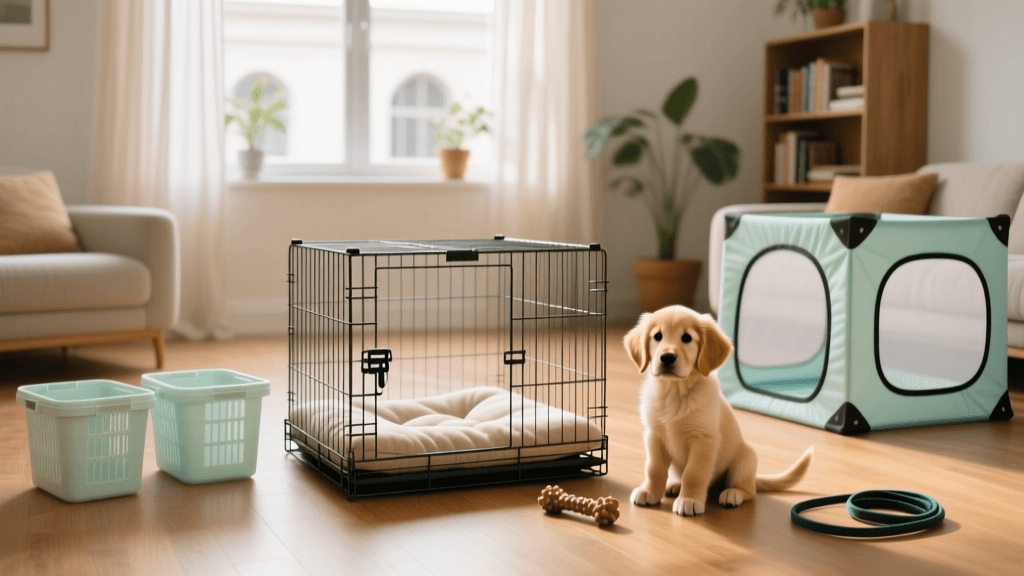
- Proper Crate Dimensions: If you are using a crate, size matters. A MidWest Homes for Pets iCrate (approx. $60) is an excellent choice because it includes a divider panel. The crate should be large enough for the dog to stand up, turn around, and lie down comfortably—but no larger. If the crate is too big, the dog may pace inside it or designate one corner for sleeping and the other for eliminating.
- Acoustic Masking: New environments are full of terrifying, unfamiliar sounds (creaking floorboards, distant traffic, neighborhood dogs). Place a white noise machine or a box fan near the crate to create a consistent acoustic blanket that masks sudden noises.
Diagnostic Chart: Stress Behaviors vs. Medical Red Flags
It is vital to distinguish between normal adjustment stress and symptoms that require immediate veterinary intervention. Use this chart to evaluate your dog's first-week behaviors.
| Symptom | Likely Stress Cause | Medical Red Flag (Vet Needed) |
|---|---|---|
| Refusal to eat | Overstimulation, new environment anxiety | Vomiting, lethargy, diarrhea lasting >24 hours |
| Indoor urination | Submissive peeing, anxiety marking | Straining to urinate, blood in urine, frequent small amounts (UTI) |
| Hiding / Pacing | Decompression, lack of safe space | Aggression when approached, extreme panting, trembling |
| Nighttime whining | Isolation distress, unfamiliar sounds | Coughing, labored breathing, signs of physical pain |
Your First-Week Action Plan
Structure is the antidote to anxiety. Follow this timeline to help your new dog decompress safely:
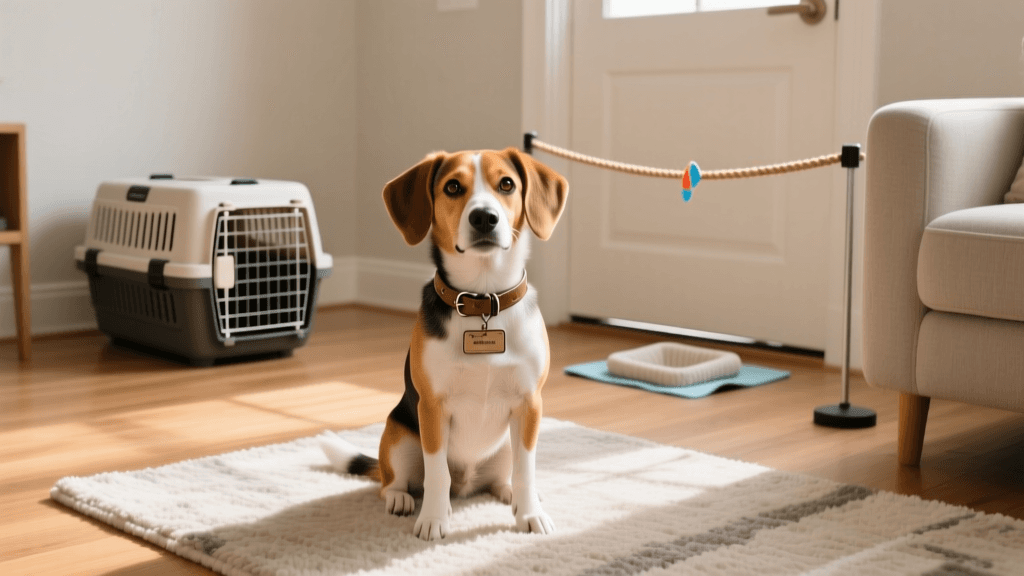
- Days 1-2 (The Quiet Phase): Limit house access to one or two rooms using baby gates. Keep interactions calm and quiet. Absolutely no visitors or trips to busy pet stores.
- Days 3-4 (Routine Building): Establish strict feeding, walking, and potty schedules. Introduce the crate as a positive retreat using high-value treats like a Kong stuffed with frozen peanut butter.
- Days 5-7 (Boundary Setting): Begin short, 3-to-5 minute training sessions focusing on basic cues like 'sit' and 'look at me' to build confidence, communication, and trust.
When to Call the Vet or a Behaviorist
While the 3-3-3 rule provides a general framework, every dog is an individual. If your dog exhibits severe resource guarding, unprovoked aggression, or self-mutilation (like chewing their own paws raw), do not wait out the three weeks. The American Veterinary Medical Association (AVMA) recommends consulting your veterinarian to rule out pain-induced behavioral changes, followed by a referral to a certified veterinary behaviorist. Early intervention is the key to a successful, lifelong bond with your new companion.
jonas-cole
All our authors care for dogs every day — read more of their work on the authors page.