Step-by-Step First-Week Training for Your New Rescue Dog
Master your newly adopted dog's first week with this step-by-step training guide. Learn crate, potty, and boundary basics for a smooth transition.
Welcome Home: Navigating the First Week With Your New Dog
Bringing a newly adopted dog into your home is a thrilling milestone, but the first seven days are critical for setting the foundation of your lifelong relationship. Whether you have adopted a young puppy or an adult rescue, the transition from a shelter or foster environment to a permanent home can be overwhelming. According to the ASPCA, shelter dogs often experience significant stress during their initial relocation, making structured, patient, and step-by-step training essential for their emotional and behavioral well-being.
Many new owners make the mistake of expecting their new dog to inherently understand household rules. In reality, dogs thrive on predictability. This comprehensive, step-by-step first-week training guide focuses on the three pillars of early dog ownership: crate training, potty conditioning, and establishing household boundaries. By following this actionable roadmap, you will minimize accidents, reduce separation anxiety, and help your new companion decompress safely.
Understanding the 3-3-3 Rule of Rescue Dogs
Before diving into the physical steps of training, it is vital to understand the psychological timeline of a newly adopted dog, commonly known as the 3-3-3 Rule:
- 3 Days: Your dog is decompressing. They may sleep excessively, hide, or refuse to eat. Do not force training; focus on quiet bonding and establishing a safe space.
- 3 Weeks: Your dog begins to understand your routine. Their true personality starts to emerge, and minor behavioral issues may surface. This is the prime window for foundational obedience.
- 3 Months: Your dog finally feels at home. Trust is established, and they recognize your house as their permanent territory.
During the first week, your primary goal is not to teach complex tricks like 'roll over' or 'play dead.' Your goal is to teach the dog where to sleep, where to eliminate, and what areas of the house are off-limits.
Step 1: Crate Training for Safety and Decompression
The crate is not a punishment; it is a den. Proper crate training provides your dog with a secure sanctuary and is the most effective tool for preventing destructive behavior when you cannot supervise them. The Humane Society of the United States emphasizes that a properly sized crate taps into a dog's natural instinct to keep their sleeping area clean, which directly aids in potty training.
Selecting and Sizing the Crate
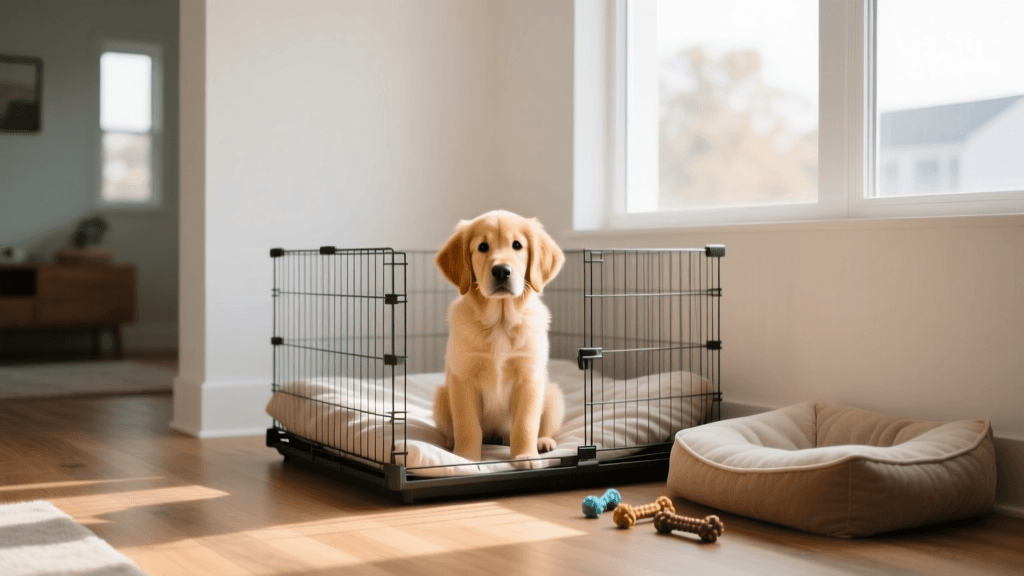
A wire crate, such as the MidWest Homes for Pets iCrate, is highly recommended for the first week because it allows the dog to observe their surroundings while remaining contained. Sizing is critical. The crate should be large enough for the dog to stand up, turn around, and lie down comfortably, but no larger. If you adopt a puppy, purchase a crate with a wire divider panel. If the space is too large, the dog may eliminate in one corner and sleep in the other, completely undermining your potty training efforts.
Step-by-Step Crate Introduction
- Location: Place the crate in a high-traffic area like the living room during the day, and move it to your bedroom at night so the dog does not feel isolated.
- Positive Association: Feed all meals inside the crate. Toss high-value treats (like freeze-dried liver or small pieces of boiled chicken) into the back of the crate to encourage voluntary entry.
- The Kong Method: Stuff a classic rubber Kong toy with peanut butter and kibble, then freeze it. Give this to your dog only when they enter the crate. This creates a positive, long-lasting distraction that builds a strong affinity for the space.
- Duration: Start with 5-minute intervals while you are in the room, gradually increasing to 30 minutes, and eventually leaving the room. Never let the dog out while they are barking or whining, as this rewards the vocalization.
Step 2: Establishing a Foolproof Potty Routine
House soiling is the number one reason dogs are surrendered to shelters. According to the American Kennel Club (AKC), consistency and supervision are the ultimate keys to successful potty training. You must manage the environment so the dog simply does not have the opportunity to make a mistake.
The Biological Clock
For puppies, the general rule of thumb is they can hold their bladder for one hour per month of age (e.g., a 3-month-old puppy can hold it for 3 hours). For adult rescue dogs, their bladder control may be compromised by stress or previous neglect. For the first week, assume your dog has zero bladder control and take them out every 1 to 2 hours.
Step-by-Step Potty Protocol
- The Leash Rule: Always take your dog out on a 6-foot leash, even if you have a fenced yard. This keeps them focused on the task at hand rather than wandering and sniffing aimlessly.
- The Command: Use a specific cue phrase like 'Go potty' in a calm, encouraging tone while they are in the act. Once they finish, immediately reward them with a high-value treat and enthusiastic praise within three seconds.
- The 15-Minute Rule: If they do not eliminate after 5 minutes outside, bring them back inside and place them immediately in their crate. Wait 15 minutes, then try again. Do not allow them to roam the house freely until they have emptied their bladder.
- Accident Cleanup: Never use ammonia-based cleaners. Use a bio-enzymatic cleaner like Nature's Miracle Advanced Stain and Odor Eliminator. Enzymatic cleaners break down the uric acid crystals that standard household cleaners leave behind, preventing the dog from returning to the same spot to mark again.
Step 3: Setting Household Boundaries With the Tether Method
Allowing a new dog full, unsupervised access to your entire house is a recipe for chewed baseboards and ruined rugs. During the first week, you must strictly manage their spatial awareness using physical barriers and the 'umbilical cord' tethering method.
Strategic Gating
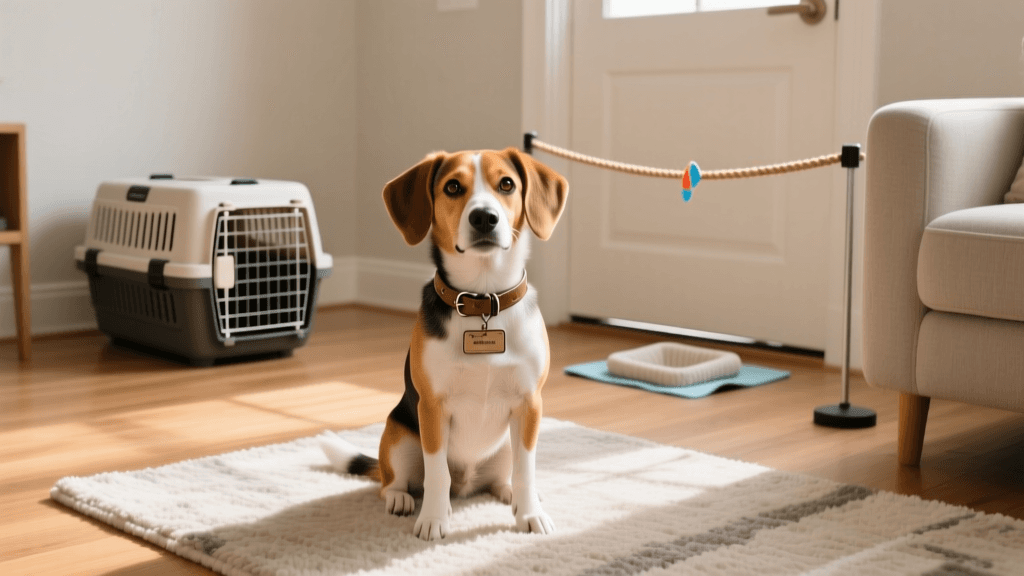
Invest in pressure-mounted baby gates, such as the Regalo Easy Step Walk Thru Gate. Block off high-risk areas like kitchens, formal living rooms, or staircases. Limit your dog's first-week access to a single 'home base' room (like a tiled kitchen or a gated-off living room section) where you spend the majority of your time.
The Umbilical Cord Tethering Technique
When you are home but cannot give the dog 100% of your attention (e.g., cooking, working on a laptop), attach a 4-foot to 6-foot lightweight leash to your belt loop or loop it around the leg of your heavy desk. This is known as tethering. It prevents the dog from sneaking off to chew on shoes or have a hidden potty accident, and it teaches them how to settle calmly at your feet. Pair this with a comfortable, washable dog bed and reward them with a treat whenever they voluntarily lie down on their bed while tethered.
The First-Week Daily Training Schedule
Dogs thrive on routine. Below is a structured daily schedule designed to balance physical exercise, mental enrichment, potty breaks, and mandatory decompression time. Stick to this schedule as closely as possible for the first seven days.
| Time | Activity | Training Focus |
|---|---|---|
| 7:00 AM | Wake up, immediate potty break | Leashed potty, reward for elimination |
| 7:30 AM | Breakfast inside the crate | Crate conditioning, positive association |
| 8:00 AM | 15-minute sniff walk or yard play | Decompression, leash walking basics |
| 8:30 AM | Crate nap (2-3 hours) | Enforced rest, bladder control |
| 11:30 AM | Potty break, followed by tethering | Settling on a mat, boundary training |
| 1:00 PM | Lunch / Puzzle toy (if applicable) | Mental stimulation, quiet time |
| 2:00 PM | Crate nap (2-3 hours) | Enforced rest |
| 5:00 PM | Potty break, structured training | Teaching 'Sit', 'Watch Me', and recall |
| 6:00 PM | Dinner inside the crate | Crate conditioning |
| 6:30 PM | Evening walk / sniffari | Bonding, environmental exposure |
| 8:00 PM | Free time (supervised) / Chewing | Appropriate chew toy redirection |
| 10:00 PM | Final potty break, crate for the night | Nighttime bladder control |
Essential First-Week Training Gear Checklist
To execute this step-by-step plan effectively, ensure you have the following specific items prepared before your dog crosses the threshold of your home:
- Wire Crate with Divider Panel: MidWest iCrate (Approx. $50 - $70). Ensure the length is 2 to 4 inches longer than your dog's nose-to-tail-base measurement.
- Enzymatic Cleaner: Nature's Miracle Advanced or Rocco & Roxie Professional Strength (Approx. $20). Buy the gallon jug; you will use it.
- Pressure-Mounted Baby Gates: Regalo or Summer Infant (Approx. $30 each). Buy at least two to create a designated 'safe zone'.
- 6-Foot Leather or Biothane Leash: Avoid retractable leashes entirely during the first week, as they teach the dog that pulling yields more freedom.
- Interactive Food Toys: 2 Classic Kong Toys (Medium or Large depending on breed size) for crate conditioning.
- Long Tether Line: A lightweight 10-foot cotton training lead for indoor umbilical tethering.
Final Thoughts on Patience and Consistency
The first week with a newly adopted dog is as much about training the human as it is about training the dog. You will likely face sleep deprivation, minor accidents, and moments of frustration. Remember that your dog is navigating a massive environmental shift. By strictly adhering to this step-by-step crate, potty, and boundary protocol, you are not restricting your dog; you are providing them with the clear, predictable communication they desperately need to feel safe. Stay consistent, utilize your management tools, and celebrate the small victories as your new best friend settles into their forever home.
jonas-cole
All our authors care for dogs every day — read more of their work on the authors page.