First-Time Puppy Essentials: Home Prep & Day One Guide
Discover essential home prep tips and a complete first-day checklist for first-time puppy owners, including costs, crate sizes, and safety proofing.
Welcome to Puppy Parenthood: Setting the Stage
Bringing a new puppy into your home for the first time is an exhilarating milestone, but it can also feel incredibly overwhelming. As a first-time dog owner, the transition from a quiet, predictable household to one filled with tiny paws, sharp teeth, and unpredictable potty breaks requires careful preparation. The key to a smooth transition lies not in buying every gadget in the pet store, but in strategic home preparation, establishing a safe zone, and sticking to a predictable day-one routine. This comprehensive guide will walk you through the exact measurements, costs, and actionable steps you need to take before your puppy ever crosses your threshold.
The Journey Home: Safety in the Car
Your first day as a dog owner actually begins in the car. Never allow a new puppy to roam freely in your vehicle or sit on a passenger's lap. The stress of leaving their littermates combined with the motion of the car frequently leads to anxiety and car sickness. Instead, secure a hard-sided plastic airline crate or a well-ventilated soft carrier in the back seat using a seatbelt threaded through the handle. Line the carrier with an absorbent puppy pad and a familiar-smelling blanket. Keep the car cool, play soft music, and drive smoothly to minimize motion sickness. If the drive is longer than two hours, plan for a brief, secure potty break in a quiet, low-traffic grassy area.
Puppy-Proofing Your Home: A Room-by-Room Guide
Puppies explore the world with their mouths, making your home a potential minefield of hazards. Get down on your hands and knees to view your living space from a puppy's perspective. Secure all loose electrical cords using split loom wire tubing or cord concealers. Move toxic houseplants out of reach; consult the ASPCA's Toxic and Non-Toxic Plants list to ensure species like Sago Palms, Lilies, and Aloe Vera are completely removed from your home and yard.
Securing the Perimeter
Invest in hardware-mounted baby gates rather than pressure-mounted ones, which a determined medium-to-large breed puppy can easily topple. The Carlson Pet Products Walk-Thru Gate (approximately $45) is an excellent choice, standing 30 inches tall to prevent early jumping attempts. Ensure that all household cleaning supplies, medications, and small choking hazards (like coins, children's toys, and socks) are locked in cabinets equipped with child-proof latches. Apply a pet-safe bitter apple spray to wooden baseboards and furniture legs to deter destructive chewing during the teething phase.
Setting Up the 'Puppy Safe Zone'
First-time owners often make the mistake of giving a new puppy free reign of the entire house. This leads to potty accidents and overwhelming anxiety. Instead, create a designated 'Safe Zone' using a wire crate and an attached exercise pen. This mimics the den-like environment puppies crave and drastically accelerates house training.
Crate and Playpen Measurements
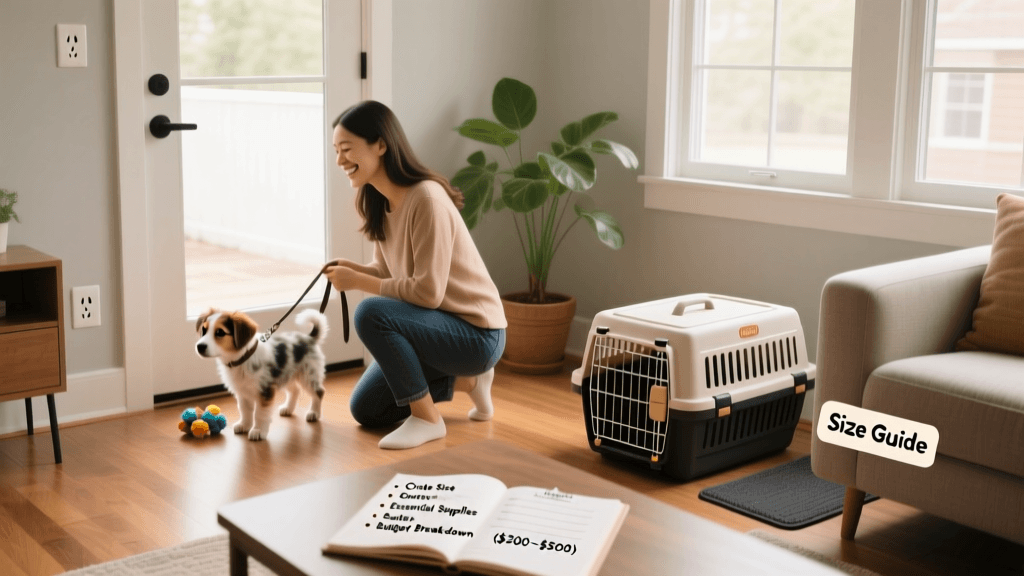
- Crate Sizing: The crate should be large enough for the puppy to stand up, turn around, and lie down, but no larger. If you buy a crate for their adult size, use the included divider panel. A good rule of thumb is the adult dog's expected length (nose to tail base) plus 4 inches, and height (floor to top of head) plus 4 inches. The MidWest iCrate Double Door ($50-$70) is an industry standard.
- Playpen Dimensions: Attach a metal exercise pen to the crate door to create a play area. For small breeds, a 4x4 foot pen is sufficient. For medium and large breeds, opt for a 4x8 foot configuration (approximately $60) to allow room for a designated potty pad area far from their sleeping and eating zones.
The Ultimate First-Day Puppy Shopping Checklist
It is easy to overspend on unnecessary accessories. Focus your budget on high-quality essentials that promote safety, hygiene, and positive behavioral development. Below is a structured breakdown of what you actually need for day one.
| Item Category | Estimated Cost | Recommended Brand/Type | Why It Matters |
|---|---|---|---|
| Enzymatic Cleaner | $15 - $25 | Nature's Miracle Advanced | Standard cleaners leave uric acid traces that encourage repeat potty accidents. Enzymes destroy the scent entirely. |
| Chew Toys | $15 - $30 | KONG Classic (Red or Black) | Provides a safe, durable outlet for natural chewing instincts and can be stuffed with food for mental enrichment. |
| Harness & Leash | $25 - $45 | Rabbitgoo No-Pull Harness | Protects a puppy's delicate trachea from the pressure of a collar while teaching loose-leash walking. |
| High-Quality Kibble | $40 - $60 | Purina Pro Plan Puppy | Provides the precise calcium-to-phosphorus ratio required for healthy bone and joint development in growing dogs. |
| Stainless Steel Bowls | $10 - $20 | Simple modern weighted bowls | Prevents bacterial buildup (like puppy acne) commonly caused by porous plastic bowls. |
The First 24 Hours: Timing and Routine
Dogs thrive on predictability. Your first day should be heavily structured around a timer to establish good habits and prevent accidents. According to the Humane Society's Puppy Care Tips, young puppies have incredibly small bladders and require frequent, supervised outings.
Hour-by-Hour Day One Timeline
- Arrival (Hour 1): Immediately carry the puppy outside to their designated potty spot the moment you arrive home. Wait patiently for up to 15 minutes. Reward heavily with a high-value treat and verbal praise the second they eliminate. Then, allow them to explore their Safe Zone.
- Decompression (Hour 2): Puppies need 18 to 20 hours of sleep a day. The excitement of the move will quickly lead to a crash. Place them in their crate with a snuggle puppy toy (which mimics a heartbeat) and let them nap undisturbed.
- First Meal (Hour 3): Feed the exact same food the breeder or shelter was using to avoid gastrointestinal upset. Measure the food precisely according to the bag's weight guidelines. Remove the water bowl two hours before bedtime to help them sleep through the night.
- Evening Routine (Hours 4-6): Engage in gentle, short play sessions (5-10 minutes max) using the KONG toy. Avoid roughhousing, which can encourage biting. Take them outside every two hours, and immediately after every meal, nap, or play session.
- Nighttime (Sleep): Place the crate in your bedroom so the puppy can hear and smell you. Set an alarm for 3:00 AM to take them out for a quick, boring, business-only potty break. Do not turn on bright lights or play with them during night outings.
Authoritative Resources and Next Steps
The first week is about survival, bonding, and establishing a baseline of trust. Within 48 hours of bringing your puppy home, you must schedule a wellness exam with a licensed veterinarian. As outlined in the AKC's First-Time Puppy Owner Guide, this initial visit is critical for establishing a vaccination schedule, discussing parasite prevention, and checking for congenital health issues.
Patience is your most valuable tool. Your puppy is not giving you a hard time; they are having a hard time adjusting to a completely alien world. Consistency, positive reinforcement, and a safe environment will build the foundation for a lifetime of companionship.
By focusing on thorough home preparation, investing in the right foundational gear, and sticking to a rigid day-one schedule, you will bypass the most common pitfalls of first-time dog ownership. Take a deep breath, prepare your safe zone, and get ready to welcome your new best friend home.
robin-maitland
All our authors care for dogs every day — read more of their work on the authors page.