The First-Time Owner Guide to Puppy Crate Training
Master puppy crate training with our first-time owner guide. Learn schedules, crate sizing, and actionable tips for a stress-free experience.
Welcome to Puppy Parenthood: The Importance of Crate Training
Bringing a new puppy home is one of the most exciting milestones in life, but it can also be incredibly overwhelming for a first-time owner. Between the potty accidents, the chewed-up shoes, and the sleepless nights, you might find yourself wondering how to instill good habits while keeping your new furry friend safe. This is where crate training becomes your most valuable tool. According to the Humane Society of the United States, a crate provides a safe, secure den for your dog and is one of the most effective methods for accelerating housebreaking and preventing destructive behavior when you cannot supervise them.
However, crate training is not about locking your dog away as a punishment; it is about creating a positive, stress-free sanctuary. In this comprehensive first-time owner guide, we will walk you through the exact steps, product recommendations, and schedules you need to successfully crate train your puppy.
Choosing the Right Crate: Sizes, Types, and Costs
Before you begin training, you need the right equipment. Buying the wrong crate can lead to potty training setbacks and anxiety. Here is a breakdown of the most common crate types for puppies:
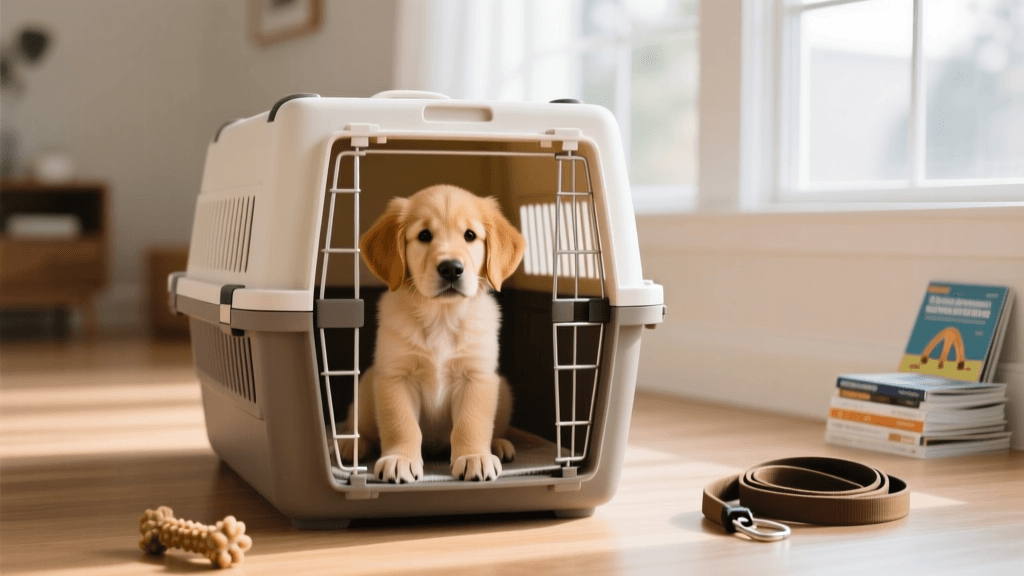
- Wire Crates (Recommended for Puppies): Wire crates offer excellent visibility and ventilation. They typically come with a divider panel, which is crucial for puppies. Product Recommendation: The MidWest Homes for Pets iCrate (approx. $45-$70) is a staple for first-time owners because the adjustable divider allows you to expand the space as your puppy grows.
- Plastic/Airline Crates: These provide a more enclosed, den-like feel and are required for air travel. However, they lack a divider panel, meaning you would need to buy multiple sizes as your puppy grows. Product Recommendation: Petmate Sky Kennel (approx. $50-$90).
- Soft-Sided Crates: Avoid these for puppies. Puppies are teething and will easily chew through the mesh, creating an escape hazard and a potential choking risk.
The Golden Rule of Crate Sizing
A puppy's crate should be just large enough for them to stand up without their head hitting the top, turn around comfortably, and lie down stretched out. If the crate is too large, your puppy may designate one corner for sleeping and the opposite corner for eliminating, completely defeating the purpose of using the crate for potty training. Always use the included divider panel to block off excess space in a wire crate until your puppy reaches their adult size.
Setting Up the Crate Environment
Location and comfort are vital for building a positive association with the crate.
- Location: Place the crate in a high-traffic area like the living room or kitchen during the day so your puppy does not feel isolated. At night, move it to your bedroom or just outside your door so they can hear and smell you, which reduces nighttime separation anxiety.
- Bedding: First-time owners often make the mistake of buying plush, expensive dog beds, only for the puppy to shred them. Start with a durable, chew-resistant option like Drymate Washable Pads or tightly woven Vetbed. Once your puppy outgrows the destructive chewing phase (usually around 6-9 months), you can introduce softer bedding.
- Enrichment: Always provide a safe, engaging toy when crating. The KONG Classic (approx. $12-$18) stuffed with a small amount of dog-safe peanut butter or plain yogurt and frozen is an excellent tool to keep your puppy occupied and create a positive association with entering the crate.
The 5-Step Puppy Crate Training Method
Patience is your greatest asset here. The American Kennel Club emphasizes that crate training should be a gradual process driven by positive reinforcement. Never force your puppy into the crate or use it as a timeout for bad behavior.
Step 1: The Introduction (Days 1-3)
Leave the crate door open and toss high-value, low-calorie treats like Zuke's Mini Naturals (approx. $8 for a 16oz bag, 3 calories per treat) inside. Let the puppy go in, eat the treat, and immediately come out. Repeat this 10-15 times a day. Feed them their regular meals near the crate, gradually moving the food bowl further inside.
Step 2: Closing the Door (Days 4-7)
Once your puppy comfortably walks in to eat their meals, gently close the door while they eat. Open it the moment they finish. Gradually increase the time the door remains closed after the meal by 1-minute increments. If they whine, wait for a brief moment of silence before opening the door so you do not reward the vocalization.
Step 3: Short Absences (Week 2)
Give your puppy a frozen KONG, close the door, and sit in the same room but out of their direct line of sight. Start with 5 minutes and work your way up to 20 minutes. This teaches them that being alone in the crate is temporary and safe.
Step 4: Leaving the Room (Week 3)
Begin leaving the house for very short errands (15-30 minutes). Do not make a big emotional fuss when you leave or return. Keep departures and arrivals incredibly boring to prevent triggering separation anxiety.
Step 5: Overnight Crating
Keep the crate near your bed. Set an alarm to take them out for a potty break in the middle of the night. As their bladder capacity increases, you will be able to phase out these nighttime alarms.
Puppy Crate Training Schedule and Bladder Capacity
One of the most common mistakes first-time owners make is expecting a young puppy to hold their bladder for an 8-hour workday. Puppies physically cannot do this. A general rule of thumb is that a puppy can hold their bladder for one hour per month of age, plus one. Below is a realistic daytime crating schedule based on developmental stages:
| Puppy Age | Maximum Daytime Crate Time | Overnight Expectation | Potty Break Frequency |
|---|---|---|---|
| 8-10 Weeks | 1 to 2 Hours | Requires 1-2 potty breaks | Every 1-2 hours |
| 11-14 Weeks | 3 to 4 Hours | Requires 1 potty break | Every 2-3 hours |
| 15-16 Weeks | 4 to 5 Hours | May sleep 6-7 hours | Every 3-4 hours |
| 17+ Weeks | 5 to 6 Hours | Can sleep 8 hours | Every 4-5 hours |
Note: If you work outside the home for 8+ hours a day, you must hire a dog walker, use a pet sitter, or come home during your lunch break to let the puppy out. Leaving an 8-week-old puppy in a crate for 8 hours is not only impossible for their bladder but is considered animal cruelty by organizations like the ASPCA.
Troubleshooting Common Crate Training Issues
Issue 1: The Puppy Won't Stop Whining
If you are certain your puppy does not need to potty (e.g., they just went 20 minutes ago) and they are whining, do not let them out. Releasing a whining puppy teaches them that making noise is the key to freedom. Instead, wait for a 10-second pause in the whining, then open the door. If the whining is relentless, cover the crate with a breathable blanket to reduce visual stimulation, which often calms them down.
Issue 2: Potty Accidents Inside the Crate
Accidents happen, especially if the crate is too large or the puppy was left inside longer than their bladder capacity allows. If this occurs, remove the puppy immediately and take them outside. Clean the crate thoroughly with an enzymatic cleaner like Nature's Miracle Advanced Stain and Odor Eliminator (approx. $15). Standard household cleaners do not break down the uric acid crystals, meaning your puppy will still smell the urine and be inclined to soil the same spot again.
Issue 3: Biting the Crate Bars
Bar biting is usually a sign of frustration or boredom. Ensure your puppy is getting adequate physical exercise and mental stimulation before being crated. A tired puppy is a quiet puppy. Provide a safe chew toy, like a Nylabone Puppy Chew, to redirect their oral fixation away from the metal bars, which can damage their teeth and gums.
Final Thoughts for First-Time Owners
Crate training requires consistency, empathy, and a well-stocked treat pouch. Remember that your puppy is a baby learning the rules of a completely foreign world. Celebrate the small victories, stick to a strict potty schedule, and always make the crate a place of comfort rather than confinement. Within a few weeks of dedicated practice, your puppy will likely start walking into their crate voluntarily to take a nap, giving you both the peace of mind you deserve.
beth-carrasco
All our authors care for dogs every day — read more of their work on the authors page.