First-Time Owner Guide: Daily Puppy Routine & Potty Schedule
Discover how to establish a successful daily routine and potty training schedule for your new puppy. Essential tips and timelines for first-time owners.
Welcome to Dog Ownership: The Power of a Predictable Routine
Bringing a new puppy into your home is one of the most exciting milestones in life, but it can quickly become overwhelming for first-time dog owners. Between the endless potty breaks, the chewing, the crying, and the sheer exhaustion, many new owners wonder if they have made a mistake. The secret to surviving and thriving during these early months is not magic; it is a strict, predictable daily routine. Dogs are creatures of habit, and puppies, in particular, rely on structure to feel safe and secure. When a puppy knows what to expect next, their anxiety decreases, and their ability to learn increases exponentially. In this comprehensive first-time owner guide, we will break down exactly how to establish a daily routine and potty schedule that sets your new companion up for lifelong success.
The Foundation of Puppyhood: Why Routines Matter
According to the ASPCA, puppies thrive in environments where their basic needs are met on a consistent schedule. A routine helps regulate their digestive system, making potty training significantly easier. It also helps manage their energy levels, preventing the overtiredness that often leads to destructive behavior and nipping. Think of your puppy's routine as the scaffolding that supports their physical and emotional development. By controlling their environment and their schedule, you are proactively preventing behavioral issues rather than reacting to them after they occur. A predictable schedule also builds a deep bond of trust between you and your dog, as they learn to rely on you for their care and leadership.
A First-Time Owner’s Blueprint: The Daily Schedule
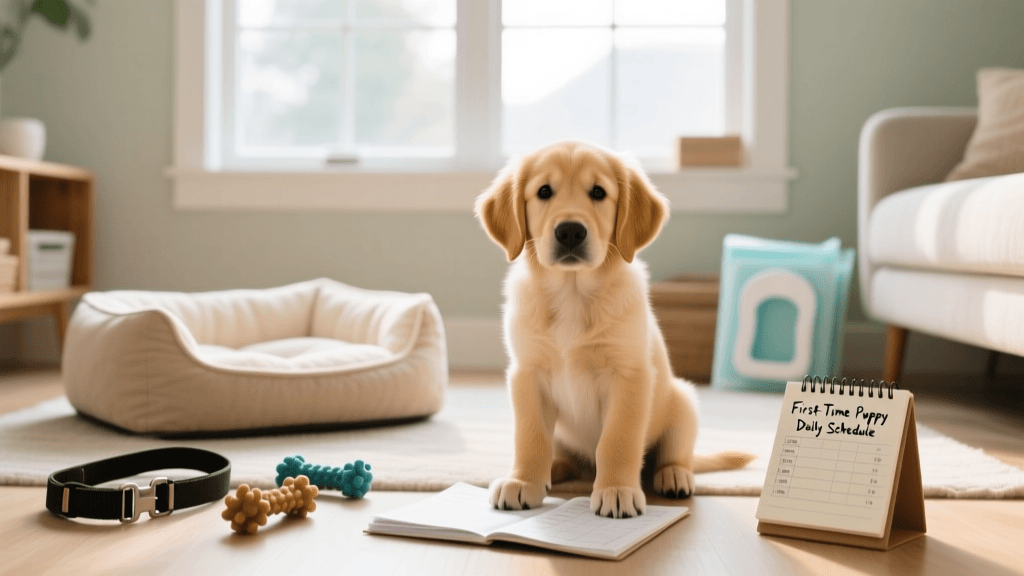
An eight-to-twelve-week-old puppy requires a schedule that revolves around three main activities: eating, pottying, and sleeping. Puppies this age need up to 18 to 20 hours of sleep per day. Here is a sample daily schedule tailored for a young puppy:
- 7:00 AM - Wake Up & Potty: Carry the puppy outside immediately to avoid accidents on the way. Use a consistent cue word like "go potty" and reward with a high-value treat immediately after they finish.
- 7:15 AM - Breakfast: Serve a high-quality puppy food, such as Purina Pro Plan Puppy or Royal Canin Puppy, measured precisely according to the package guidelines based on your dog's projected adult weight.
- 7:45 AM - Post-Meal Potty & Play: Take them out again. Follow this with 15 minutes of gentle play or basic training (like teaching them to sit or look at you).
- 8:30 AM - Morning Nap: Place the puppy in their crate for an enforced nap. Puppies rarely put themselves to sleep and will fight exhaustion until they become cranky.
- 10:30 AM - Wake, Potty & Socialize: Another potty break followed by a short socialization session or a sniffari in the yard.
- 11:30 AM - Mid-Day Nap: Back to the crate for rest.
- 1:00 PM - Lunch & Potty: Puppies under six months generally require three meals a day. Serve lunch, followed by a potty break.
- 1:30 PM - Afternoon Nap: Crate time.
- 3:30 PM - Wake, Potty & Training: Keep training sessions short (5-10 minutes) to maintain their focus.
- 4:30 PM - Late Afternoon Nap: Crate time to recharge before the evening.
- 6:00 PM - Dinner & Potty: The final meal of the day. Remove the food bowl after 15 minutes to establish a strict feeding schedule.
- 8:00 PM - Water Curfew: Pick up the water bowl to help your puppy sleep through the night without needing a potty break.
- 9:30 PM - Final Potty & Bedtime: A quiet, boring potty break, then straight into the crate for the night.
Potty Training: The Age-to-Bladder Capacity Chart
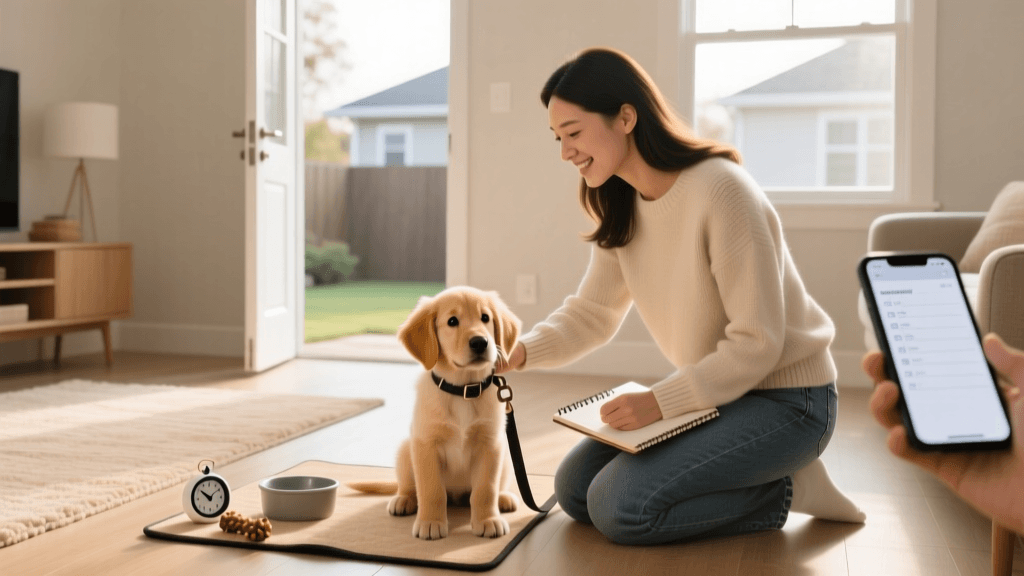
Potty training is often the most stressful aspect for first-time owners. The American Kennel Club (AKC) emphasizes that consistency, supervision, and positive reinforcement are the cornerstones of successful housebreaking. You must take your puppy out after every transition: waking up, eating, drinking, and playing. Understanding their physical limitations is crucial to setting realistic expectations. Below is a general guide to a puppy's bladder capacity based on their age.
| Puppy Age | Maximum Bladder Capacity | Recommended Potty Break Frequency |
|---|---|---|
| 2 Months (8 Weeks) | 2 Hours | Every 1 to 2 Hours |
| 3 Months (12 Weeks) | 3 Hours | Every 2 Hours |
| 4 Months (16 Weeks) | 4 Hours | Every 3 Hours |
| 6 Months (24 Weeks) | 6 Hours | Every 4 to 6 Hours |
Note: These are maximum capacities. During active play or immediately after meals, puppies will need to go out much more frequently.
Essential Gear for Routine Success
To execute this routine effectively, you need the right tools. Budget approximately $150 to $250 for these foundational items:
- The Crate: A wire crate like the MidWest Homes for Pets iCrate (approx. $45-$60) is ideal because it allows visibility and airflow. Buy one with a divider panel so you can adjust the size as your puppy grows. The crate should only be large enough for them to stand up, turn around, and lie down comfortably.
- Enzymatic Cleaner: Accidents will happen. Standard household cleaners do not break down uric acid crystals, meaning your puppy will still smell the accident and return to the same spot. Invest in Nature's Miracle Advanced Stain & Odor Remover (approx. $12-$15) to completely eliminate the scent.
- Long Training Lead: A 15-foot lightweight cotton or biothane leash, such as the Mendota Pets Slip Lead or a basic Amazon Basics long line (approx. $15-$20), allows you to give your puppy freedom in the yard while maintaining control for potty training and recall practice.
- High-Value Treats: For potty training rewards, use something irresistible. Zuke's Mini Naturals or freeze-dried beef liver (approx. $8-$12) are perfect because they are small, low-calorie, and highly motivating.
Navigating the Evening "Witching Hour"
First-time owners are often caught off guard by the "witching hour," a period typically occurring between 5:00 PM and 8:00 PM where puppies become hyperactive, bite aggressively, and exhibit the "zoomies." This behavior is usually a combination of pent-up energy and extreme overtiredness. To manage this, anticipate the witching hour and provide a constructive outlet. Prepare a KONG Classic toy stuffed with plain pumpkin puree, plain yogurt, and kibble, then freeze it solid. Handing your puppy this frozen treat at 5:00 PM will give them a calming, mentally stimulating activity that satisfies their need to chew while naturally lowering their heart rate. If the biting persists, it is a clear sign your puppy is overtired and needs an enforced nap in their crate immediately.
Crate Training: The Key to Enforced Naps
The Humane Society of the United States notes that a crate is not a punishment, but a safe den that aids in housebreaking and keeps your puppy safe when unsupervised. To build a positive association with the crate, feed all meals inside it with the door open. Toss high-value treats into the back of the crate and praise your puppy when they enter voluntarily. When it is time for a nap, place the puppy in the crate, cover it with a breathable blanket to reduce visual stimulation, and turn on a white noise machine. Expect some crying during the first few days; this is a normal protest to a new boundary. As long as you are certain they do not need to potty, allow them to self-soothe. Giving in to the crying teaches the puppy that vocalizing results in freedom, which will severely hinder your routine.
Adjusting the Routine as Your Dog Grows
As your puppy matures, their routine will naturally evolve. Around the six-month mark, you will transition from three meals a day to two meals a day (typically morning and early evening). Their bladder capacity will increase, allowing for longer stretches between potty breaks and longer periods of awake time. However, the foundational structure of the routine—eating at the same times, sleeping in a designated safe space, and engaging in structured training—should remain a permanent fixture in your shared life. Consistency in these early months builds the reliable, well-mannered adult dog you have always dreamed of. Remember, patience and repetition are your greatest tools as a first-time owner.
anouk-beaumont
All our authors care for dogs every day — read more of their work on the authors page.