The Ultimate First-Time Puppy Schedule and Potty Guide
Master your first-time puppy schedule with our step-by-step daily routine, potty training timeline, and essential tips for a smooth transition home.
Welcome Home: Setting Up Your Puppy for Success
Bringing a new puppy home is one of the most exciting milestones in life, but it can quickly become overwhelming for first-time dog owners. Between the midnight whining, the unexpected puddles on the rug, and the razor-sharp puppy teeth, many new owners find themselves wondering if they are doing things right. The secret to surviving and thriving during these early months is establishing a predictable, consistent daily routine. Puppies thrive on structure. When they know what to expect and when to expect it, their anxiety decreases, and their ability to learn skyrockets. This comprehensive guide will walk you through the ultimate first-time puppy schedule, focusing heavily on potty training, enforced naps, and managing the chaotic moments of early dog ownership.
The Science Behind a Puppy's Bladder
Before diving into the daily schedule, it is crucial to understand the physiological limitations of your new companion. According to the American Kennel Club (AKC), a general rule of thumb for potty training is that a puppy can hold their bladder for roughly one hour for every month of age. This means an eight-week-old (two-month-old) puppy can only hold it for about two hours maximum, and that is only when they are resting. When they are playing, drinking water, or waking up from a nap, that window shrinks to mere minutes. Setting your expectations to match their biological reality is the first step toward successful housebreaking. Punishing a puppy for an accident caused by a biological limitation will only teach them to fear you and hide when they need to eliminate.
A Sample Daily Schedule for an 8-to-12 Week Old Puppy
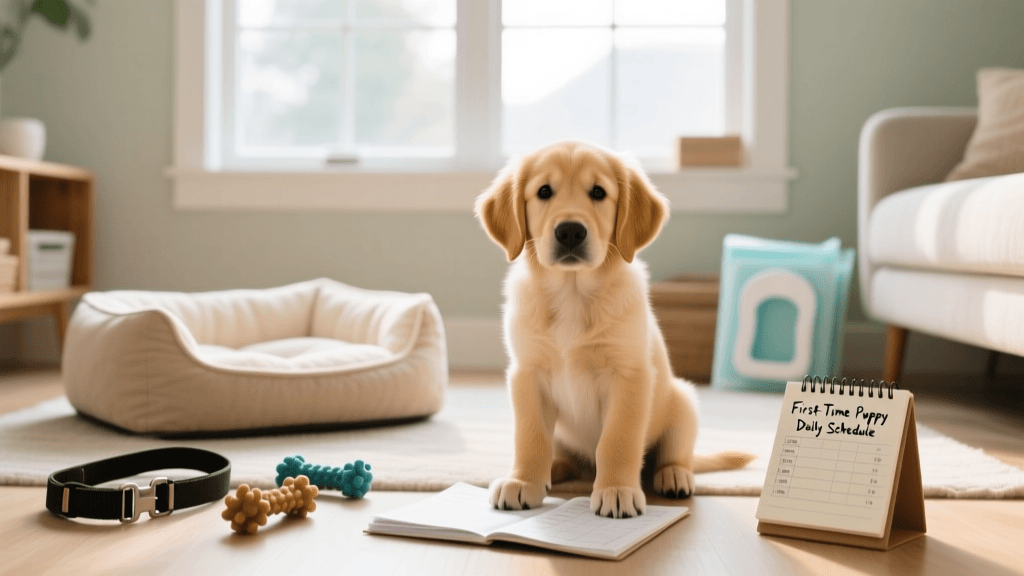
Creating a routine does not mean you must be a robot, but it does require dedication. Below is a highly effective daily schedule tailored for an eight-to-twelve-week-old puppy. Adjust the times to fit your personal work and life schedule, but keep the intervals consistent.
- 6:00 AM - Wake Up & Potty: Carry your puppy outside immediately upon waking. Do not let their paws touch the floor inside. Use a consistent cue word like 'Go potty' and reward heavily with a high-value treat (like Zuke's Mini Naturals) the second they finish.
- 6:15 AM - Breakfast: Serve their measured morning meal. For most medium breeds, this is roughly 1/2 to 3/4 cup of high-quality puppy kibble. Remove the bowl after 15 minutes to establish a strict feeding schedule, which in turn creates a predictable potty schedule.
- 6:45 AM - Potty Break: Take them back outside. Puppies usually need to eliminate 15 to 30 minutes after eating.
- 7:00 AM - Supervised Play & Training: Engage in 20 minutes of gentle play and basic training (like 'sit' or name recognition). Keep sessions short to avoid frustration.
- 7:30 AM - Enforced Nap: Place the puppy in their crate or a quiet playpen. Puppies need immense amounts of sleep, and they often do not know how to put themselves to bed.
- 9:30 AM - Potty & Activity: Wake up, carry outside to potty, followed by 30 minutes of supervised exploration or a short walk in a low-traffic area.
- 10:00 AM - Enforced Nap: Back to the crate for another two-hour rest period.
- 12:00 PM - Potty & Lunch: Outside to potty, followed by their midday meal and another quick potty trip 20 minutes later.
- 12:45 PM - Enforced Nap: Crate time while you eat lunch or work.
- 3:00 PM - Potty & Socialization: Carry outside, then engage in safe socialization. Let them watch the world from a porch or carry them in a sling to hear traffic and see strangers without exposing them to ground-level disease risks.
- 4:00 PM - Enforced Nap: Afternoon snooze.
- 6:00 PM - Potty & Dinner: Evening meal and subsequent potty trip.
- 7:00 PM - Free Play & Chew Time: Allow the puppy to roam a puppy-proofed room while you watch TV. Provide safe chew toys like a frozen Kong stuffed with puppy-safe peanut butter.
- 8:30 PM - Final Potty & Wind Down: Remove water bowls by 7:30 PM to limit nighttime accidents. Take them out for a calm, boring potty trip.
- 9:00 PM - Bedtime: Crate them for the night. Expect one or two midnight potty breaks for the first few weeks.
Essential Gear for Your New Routine
To execute this schedule successfully, you need the right tools. Budgeting for these essentials upfront will save you time, money, and frustration. First, invest in a high-quality wire crate, such as the MidWest Homes for Pets iCrate (approximately $45 to $70 depending on size). The crate should be large enough for the puppy to stand, turn around, and lie down, but no larger, as excess space encourages them to soil one corner and sleep in the other. Second, stock up on an enzymatic cleaner like Nature's Miracle Advanced Stain and Odor Eliminator (around $15 per bottle). Standard household cleaners do not break down uric acid crystals, meaning your puppy will still smell the urine and return to the same spot to eliminate. Finally, keep a dedicated treat pouch filled with soft, low-calorie training treats near your door so you are always ready to reward outdoor success instantly.
Potty Training Troubleshooting Guide
Even with a perfect schedule, accidents will happen. How you react and adjust your strategy is what determines long-term success. Review the table below to troubleshoot common potty training hurdles.
| Problem | Potential Cause | Actionable Solution |
|---|---|---|
| Frequent indoor accidents | Too much freedom; bladder not fully developed. | Tether the puppy to your waist with a leash indoors or restrict them to a small, puppy-proofed pen when not actively supervised. |
| Eliminating in the crate | Crate is too large; puppy was left in too long. | Use the included crate divider to shrink the space. Ensure you are adhering to the 'one hour per month of age' rule for crate time. |
| Submissive urination when greeted | Overstimulation; natural canine appeasement behavior. | Ignore the puppy upon entering the house. Wait until they are completely calm and all four paws are on the floor before offering gentle, low-key affection. |
| Refusing to potty outside | Distracted by environment; surface preference. | Take them to the exact same 'potty spot' every time. Stand still and be boring. If they do not go within 5 minutes, go back inside, crate for 10 minutes, and try again. |
Managing the 'Witching Hour' and Bite Inhibition
First-time owners are frequently blindsided by the evening 'witching hour'—a period usually between 6:00 PM and 8:00 PM where a previously angelic puppy turns into a landshark, biting ankles, barking at shadows, and getting the 'zoomies.' According to the ASPCA, this behavior is rarely a sign of aggression or dominance; rather, it is almost always a symptom of an overtired puppy who lacks the emotional regulation to put themselves to sleep. Just like a human toddler throwing a tantrum past their bedtime, an overtired puppy bites harder and listens less. The solution is not more exercise, which will only overstimulate them further, but rather an enforced nap. If the biting becomes intense, calmly place the puppy in their crate or a quiet pen with a long-lasting chew toy to help them decompress and transition into sleep.
Socialization and the Importance of Enforced Naps
While potty training is a daily priority, socialization is the most critical developmental task your puppy will face. The primary socialization window closes around 14 to 16 weeks of age. The Humane Society of the United States emphasizes that proper socialization is not just about meeting other dogs; it is about exposing your puppy to novel surfaces, sounds, sights, and handling in a positive, low-stress manner. However, you must balance this exposure with their immense need for rest. Puppies require between 18 to 20 hours of sleep per day to support their rapid physical and neurological growth. If you skip enforced naps to socialize your puppy, you risk creating a chronically stressed, hyperactive dog. Always prioritize a good nap over a forced social interaction.
Final Thoughts for First-Time Owners
Raising a puppy is a marathon, not a sprint. There will be days when you feel like you are taking ten steps forward and twelve steps backward. Remember that consistency is your greatest asset. Stick to the schedule, manage their environment to prevent mistakes, and reward the behaviors you want to see repeated. By laying this groundwork during the first few months, you are not just potty training a dog; you are building a foundation of trust and communication that will result in a well-adjusted, happy adult dog for the rest of their life.
hannah-wickes
All our authors care for dogs every day — read more of their work on the authors page.