First-Time Owner Guide to Puppy Crate Training Success
Discover the ultimate first-time owner guide to puppy crate training. Learn sizing, timelines, costs, and step-by-step methods for a stress-free experience.
Welcome to Dog Ownership: The Crate Training Foundation
Bringing home your first puppy is an exhilarating milestone, but it quickly becomes clear that puppies require immense structure, patience, and guidance. For first-time dog owners, few training endeavors are as critical—or as misunderstood—as crate training. When executed correctly, a crate is not a cage; it is a sanctuary, a potty-training accelerator, and a vital management tool that keeps your curious puppy safe from household hazards when you cannot directly supervise them.
This comprehensive guide is designed specifically for first-time owners. We will walk you through the exact equipment you need, the realistic costs involved, and a proven four-week timeline to transform a terrifying metal box into your puppy's favorite place in the house.
Why Crate Training is Non-Negotiable
Dogs are naturally den-dwelling animals. In the wild, canines seek out small, enclosed spaces to sleep and feel secure. Crate training taps into this innate instinct. According to the American Society for the Prevention of Cruelty to Animals (ASPCA), a properly sized crate provides a safe haven that reduces anxiety and prevents destructive behaviors born from boredom or stress.
Furthermore, the crate is your most powerful ally in housebreaking. Puppies naturally avoid soiling their sleeping area. By utilizing a correctly sized crate, you encourage your puppy to hold their bladder until you take them outside, drastically reducing indoor accidents and accelerating the potty training process.
Choosing the Right Crate: Types, Costs, and Features
Walking into a pet supply store or browsing online can be overwhelming. There are three primary types of crates on the market, each with distinct advantages and price points. Below is a comparison chart to help you choose the best option for your first puppy.
| Crate Type | Popular Model Example | Pros | Cons | Average Cost |
|---|---|---|---|---|
| Wire Crate | MidWest Homes for Pets iCrate | Excellent ventilation, folds flat for storage, includes adjustable divider panels. | Heavier, less 'den-like' without a cover, can rattle if the puppy moves. | $40 - $80 |
| Plastic Crate | Petmate Sky Kennel | Cozy, enclosed den feel, durable, often airline-approved for travel. | Poor ventilation in warm climates, bulky to store, harder to clean deep crevices. | $50 - $120 |
| Soft-Sided | EliteField 3-Door Folding Soft Crate | Lightweight, highly portable, comfortable, aesthetically pleasing. | Easily destroyed by teething puppies, impossible to clean if soiled, not for chewers. | $30 - $70 |
The First-Time Owner Verdict: For a new puppy, a wire crate with a divider panel is the undisputed best choice. The divider allows you to buy a crate that will fit your dog's adult size, while restricting their space to the appropriate dimensions for their current puppy size. This prevents them from eliminating in the back corner and sleeping in the front.
Sizing Rules: Getting the Measurements Right
Size matters immensely in crate training. If the crate is too large, your puppy will designate one corner as a bathroom and another as a bedroom. If it is too small, they will be physically uncomfortable and develop negative associations with the space.
- The Golden Rule: Your puppy should be able to stand up without their head touching the top, turn around in a full circle, and lie down stretched out comfortably.
- Measurement Guide: Measure your puppy from the tip of their nose to the base of their tail, and add 2 to 4 inches. Measure from the top of their head to the ground, and add 2 inches for height.
- Pro Tip: If you have a Golden Retriever puppy that will grow to 70 lbs, purchase a 42-inch wire crate. Use the included metal divider to block off the back half, giving them only a 24-inch space. Move the divider back every few weeks as they grow.
The 4-Week Puppy Crate Training Timeline
Patience is your most valuable currency as a first-time owner. Do not expect your puppy to love the crate on day one. Follow this structured four-week timeline to build a positive, lifelong association with the crate.
Week 1: Introduction and Positive Association
Goal: Teach the puppy that the crate equals amazing things.
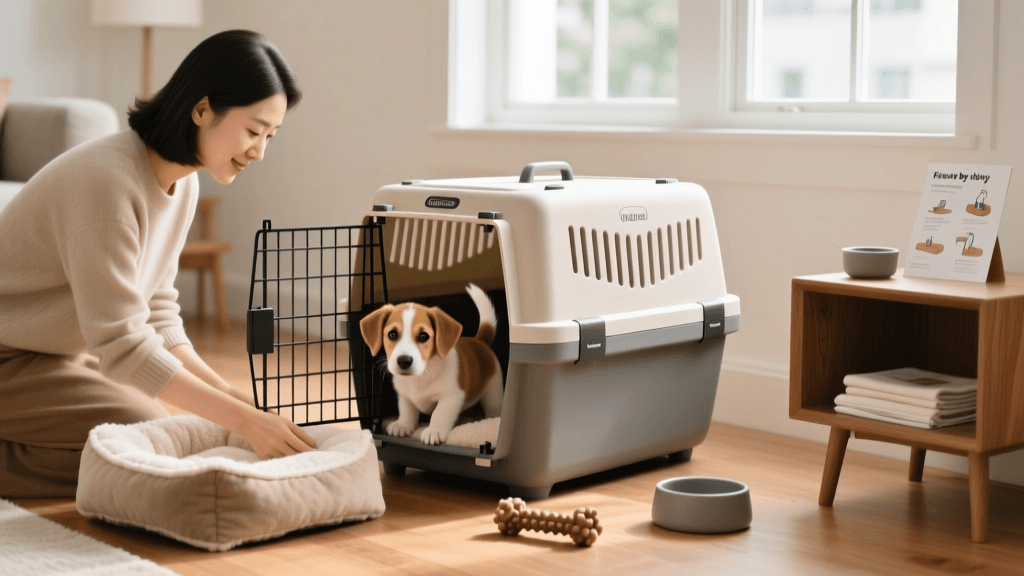
- Setup: Place the crate in a high-traffic family area like the living room. Leave the door securely tied open. Add a washable fleece blanket and a safe chew toy.
- Action: Feed your puppy all of their daily meals inside the crate. Start with the bowl near the entrance. With each subsequent meal, push the bowl further back until they are eating comfortably at the rear of the crate.
- Treat Tossing: Randomly toss high-value, pea-sized treats (such as Zuke's Mini Naturals, which cost about $6 per bag and are low in calories) into the crate. Let the puppy run in, grab the treat, and run back out. Do not close the door.
Week 2: Closing the Door and Short Durations
Goal: Normalize the closed door without inducing panic.
- Action: During mealtime, once the puppy is eating from the back of the crate, gently swing the door closed. Do not latch it yet. Just let it rest closed.
- Progression: By day four of week two, latch the door while they eat. The moment they finish their last bite, open the door immediately.
- Duration Building: Give them a long-lasting chew (like a bully stick or a Kong stuffed with frozen peanut butter) inside the crate. Close and latch the door. Sit in the room with them. Once the chew is finished, let them out. Aim for 10 to 15 minutes of closed-door time.
Week 3: Leaving the Room and Nighttime Sleep
Goal: Teach the puppy that you always come back, and establish a nighttime routine.
- Action: Put the puppy in the crate with a treat, close the door, and quietly leave the room for 5 minutes. Return before they start whining. Gradually increase your absence to 15, then 30 minutes.
- Nighttime Setup: The Humane Society of the United States recommends placing the crate in your bedroom for the first few weeks. Hearing your breathing and scent will soothe the puppy's isolation distress.
- The Nighttime Alarm: An 8-week-old puppy cannot hold their bladder all night. Set an alarm for 3 hours after bedtime (e.g., 2:00 AM). Wake up, carry them silently outside to potty, and return them directly to the crate. No playtime, no talking.
Week 4: Extending Time and Departures
Goal: Prepare the puppy for your real-world absences.
- Action: Begin crating the puppy for 30 to 60 minutes while you are home but in a different room.
- Departure Cues: Practice your 'leaving the house' routine. Put on your shoes, grab your keys, put the puppy in the crate, give them a Kong, and walk out the door. Return 10 minutes later. This desensitizes them to the triggers that usually cause separation anxiety.
Essential Crate Training Supplies and Budget
To set yourself up for success, budget for the following starter kit. These specific items address the most common first-time owner hurdles.
- Wire Crate with Divider (36-inch): ~$60. (Brands like MidWest or Frisco offer excellent durability).
- Washable Crate Pad: ~$20. Avoid thick, plush beds initially; teething puppies will shred and ingest them, leading to costly vet bills. Use a flat, durable fleece pad.
- High-Value Training Treats: ~$15. Zuke's Mini Naturals or boiled chicken breast. Keep them under 3 calories each.
- Interactive Puzzle Toy: ~$15. A classic rubber Kong. Stuff it with plain pumpkin puree and freeze it to keep the puppy occupied for 45+ minutes.
- Enzymatic Cleaner: ~$12. Nature's Miracle Advanced Stain and Odor Eliminator. Essential for completely erasing the biological scent of any accidents outside the crate.
Total Estimated Startup Cost: $122.00
Potty Training Intersections and Bladder Limits
First-time owners often make the mistake of leaving a young puppy crated for too long, resulting in forced soiling and a ruined potty training foundation. The American Kennel Club (AKC) champions the standard rule of thumb for puppy bladder control: A puppy can hold their bladder for one hour per month of age.
- 2-Month-Old (8 weeks): Maximum 2 hours in the crate during the day.
- 3-Month-Old (12 weeks): Maximum 3 hours in the crate during the day.
- 4-Month-Old (16 weeks): Maximum 4 hours in the crate during the day.
If you work a standard 8-hour day, you must arrange for a dog walker, a trusted neighbor, or a pet sitter to let your puppy out midday. Leaving a 10-week-old puppy crated for 8 hours guarantees accidents, distress, and severe setbacks in your training progress.
Troubleshooting Common First-Time Mistakes
Even with the best plan, challenges will arise. Here is how to handle the most frequent hurdles:
1. The Puppy Won't Stop Whining
If you are certain the puppy does not need to eliminate and is not in physical danger, you must ignore the whining. Releasing a crying puppy from the crate teaches them a very clear lesson: 'Crying is the button I press to make the door open.' Wait for a brief moment of silence—even just three seconds—before opening the door to reward the quiet behavior.
2. Using the Crate as Punishment
Never send your dog to their crate when you are angry. If the crate becomes associated with time-outs and scolding, your puppy will resist entering it. The Humane Society heavily emphasizes that the crate must remain a purely positive, happy space. If your puppy misbehaves, redirect them or use positive reinforcement for alternative behaviors, but keep the crate out of the disciplinary equation.
3. Water Bowl Inside the Crate
Do not leave a water bowl inside the crate for a young puppy. This will lead to excessive drinking, a full bladder, and inevitable soiling of the crate bedding. Instead, offer water frequently during their time outside the crate, and implement a strict water cutoff time two hours before bed to help them sleep through the night.
Final Thoughts for the New Owner
Crate training is a marathon, not a sprint. There will be nights where you feel sleep-deprived and days where your puppy seems to take a step backward. This is entirely normal. Stick to the timeline, maintain a consistent schedule, and always prioritize positive associations. Within a month, you will likely find your puppy voluntarily trotting into their crate for a nap, providing you with the peace of mind every first-time dog owner deserves.
robin-maitland
All our authors care for dogs every day — read more of their work on the authors page.