First-Time Owner Guide to Puppy Potty Training Success
Master puppy potty training with our first-time owner guide. Learn crate sizing, daily schedules, and troubleshooting tips for an accident-free home.
Welcome to Dog Ownership: The Potty Training Reality
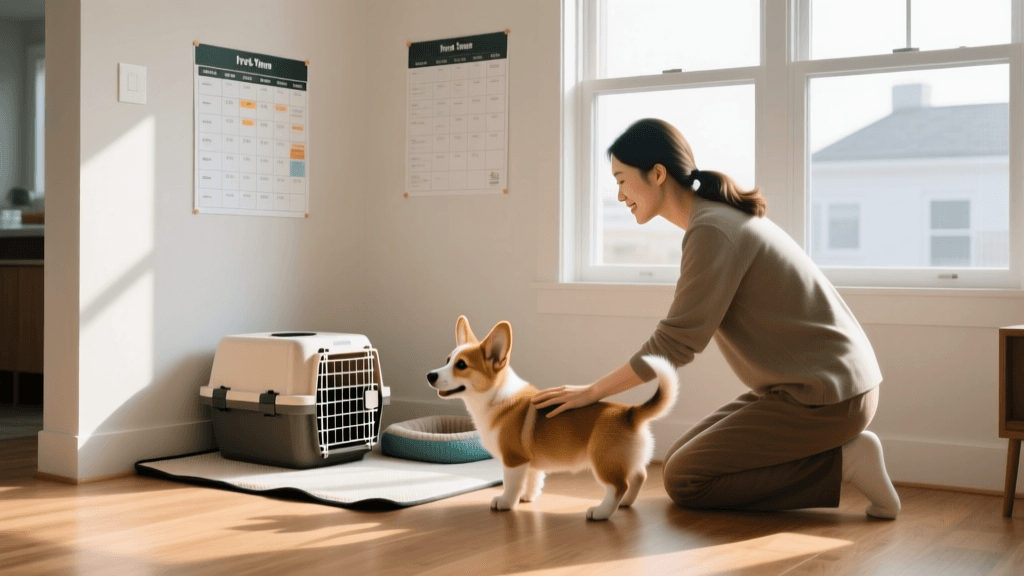
Bringing home your first puppy is an exhilarating experience filled with wagging tails, clumsy paws, and unforgettable bonding moments. However, it is also a period that tests the patience of even the most dedicated first-time dog owners. Among the various challenges you will face, potty training is often the most daunting. According to the ASPCA's official house-training guidelines, consistency, supervision, and positive reinforcement are the absolute cornerstones of successful behavioral conditioning. As a first-time owner, you might feel overwhelmed by conflicting advice from friends, family, and the internet. This comprehensive guide is designed to cut through the noise, providing you with a structured, actionable, and scientifically backed roadmap to achieving an accident-free home.
Step 1: Choosing and Sizing the Right Crate
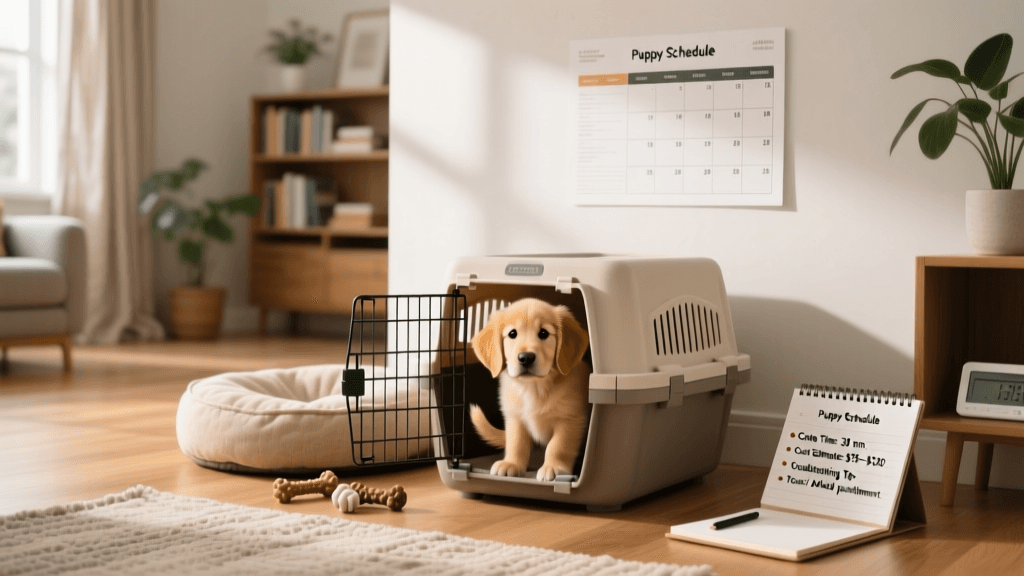
Crate training is not just about giving your dog a safe space; it is the most effective tool for potty training. Dogs have a natural den instinct and will avoid soiling their immediate sleeping area if the space is sized correctly. If the crate is too large, your puppy will simply designate one corner as a bathroom and the other as a bedroom.
Measurements and Product Recommendations
For a first-time owner, we highly recommend purchasing a wire crate with an adjustable divider panel. The MidWest Homes for Pets iCrate (Cost: $45 - $70 depending on size) is an industry standard. Here is how to size it based on your puppy's projected adult weight:
- Small Breeds (11-25 lbs adult): 24-inch crate (e.g., Chihuahuas, Pugs).
- Medium Breeds (26-40 lbs adult): 30-inch crate (e.g., Beagles, Cocker Spaniels).
- Large Breeds (41-70 lbs adult): 36-inch crate (e.g., Labrador Retrievers, Boxers).
- Extra-Large Breeds (71+ lbs adult): 42-inch or 48-inch crate (e.g., Great Danes, Mastiffs).
Adjust the divider so your puppy has just enough room to stand up, turn around, and lie down comfortably. As they grow, move the divider back. This physical restriction is the foundation of bladder control conditioning.
Step 2: The Ultimate First-Time Owner Potty Schedule
Puppies thrive on routine. A predictable schedule helps their digestive system regulate and teaches them exactly when and where to eliminate. The golden rule of puppy bladder control is the 'month plus one' rule: a puppy can hold their bladder for roughly one hour per month of age, plus one additional hour. Therefore, a two-month-old puppy can hold it for a maximum of three hours, though you should take them out much more frequently to prevent accidents.
Sample Daily Schedule for a 10-Week-Old Puppy
- 7:00 AM: Wake up and immediately carry the puppy outside to the designated potty spot.
- 7:15 AM: Breakfast time. Remove the food bowl after 15 minutes to regulate digestion.
- 7:45 AM: Potty break outside.
- 8:00 AM - 9:00 AM: Supervised play and training session.
- 9:00 AM: Potty break, followed by morning crate nap.
- 11:00 AM: Potty break immediately upon waking.
- 12:00 PM: Potty break after active play.
Always use a consistent verbal cue like 'Go Potty' while they are eliminating, and reward them immediately afterward. The Humane Society of the United States emphasizes that timing is everything; if you wait until the puppy comes back inside to give them a treat, you are rewarding them for coming inside, not for eliminating outdoors.
Bladder Control by Age: What to Expect
Understanding your puppy's physical limitations will save you from unnecessary frustration. Use the table below to set realistic expectations for your puppy's maximum crate time during the day. Note that overnight, puppies can often hold it slightly longer because their metabolism slows down during sleep.
| Puppy Age | Maximum Daytime Bladder Control | Recommended Potty Break Interval |
|---|---|---|
| 8 - 10 Weeks | 2 to 3 Hours | Every 1 to 2 Hours |
| 11 - 14 Weeks | 3 to 4 Hours | Every 2 to 3 Hours |
| 15 - 16 Weeks | 4 to 5 Hours | Every 3 to 4 Hours |
| 4 - 6 Months | 5 to 6 Hours | Every 4 to 5 Hours |
| 6+ Months | 6 to 8 Hours | Every 6 to 8 Hours |
Step 3: Selecting the Right Cleaning and Reward Supplies
Accidents will happen, especially in the first few weeks. How you clean them up dictates whether your puppy will repeat the offense. Dogs have an incredibly sensitive sense of smell, and if they can detect even a faint trace of urine, they will view that spot as an acceptable bathroom.
The Danger of Ammonia-Based Cleaners
Never use bleach or ammonia-based household cleaners. Urine contains ammonia, so cleaning with these products actually signals to your dog that this is a designated potty area. Instead, you must use an enzymatic cleaner. Enzymatic cleaners contain specific bacteria that break down the uric acid crystals in dog urine, completely eliminating the scent.
Product Recommendation: Nature's Miracle Advanced Stain and Odor Eliminator (Cost: $12 - $15). Spray the area generously, let it sit for 10-15 minutes to penetrate the carpet padding or floor seams, and blot it dry. Allow it to air dry completely.
High-Value Training Treats
For potty training, dry kibble rarely cuts it. You need a high-value reward that your puppy only gets when they eliminate outside. Zuke's Mini Naturals (Cost: $7 - $9 per bag) are excellent because they are small (under 3 calories each), soft, and highly palatable. Keep a treat pouch by the door so you can reward the behavior within three seconds of completion.
Step 4: Troubleshooting Common Accidents
Even with a perfect schedule, first-time owners often encounter specific behavioral hurdles. Here is how to handle the most common issues.
Submissive and Excitement Urination
If your puppy leaks a small amount of urine when you come home, when guests arrive, or when they are being scolded, this is likely submissive or excitement urination. This is not a potty training failure; it is an involuntary physiological response. The American Kennel Club (AKC) advises owners to completely ignore the puppy upon entering the house until they are calm. Do not scold them, as this increases anxiety and worsens submissive urination. Take them outside immediately after the greeting is over.
The 'Sneaky' Potty
If your puppy is sneaking behind furniture or into other rooms to eliminate, you have granted them too much unsupervised freedom. A puppy under six months old should never be allowed to roam the house unattended. Use baby gates to restrict them to the room you are in, or tether their leash to your belt loop while you do chores around the house. If you cannot actively watch them, they must be in their crate or a secure exercise pen.
Potty Training Regression
It is incredibly common for puppies to seem fully trained at four months, only to suddenly start having accidents again at six or seven months. This regression often coincides with teething, growth spurts, or hormonal changes. Do not panic and do not punish. Simply revert to the strict schedule you used when they were eight weeks old for a period of two weeks. Consistency will quickly rebuild the habit.
Final Thoughts for First-Time Owners
Potty training is a marathon, not a sprint. It requires early mornings, interrupted evenings, and a lot of patience. Remember that your puppy is not giving you a hard time; they are simply having a hard time learning a completely foreign concept. If your puppy is having frequent accidents despite a strict schedule, or if they seem to strain while urinating, consult your veterinarian immediately to rule out medical issues such as a urinary tract infection (UTI) or parasites. By utilizing a properly sized crate, adhering to a strict schedule, using enzymatic cleaners, and rewarding heavily with high-value treats, you will set your new companion up for lifelong success and build a foundation of trust that will benefit every other aspect of your dog ownership journey.
marcus-aldridge
All our authors care for dogs every day — read more of their work on the authors page.