Optimize Dog Training With Smart Feeding Schedules And Treats
Discover how to optimize your dog's training focus using strategic feeding schedules, treat hierarchies, and high-value food rewards for better obedience.

When it comes to dog training, many owners focus entirely on the mechanics of commands, leash handling, and timing, completely overlooking one of the most powerful tools at their disposal: nutrition. The way you feed your dog, the schedule you maintain, and the specific treats you utilize can mean the difference between a distracted, uncooperative pet and a highly focused, eager-to-please working partner. In the realm of behavioral conditioning and obedience training, food is not just sustenance; it is currency. Understanding how to leverage your dog's diet and feeding strategies is essential for maximizing training outcomes. This comprehensive guide will explore the intersection of canine nutrition and behavioral training, providing actionable strategies to transform your dog's mealtime into a powerful motivational tool.
The Science of Food Motivation
At the core of modern, reward-based dog training is operant conditioning. When a dog performs a desired behavior and receives a positive reinforcer, the likelihood of that behavior being repeated increases. According to the American Veterinary Society of Animal Behavior (AVSAB), reward-based training methods are not only the most effective but also the safest for canine welfare. Food acts as a primary reinforcer, meaning it satisfies a fundamental biological drive. However, a dog that has constant access to food lacks the biological drive to work for it. By strategically managing your dog's appetite and utilizing high-value food rewards, you tap into their natural foraging and survival instincts, creating a state of optimal arousal and focus during training sessions.
Ditching the Food Bowl: Scheduled Feeding vs. Free-Feeding
Free-feeding—the practice of leaving a bowl of kibble out all day for the dog to graze on—is one of the biggest saboteurs of training success. If a dog can eat whenever they want, their motivation to work for food plummets. Transitioning to a scheduled feeding routine establishes you as the provider of resources and creates predictable windows of hunger that you can exploit for training.
To transition safely, start by measuring your dog's daily caloric requirement based on their weight, age, and activity level. Divide this total into two or three distinct meals. Offer the food bowl at a specific time, and if the dog does not eat within fifteen minutes, remove the bowl until the next scheduled meal. Within a few days, your dog will develop a healthy appetite and a predictable eating schedule. This predictable hunger is your training advantage. You can now schedule your most demanding training sessions right before a meal, when the dog's food drive is at its absolute peak.
The Treat Hierarchy: Matching Rewards to the Task
Not all training scenarios require the same level of motivation. Asking your dog to sit in your quiet living room requires far less incentive than asking them to perform a reliable recall away from a chasing squirrel. To manage this, professional trainers use a treat hierarchy. This involves categorizing food rewards into low, medium, and high-value tiers, and deploying them strategically based on the environment and the difficulty of the task.
Here is a breakdown of how to structure your treat hierarchy, including specific product recommendations, estimated costs, and caloric densities.
| Treat Tier | Example Products | Calories per Treat | Best Training Scenario | Approx. Cost per Ounce |
|---|---|---|---|---|
| Low Value | Dog's regular kibble, Zuke's Mini Naturals | 3 - 5 kcal | Basic obedience indoors, repetitive drills | $0.40 - $1.20 |
| Medium Value | Blue Buffalo Bits, small pieces of hot dog | 8 - 12 kcal | Learning new behaviors, mild distractions | $1.50 - $2.00 |
| High Value | Stella & Chewy's Meal Mixers, boiled chicken, freeze-dried liver | 5 - 15 kcal | Recall proofing, high-distraction public areas, counter-conditioning | $2.50 - $4.00 |
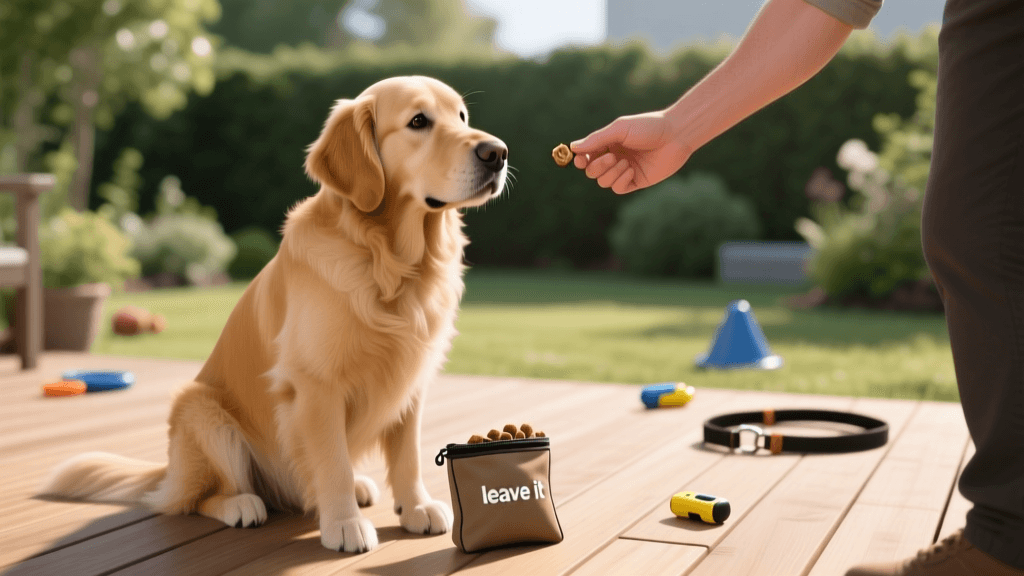
Low-value treats are best for repetitive drills in low-distraction environments. Medium-value treats are ideal for learning new behaviors or training in mildly distracting settings like your backyard. High-value treats are reserved for high-stakes scenarios: proofing a recall, counter-conditioning fear responses, or training in highly distracting public spaces.
Calorie Management: Keeping Your Dog Fit While Training
A common pitfall among dedicated trainers is the accidental overfeeding of treats, leading to canine obesity. An overweight dog suffers from joint stress, reduced stamina, and a shorter lifespan. The Tufts University Cummings Veterinary Medical Center emphasizes that treat calories must be factored into a dog's total daily energy intake. Treats should never constitute more than ten percent of your dog's daily caloric allowance.
To manage this, adopt the 'kibble deduction' method. If you plan a heavy training day using low-value kibble as rewards, simply scoop out a quarter-cup of your dog's regular dinner and use it in your treat pouch. If you are using high-value, calorie-dense rewards like freeze-dried liver or cheese, you must proportionally reduce their evening meal to compensate. For example, if your dog requires 800 calories a day, and you feed 80 calories worth of training treats, you only feed 720 calories in their main meals. Using tiny, pea-sized pieces of high-value treats allows you to deliver maximum flavor impact with minimal caloric consequence.
Timing Your Meals and Training Sessions
The timing of your training sessions relative to your dog's meals can drastically alter their performance. A dog that has just eaten a large meal will likely be lethargic, focused on digestion, and entirely uninterested in working. Conversely, a dog that is ravenously starving may be too frantic and over-aroused to think clearly, leading to frustration and poor impulse control.
The sweet spot for optimal training focus is typically thirty to forty-five minutes before a scheduled meal. During this window, the dog's ghrelin levels (the hunger hormone) are rising, creating a sharp, eager focus without crossing the threshold into frantic desperation. If you must train after a meal, wait at least two hours to allow for initial digestion and to prevent the risk of gastric dilatation-volvulus (bloat), particularly in large, deep-chested breeds. The ASPCA also recommends keeping training sessions short—around five to ten minutes—to maintain a high level of engagement and prevent mental fatigue.
Advanced Strategy: The Premack Principle and Food
Beyond simple treats, you can use the act of eating itself as a reward through the Premack Principle. This psychological principle states that a more probable behavior can be used to reinforce a less probable behavior. In practical terms, you can use your dog's daily meal as the ultimate reward for obedience.
Instead of simply placing the food bowl on the floor, ask your dog to perform a sequence of commands—such as a sit, down, and stay—before granting permission to eat. This not only reinforces basic obedience but also teaches profound impulse control. You can take this a step further by incorporating scatter feeding or using puzzle toys like the Kong Classic or Outward Hound Nina Ottosson puzzles. Making your dog work for their meal engages their brain, satisfies their natural foraging instincts, and reinforces the concept that calm, focused behavior yields the best nutritional rewards.
Conclusion
Integrating smart nutrition and feeding strategies into your training regimen is a game-changer for dog owners. By abandoning free-feeding, establishing a structured treat hierarchy, meticulously managing caloric intake, and timing your sessions to align with your dog's natural hunger cycles, you create an environment where learning thrives. Food is the most potent tool in your training arsenal; wield it wisely, and you will unlock a level of focus, obedience, and partnership with your dog that extends far beyond the training field.
priya-sutaria
All our authors care for dogs every day — read more of their work on the authors page.