Engage-Disengage Protocol for Urban Leash Reactivity in 2026
Master the engage-disengage protocol for urban leash reactivity in 2026. Learn threshold training, top front-clip harnesses, and calming strategies.
The Modern Urban Landscape and Canine Reactivity
Navigating city streets with a reactive dog has always been a challenge, but the urban environment of 2026 presents an entirely new array of sensory triggers. Between the silent approach of next-generation e-scooters, the unpredictable movement of automated sidewalk delivery robots, and the sheer density of high-rise living, dogs are frequently exposed to environmental stressors that their nervous systems were never evolved to process. For owners of anxious and leash-reactive dogs, these modern stimuli can turn a simple bathroom break into a neurological battleground.
Reactivity is not a moral failing, nor is it a sign of a 'bad' dog. It is a manifestation of fear, frustration, or barrier-induced anxiety. When a dog spots a trigger while confined to a leash, their fight-or-flight response is activated, but the leash removes the 'flight' option. This often results in lunging, barking, and snarling—a preemptive strike designed to make the scary thing go away. According to the American Veterinary Medical Association (AVMA), understanding the root cause of this fear-based behavior is the critical first step toward rehabilitation.
Differentiating Reactivity from Aggression
Before implementing any training protocol, it is vital to distinguish between leash reactivity and true aggression. Leash reactivity is highly context-dependent; a dog may bark ferociously at other dogs while on a leash but play beautifully in an off-leash, fenced environment. True aggression involves the intent to cause harm, regardless of the physical barriers present. The ASPCA's common dog behavior issues hub notes that the vast majority of leash-lunging dogs are displaying distance-increasing behaviors rooted in anxiety, not a genuine desire to inflict injury. Recognizing this distinction allows handlers to approach training with empathy rather than punishment.
Reactivity is a neurological response to perceived environmental overwhelm. Our goal is not to suppress the behavior, but to change the underlying emotional response.
The Engage-Disengage Protocol: A 2026 Masterclass
The Engage-Disengage game, originally popularized by canine behavior consultants, remains the gold standard for desensitization and counter-conditioning (DS/CC) in 2026. The objective is to rewire the dog's brain so that the sight of a trigger predicts a high-value reward, rather than a threat. This protocol is broken down into two distinct phases.
Phase 1: The Engage (Mark and Reward)
In Phase 1, you are working strictly below your dog's threshold distance—the exact point where they notice the trigger but are still capable of eating treats and responding to cues. When your dog looks at the trigger (the 'engage'), you immediately mark the behavior with a clicker or a verbal marker like 'Yes!', and then deliver a high-value reward. The dog does not need to look back at you; the marker simply bridges the gap between seeing the trigger and receiving the food. This builds a positive conditioned emotional response (+CER).
Phase 2: The Voluntary Disengage
Once the dog begins to anticipate a treat upon seeing the trigger, you move to Phase 2. Now, when the dog looks at the trigger, you wait. You do not mark immediately. Instead, you wait for the dog to voluntarily turn their head away from the trigger and look back at you (the 'disengage'). The moment they make eye contact with you, mark and reward heavily. This teaches the dog that checking in with their handler is far more rewarding and safe than fixating on the environmental stressor.
Finding the Sub-Threshold Distance
Success in this protocol hinges entirely on distance management. If your dog is already barking and lunging, they are over threshold, and learning cannot occur. In dense 2026 urban settings, finding space requires creativity. Utilize wide boulevards, empty parking lots on weekends, or even the perimeters of local parks. Many modern handlers use smartphone mapping tools or portable laser rangefinders to measure exact distances, tracking their dog's threshold down to the foot. If your dog reacts at 30 feet, you must start training at 45 feet.
The Power of High-Value Reinforcement
Kibble will not cut it when the amygdala is firing. You need treats that trigger a massive dopamine release to compete with the adrenaline of the trigger. In 2026, top choices among behaviorists include freeze-dried beef lung, single-ingredient salmon bites, or commercial high-value pastes that can be squeezed from a tube, allowing for rapid, continuous feeding without dropping food on dirty city sidewalks.
Essential Gear: Front-Clip Harnesses for Redirecting Momentum
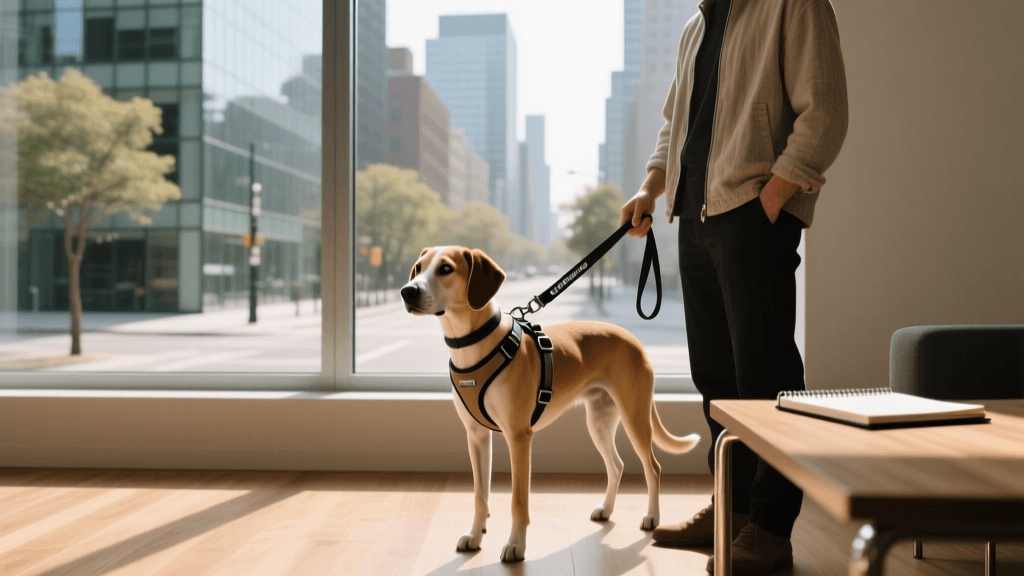
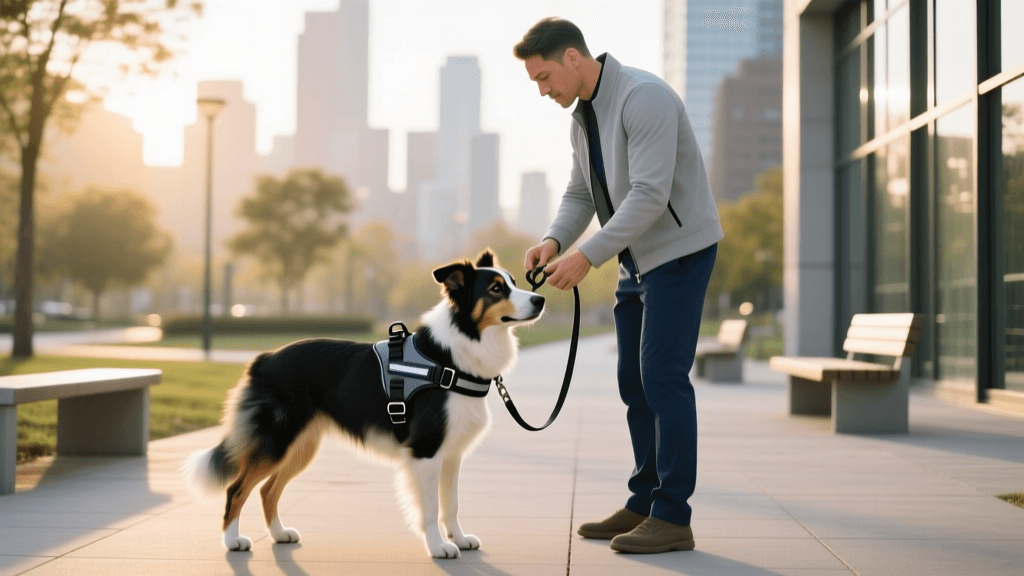
Managing a reactive dog safely requires equipment that prevents injury to the dog's trachea and gives the handler mechanical leverage without causing pain. Choke chains, prong collars, and e-collars are strongly discouraged by modern veterinary behaviorists, as adding pain to a fear-based reaction only worsens the underlying anxiety. Instead, a well-fitted front-clip harness is the tool of choice. When the dog pulls toward a trigger, the front D-ring gently redirects their center of mass back toward the handler, neutralizing their forward momentum.
| Harness Model (2026 Lineup) | Front-Clip Design | Best For | Est. Price |
|---|---|---|---|
| Ruffwear Front Range | Aluminum V-Ring | Everyday urban walks and mild pullers | $45.00 |
| Kurgo Tru-Fit Smart Harness | Nested Steel V-Ring | Escape artists and car travel (crash-tested) | $35.00 |
| Perfect Fit Modular Harness | Stainless Steel D-Ring | Oddly shaped breeds and extreme chafing sensitivity | $75.00 |
| Rabbitgoo No-Pull Tactical | Heavy-Duty Zinc Alloy | Large, powerful breeds requiring dual-handle control | $28.00 |
Pair your chosen harness with a 15-foot biothane long line. Biothane is waterproof, easy to sanitize, and won't burn your hands if the dog suddenly lunges. Avoid retractable leashes entirely; their thin cords can cause severe friction burns, and their locking mechanisms frequently fail under the sudden kinetic force of a reactive lunge.
Pre-Walk Neurological Support: Calming Supplements
Training is vastly more effective when the dog's baseline anxiety is lowered. In 2026, the integration of nutraceuticals into behavioral modification plans is standard practice. Supplements containing L-theanine, alpha-casozepine (found in Zylkene), and specific strains of probiotics (like Bl999 in Calming Care) have been shown to support neurological balance.
- L-Theanine: An amino acid that promotes alpha-brain wave production, inducing a state of relaxed alertness.
- Alpha-Casozepine: A milk-protein derivative that mimics the calming effects of GABA in the brain.
- Timing is Critical: These supplements are not instant sedatives. They must be administered 90 to 120 minutes before the anticipated stressor (the walk) to allow for proper gastrointestinal absorption and crossing of the blood-brain barrier.
The Emergency U-Turn: When Management Fails
Despite meticulous planning, urban environments are unpredictable. A neighbor might step out of an alley with an off-leash dog, or a silent e-bike might bypass you on a narrow trail. When a trigger suddenly appears inside your dog's threshold distance, the Engage-Disengage game is no longer viable. You must execute an Emergency U-Turn.
- The Happy Cue: Say a specific, cheerful cue word like 'Let's Go!' or 'Turn!' before your dog has a chance to react.
- The Pivot: Use the leash attached to the front-clip harness to gently guide the dog's nose toward your hip, pivoting 180 degrees on your heel.
- The Scatter Feed: As you jog away from the trigger, toss a handful of high-value treats onto the ground or into the grass. Sniffing and foraging naturally lower a dog's heart rate and engage the parasympathetic nervous system.
- Regroup: Do not return to the trigger. End the walk if necessary, allowing the dog's cortisol levels to return to baseline, which can take up to 72 hours in severely stressed dogs.
Consistency and the Extinction Burst
As you implement the Engage-Disengage protocol, be prepared for an 'extinction burst'—a temporary increase in the intensity of the reactive behavior as the dog realizes their old tactics (lunging) are no longer yielding the desired result of making the trigger go away. This is a sign that the neurological rewiring is occurring, not that the training is failing. Stay patient, maintain your distance, and continue to advocate for your dog's need for space. By combining modern, force-free gear with evidence-based counter-conditioning and nutritional support, even the most anxious urban dogs can learn to navigate the chaotic world of 2026 with confidence and calm.
priya-sutaria
All our authors care for dogs every day — read more of their work on the authors page.