Dog-Proofing Your Home for Successful Potty and Crate Training
Learn how to dog-proof your home environment to accelerate potty and crate training. Discover layout tips, safe zones, and essential gear for success.
The Intersection of Environment and Behavioral Conditioning
When embarking on the journey of dog training, most owners focus entirely on verbal commands, treat rewards, and leash mechanics. However, professional behaviorists know a fundamental truth: environmental management is the invisible foundation of all successful obedience and house training. If your home environment is not properly dog-proofed, you are inadvertently setting your dog up to fail, rehearse bad habits, and develop behavioral issues that could have been entirely prevented.
Dog-proofing from a training perspective goes far beyond simply hiding toxic chemicals or securing loose wires. It is about controlling the dog's choices. By manipulating the physical space, you eliminate the opportunity for your dog to practice unwanted behaviors like inappropriate elimination, destructive chewing, or counter-surfing. Every time a dog successfully steals a shoe or pees on a rug, that behavior is reinforced, making it significantly harder to extinguish later. Therefore, structuring your home to guarantee success is the very first step in any comprehensive training protocol.
The Psychology of Space in Dog Training
Dogs are highly opportunistic creatures that learn through immediate consequences and environmental associations. According to the Humane Society's dog-proofing checklist, viewing your home from a dog's eye level is critical. A space that looks safe to a standing adult may be a minefield of temptations and hazards for a puppy or an untrained adult dog.
In behavioral conditioning, we use the concept of 'errorless learning.' This means setting up the environment so the dog can only make the correct choice. If a puppy is placed in a room with a trash can, a pair of shoes, and an area rug, the likelihood of them making a 'mistake' is nearly 100%. By removing the trash can, elevating the shoes, and rolling up the rug, you create a sterile training environment where the only available options are the dog's approved chew toys and their designated potty area. This drastically accelerates the learning curve and reduces frustration for both the owner and the dog.
Room-by-Room Dog-Proofing for Training Success
The Kitchen: Managing Scavenging and Toxins
The kitchen is the primary zone for counter-surfing and scavenging behaviors. From a training standpoint, every time a dog successfully finds dropped food or raids the garbage, the behavior is self-rewarding. To prevent this, invest in a heavy, step-on trash can (such as the Simplehuman 50-Liter model, typically around $80) that cannot be nudged open. Additionally, use baby gates to block kitchen access entirely when you are not actively supervising. This prevents the rehearsal of scavenging behaviors while you are busy cooking or out of the room.
The Living Room: Eliminating Potty Confusion
Removing area rugs isn't just about protecting your decor; it's a critical step in potty training. Dogs generalize textures. If they learn to eliminate on the soft, absorbent surface of a wool rug, they will seek out similar textures, like your bed or a guest's towel, when they need to go. By stripping the home of confusing textures during the first 90 days of housebreaking, you force the dog to associate elimination solely with the outdoor grass or gravel. Furthermore, secure all loose electrical cords using split-loom tubing or cord concealers (like the JOTO Cord Protector, approx. $15 for 12 feet) to prevent life-threatening chewing incidents.
The Bathroom: Toilet and Toiletry Hazards
Bathrooms present unique potty training challenges. A dog that drinks from the toilet may begin to associate the bathroom tile as an acceptable elimination zone. Always keep toilet lids closed and use childproof latch locks (approx. $10 for a multi-pack) on lower vanity cabinets where cleaning supplies and medications are stored. Establishing the bathroom as a 'human-only' zone via a closed door or a tall baby gate helps maintain clear spatial boundaries for the dog.
Confinement Tools: A Comparison Chart
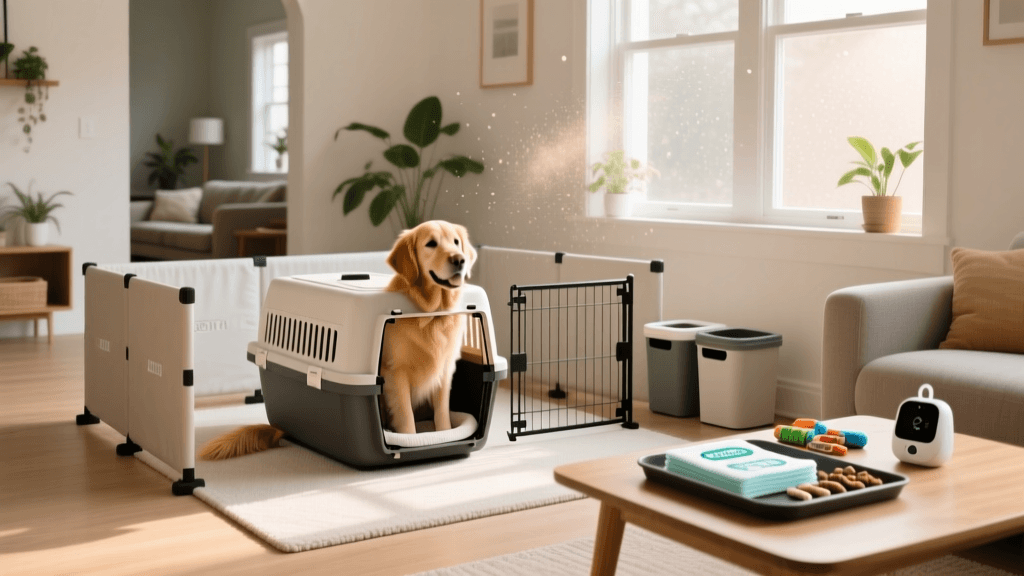
Proper confinement is not about punishment; it is a vital training tool that aids in bladder control, prevents separation anxiety destruction, and facilitates crate training. The American Kennel Club's crate training advice emphasizes that a dog's confinement area should be a safe, den-like sanctuary. Below is a comparison of the most effective environmental management tools for training.
| Confinement Tool | Best Use Case | Training Application | Estimated Cost |
|---|---|---|---|
| Wire Crate (e.g., Midwest iCrate) | Nighttime sleep, potty training, travel | Teaches bladder control via den instinct; prevents overnight wandering and accidents. | $50 - $90 |
| Metal X-Pen (e.g., Iris USA 8-Panel) | Daytime play, larger safe zones | Provides a larger 'success zone' with potty pads and toys; ideal for owners working from home. | $60 - $120 |
| Freestanding Baby Gate | Room blocking, boundary training | Teaches the dog to respect thresholds and stay out of restricted rooms without needing a closed door. | $40 - $80 |
| Tether / Umbilical Cord | Active supervision indoors | Attaches dog's leash to owner's belt; prevents sneaking off to chew furniture or potty indoors. | $15 - $25 |
Scent Management: The Hidden Key to Potty Training
One of the most common reasons potty training fails is improper cleanup of previous accidents. Dogs possess up to 300 million olfactory receptors, allowing them to detect microscopic traces of urine that humans cannot smell. If a dog can smell their previous accident, they will instinctively return to that exact spot to eliminate again, completely undermining your outdoor training efforts.
Standard household cleaners, bleach, or steam cleaners will not destroy the uric acid crystals found in dog urine. You must use a high-quality enzymatic cleaner, such as Nature's Miracle or Rocco & Roxie (approx. $15-$20 per bottle). According to the ASPCA's guidelines on house training, enzymatic cleaners work by introducing bacteria that digest the organic matter causing the odor. To use them correctly, you must saturate the area entirely, let it sit for 10 to 15 minutes to break down the uric acid, and then blot it dry. Never use ammonia-based cleaners, as ammonia smells similar to urine to a dog and will actually attract them back to the spot.
Setting Up a 'Place' Command Station
Environmental setup also involves creating designated zones for specific behaviors. Teaching the 'Place' command is one of the most valuable obedience skills for impulse control and managing guests. To train this effectively, you need a distinct, elevated boundary.
Invest in a raised dog cot, such as a Kuranda PVC or Aluminum framed bed (approx. $120 - $150). Elevated beds are vastly superior to flat mats for initial training because they provide a clear, physical boundary that the dog can feel with their paws. Place the cot in a common area, like the corner of the living room, where the dog can observe the household without being in the middle of foot traffic. By consistently rewarding the dog for settling on this specific piece of furniture, you create an environmental anchor for the 'settle' and 'place' commands, which is highly effective for reducing hyperactivity and door-dashing.
Umbilical Training: The Ultimate Indoor Management
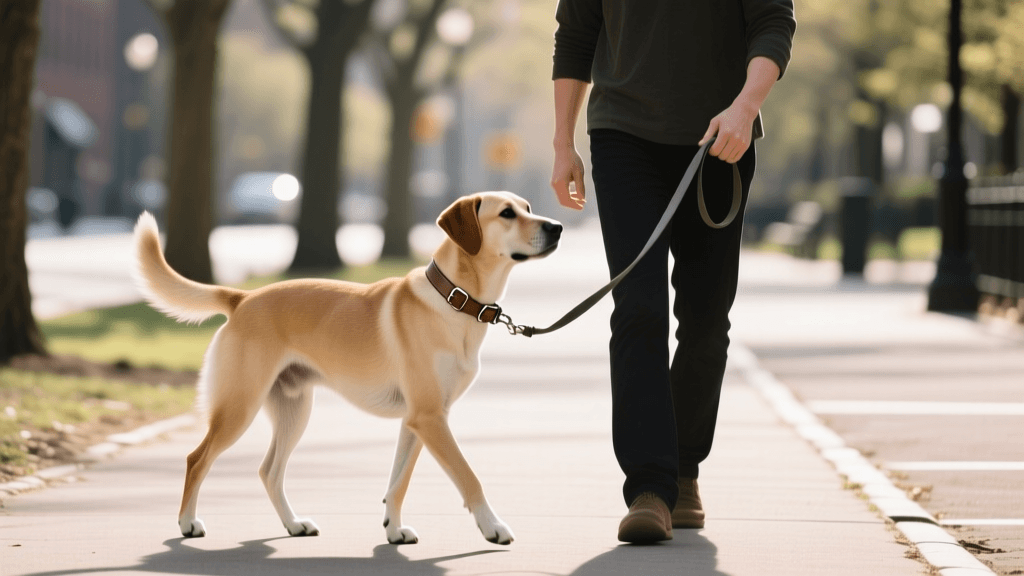
When you are home but cannot give the dog your undivided attention, 'umbilical training' is the most effective environmental management technique. This involves attaching a 4-to-6-foot leash to your belt or waist and clipping the other end to the dog's flat collar or harness. As you move around the house to fold laundry, work at your desk, or cook, the dog moves with you.
This technique completely eliminates the opportunity for the dog to wander into another room and chew a baseboard or have a potty accident behind the sofa. It also builds a strong bond and teaches the dog to settle calmly at your feet, which is a foundational skill for public obedience and cafe etiquette. It requires zero active commands from you; the physical environment (the leash) does the training for you.
Conclusion
Ultimately, successful dog training is a partnership between consistent communication and a meticulously managed environment. By dog-proofing your home with a trainer's mindset, you remove the friction from the learning process. You protect your belongings, ensure your dog's physical safety, and most importantly, you set your canine companion up for a lifetime of behavioral success. Remember that management is not a shortcut; it is the very scaffolding upon which all lasting obedience is built.
jonas-cole
All our authors care for dogs every day — read more of their work on the authors page.