DIY Scent Work & Snuffle Mats: Unlocking Canine Psychology
Discover how DIY snuffle mats and homemade scent work tap into your dog's foraging instincts, reducing anxiety and boosting mental enrichment at home.
The Olfactory Psychology: How Dogs Process the World
To truly understand your dog, you must first understand how they perceive the universe. While humans are primarily visual creatures, navigating the world through sight and sound, canines are olfactory masters. A dog's brain is hardwired to process complex chemical signatures, making their nose their most vital sensory organ. According to the American Kennel Club, dogs possess up to 300 million olfactory receptors in their noses, compared to a mere 6 million in humans. Furthermore, the part of a dog's brain devoted to analyzing smells is proportionally 40 times greater than ours.
But the anatomy goes even deeper. As highlighted by Smithsonian Magazine, dogs have a specialized secondary olfactory system known as the Jacobsen's organ, or vomeronasal organ. Located inside the nasal cavity and opening into the roof of the mouth, this organ is designed specifically to detect pheromones and complex environmental scents. When you see your dog curling their lip slightly while sniffing a fire hydrant (the Flehmen response), they are actively utilizing this organ to gather deep psychological and social data about other animals in the area.
Understanding this biological imperative is the first step in addressing common behavioral issues. When we bring dogs into our homes and deny them the opportunity to engage in deep, prolonged sniffing, we are essentially blindfolding them. This sensory deprivation often manifests as anxiety, hyperactivity, and destructive behavior. By creating DIY scent-based enrichment tools, we can satisfy their psychological need to 'see' the world through their noses.
The Foraging Instinct and Dopamine Release
In the wild, canine ancestors spent up to 80% of their waking hours scavenging, tracking, and foraging for food. Today, the average domestic dog is presented with a bowl of kibble that they can consume in under two minutes. This severe mismatch between their evolutionary instincts and their modern lifestyle leaves a massive psychological void.
Foraging is not just about eating; it is a complex cognitive puzzle that triggers the release of dopamine—the brain's 'feel-good' neurotransmitter. When a dog successfully tracks a scent and uncovers a hidden reward, they experience a profound sense of accomplishment and neurological satisfaction. Homemade DIY solutions allow us to replicate this wild foraging experience safely within our living rooms, turning mealtime into an engaging, anxiety-reducing mental workout.
DIY Project 1: The Ultimate Homemade Snuffle Mat
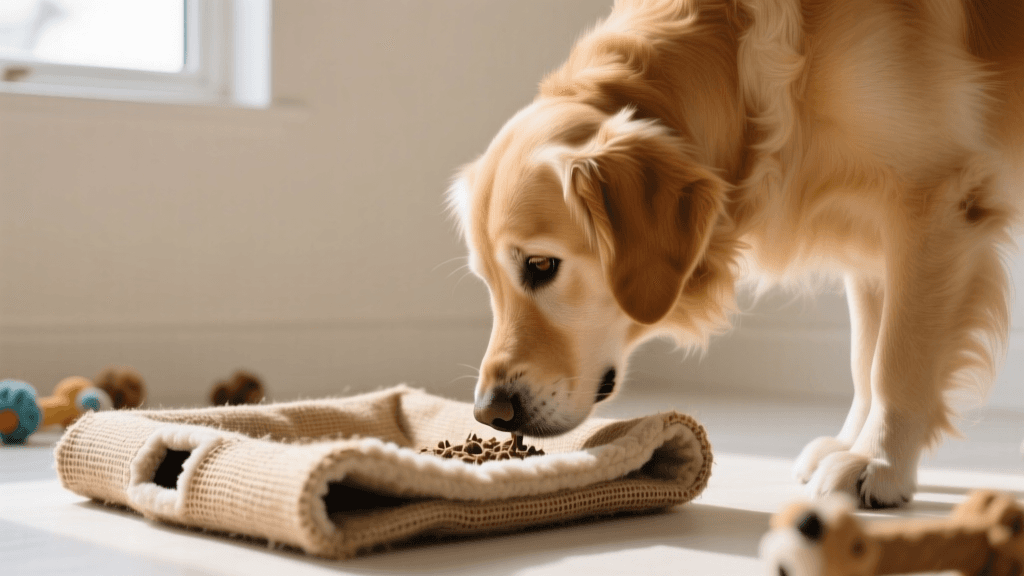
A snuffle mat is a fabric-based puzzle feeder that mimics the experience of foraging for food in tall grass. While commercial versions can cost upwards of $40, you can build a highly durable, customizable snuffle mat at home for under $15.
Materials and Measurements
- Base: 1 rubber sink mat with a grid of holes (approx. 12x18 inches). Cost: ~$5.
- Fabric: 2 yards of anti-pill fleece (fleece is ideal because it does not fray and is machine washable). Cost: ~$8.
- Tools: Fabric scissors and a ruler.
Step-by-Step Assembly
- Cut the Strips: Measure and cut your fleece into strips that are exactly 1 inch wide and 7 inches long. For a standard 12x18 sink mat, you will need approximately 300 to 350 strips. The more strips you use, the denser and more challenging the mat will be.
- Tie the First Row: Take one fleece strip and thread it through two adjacent holes in the rubber mat. Tie a simple, tight overhand knot. Ensure the knot is pulled snug against the rubber base.
- Build the Grid: Continue threading and knotting strips across the entire mat. For a denser puzzle, tie strips in every single hole, overlapping the knots so the rubber base is completely hidden.
- Fluff and Hide: Once all strips are tied, fluff the fleece 'grass' with your fingers. Sprinkle high-value treats (like freeze-dried liver or small kibble) deep into the base of the fleece strips.
Pro-Tip: To increase the psychological challenge, fold small pieces of cardboard or crinkle paper into the mat alongside the treats. The auditory feedback mimics the rustling of dry leaves in the wild, further engaging your dog's predatory sequence.
DIY Project 2: Homemade Scent Trails and 'Find It' Games
Scent work is a competitive canine sport, but you do not need professional equipment to harness its psychological benefits. You can create homemade scent trails using everyday household items to build your dog's confidence and focus.
The Scent Article Method
Dogs can be trained to isolate specific human scents or household odors. To start a DIY scent discrimination game:
- Select a 'scent article'—a clean wooden spoon, a specific cotton sock, or an unused ceramic mug.
- Rub the item gently between your hands to transfer your natural skin oils and scent.
- Place the item on the floor and reward your dog heavily with a treat the moment they sniff it. Repeat this until the dog associates the specific scent with a positive reward.
- Begin hiding the scented article in easy locations (under a pillow, behind a door). Use the cue 'Find it!' and reward enthusiastically when they locate the object.
This DIY game is particularly effective for reactive or anxious dogs. As noted in AKC training guides, scent work forces a dog to lower their head and engage their parasympathetic nervous system, which naturally reduces heart rate and promotes a state of calm focus.
Comparison Chart: Commercial Puzzles vs. DIY Scent Solutions
When deciding how to enrich your dog's environment, it is helpful to weigh the pros and cons of store-bought items versus homemade alternatives. Below is a structured comparison to help you make an informed choice for your dog's specific psychological needs.
| Feature | Commercial Plastic Puzzles | DIY Snuffle Mats & Scent Games |
|---|---|---|
| Average Cost | $20 - $60+ | $5 - $15 |
| Sensory Engagement | Low (Mostly visual/tactile) | High (Deep olfactory stimulation) |
| Customization | Fixed difficulty levels | Infinitely adjustable (hide depth, scent type) |
| Washability | Wipe clean (harbors bacteria in crevices) | Machine washable (fleece) |
| Noise Level | Loud (plastic clattering on hard floors) | Silent (soft fabric) |
| Destructibility | High (chewed plastic is a choking hazard) | Low (fleece is tear-resistant and safe) |
Reading Your Dog's Body Language During Scent Work
Understanding your dog's psychology also means learning to read their subtle body language during enrichment activities. Scent work should be a rewarding experience, but it can occasionally lead to frustration if the puzzle is too difficult. Observing your dog's physical cues will tell you if you need to adjust the difficulty of your DIY setup.
Signs of Healthy Engagement
- Soft, Relaxed Eyes: The dog's gaze is focused downward, with relaxed facial muscles.
- Rhythmic Tail Sweeps: A slow, sweeping wag at mid-mast indicates a relaxed, problem-solving state of mind.
- Deep, Prolonged Sniffing: The dog is actively processing olfactory data, often accompanied by slow, deliberate movements.
Signs of Frustration or Stress
- Pawing and Digging: If your dog abandons their nose and starts frantically digging at the snuffle mat with their front paws, they have become frustrated. Solution: Lift the mat, show them a treat, and place it higher up in the fleece to rebuild confidence.
- Lip Licking and Yawning: These are classic 'calming signals' dogs use when they feel stressed or confused.
- Shaking Off: If your dog suddenly stops and shakes their entire body as if wet, they are attempting to 'reset' their nervous system after a moment of mental tension.
Conclusion
Understanding your dog requires acknowledging that their reality is built on a foundation of scent. By integrating DIY snuffle mats and homemade scent trails into your daily routine, you are not just saving money—you are actively participating in your dog's psychological well-being. These simple, homemade solutions honor their evolutionary instincts, transform mealtime into a cognitive adventure, and foster a deeper, more empathetic bond between you and your canine companion.
anouk-beaumont
All our authors care for dogs every day — read more of their work on the authors page.