Best Calming Products For Anxious Dogs: A Buyer's Guide
Discover the best calming products for anxious dogs. Our buyer's guide reviews anxiety wraps, calming beds, and pheromones to soothe canine stress.
Understanding Canine Anxiety: The Psychology of Stress
To truly understand why certain calming products work, we must first look at canine psychology and the nervous system. When a dog encounters a trigger—be it a thunderstorm, a departing owner, or an unfamiliar environment—their sympathetic nervous system activates. This 'fight or flight' response floods the body with cortisol and adrenaline, elevating heart rate and causing visible stress signals like panting, pacing, whale eye, and trembling. As pet parents, our goal is to help engage the parasympathetic nervous system, which promotes 'rest and digest' behaviors. While behavioral modification and counter-conditioning are the gold standards for treating anxiety, specific products can act as powerful physiological bridges, helping to lower a dog's arousal threshold so they can actually learn and relax. In this comprehensive buyer's guide, we review the top categories of calming products through the lens of canine behavior, helping you choose the right tool for your dog's specific psychological needs.
1. Pressure Wraps and Anxiety Vests
How They Work: Deep Pressure Therapy and Proprioception
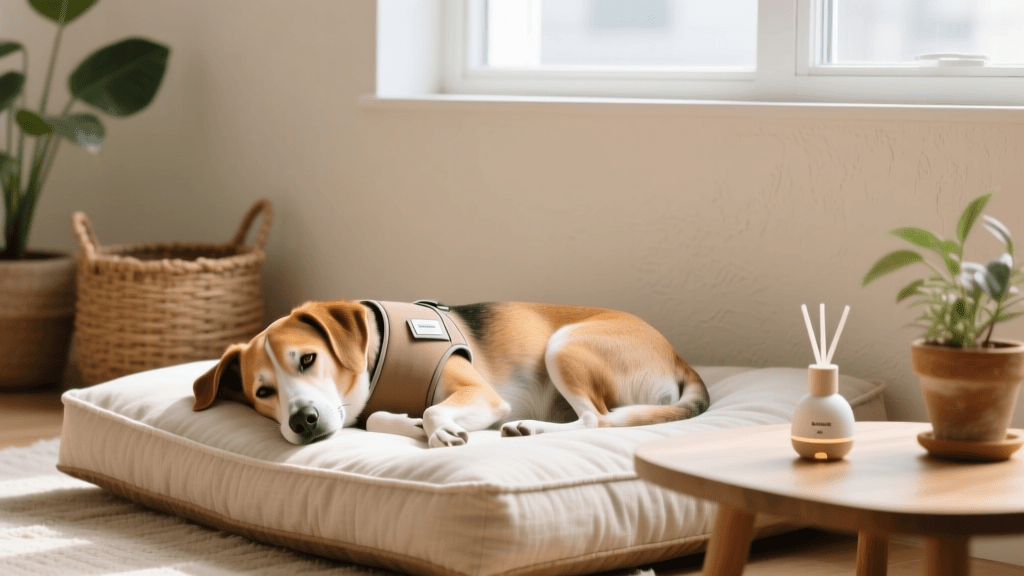
Anxiety wraps, such as the famous ThunderShirt, utilize a psychological and physiological concept known as Deep Pressure Therapy (DPT). In canine behavior, constant, gentle pressure provides profound proprioceptive input. Proprioception is the body's ability to sense its location, movements, and actions. When a dog wears a compression vest, the gentle squeezing sensation mimics the feeling of being held or swaddled. This tactile input stimulates the release of endorphins and oxytocin while simultaneously reducing the production of stress hormones. For dogs suffering from noise phobias (fireworks, thunderstorms) or generalized environmental anxiety, this physical grounding can interrupt the panic loop in the brain.
Buyer's Guide: Sizing, Costs, and Top Picks
Top Pick: The ThunderShirt Classic or Platinum (Cost: $45 - $55). The Platinum version features a more breathable, durable fabric and a patented strap system that avoids putting pressure on the male dog's anatomy.
Alternative: The Wrap-Tech Anxiety Wrap (Cost: $60 - $70). Designed by animal behaviorists, this wrap applies pressure to specific acupressure points rather than just general compression.
Actionable Advice: Sizing is critical for behavioral efficacy. If the vest is too loose, it provides no proprioceptive feedback; if it is too tight, it induces panic. Measure your dog's girth at the deepest part of the chest, just behind the front legs. Introduce the vest using classical conditioning: pair the sight of the vest with high-value treats (like boiled chicken or freeze-dried liver) before a stressor occurs. Never put the vest on a dog that is already in a full-blown panic attack without prior desensitization.
2. Dog Appeasing Pheromones (DAP)
How They Work: Olfactory Limbic Stimulation
Dogs experience the world primarily through their noses. The olfactory bulb in a dog's brain is proportionally much larger than in humans, and it is directly connected to the limbic system, which governs emotion and memory. Dog Appeasing Pheromones (DAP) are synthetic replicas of the pheromones secreted by a nursing mother dog to comfort and reassure her puppies. When an adult dog inhales these synthetic pheromones, the chemical signals are processed by the vomeronasal organ (Jacobson's organ) and send a primal, subconscious message of safety and security to the brain.
Buyer's Guide: Diffusers, Collars, and Sprays
Top Pick for Home Use: Adaptil Calm Home Diffuser (Cost: $25 - $30 for the starter kit; $18 for refills). A single diffuser covers up to 700 square feet and lasts for 30 days.
Top Pick for Travel: Adaptil Calm On-The-Go Collar (Cost: $15 - $20). The collar is activated by the dog's body heat and provides continuous pheromone release for up to 30 days.
Actionable Advice: Placement is everything. Do not plug a diffuser under a shelf, behind furniture, or near an open window, as the pheromone vapor will be disrupted or escape outside. Plug it into the room where your dog spends the most time or where their primary resting area is located. For separation anxiety, plug it in near the dog's safe space or crate. Remember that pheromones are odorless to humans, so do not assume the product has 'run out' just because you cannot smell it.
3. Bolster and 'Calming' Donut Beds
How They Work: Thigmotaxis and Denning Instincts
In canine psychology, thigmotaxis refers to an organism's response to physical contact or the proximity of a physical boundary. Dogs are den animals by evolutionary design, and they naturally seek out enclosed, supportive spaces when they feel vulnerable. 'Calming' beds—typically characterized by raised, plush bolsters or deep, shaggy donut shapes—cater directly to this instinct. The raised edges provide a physical boundary that the dog can press their spine or head against, satisfying their thigmotactic needs and providing a 360-degree field of security. This allows the dog to lower their vigilance, knowing their back is protected.
Buyer's Guide: Materials and Dimensions
Top Pick: Best Friends by Sheri The Original Calming Donut Bed (Cost: $40 - $120 depending on size). The deep crevices and shag vegan fur mimic the sensation of burrowing and resting against a mother's coat.
Alternative: Furhaven Orthopedic Bolster Sofa Bed (Cost: $35 - $80). Ideal for older dogs with arthritis who need firm orthopedic foam support combined with the psychological security of three-sided bolsters.
Actionable Advice: Measure your dog from the tip of their nose to the base of their tail, and add 6 to 8 inches to determine the correct bed diameter. If your dog is a 'sprawler,' a bolster bed may frustrate them; opt for a large, flat orthopedic mat instead. For anxious dogs, place the bed in a low-traffic, draft-free corner of the room to maximize the 'den' effect.
Comparison Chart: Top Calming Products for Dogs
| Product Category | Best Behavioral Trigger | Average Cost | Mechanism of Action | Time to Effect |
|---|---|---|---|---|
| Pressure Wraps (e.g., ThunderShirt) | Noise phobias, vet visits, acute stress | $45 - $70 | Proprioceptive deep pressure therapy | Immediate (upon proper fitting) |
| Pheromone Diffusers (e.g., Adaptil) | Separation anxiety, general home stress | $25 - $30 (Starter) | Vomeronasal olfactory limbic stimulation | 24 - 48 hours for environmental saturation |
| Pheromone Collars | Travel anxiety, boarding, socialization | $15 - $20 | Localized body-heat activated pheromones | Immediate (upon body heat activation) |
| Calming Donut/Bolster Beds | Vigilance, insecurity, need for a safe space | $40 - $120 | Thigmotaxis and evolutionary denning | Immediate (upon resting) |
Matching the Product to the Behavioral Trigger
Understanding your dog's specific anxiety profile is crucial for selecting the right product. Not all anxiety is created equal, and a product that works wonders for a thunderstorm might be ineffective for separation distress.
- Noise Phobias (Fireworks, Thunder): Pressure wraps are your first line of defense. The acute, intense nature of noise phobias requires immediate proprioceptive grounding. Pair the wrap with white noise or classical music to mask the auditory triggers.
- Separation Anxiety: Pheromone diffusers combined with a secure, thigmotactic bed are ideal. Separation anxiety is a chronic state of panic related to isolation. Creating a 'safe zone' saturated with appeasing pheromones helps lower the dog's baseline stress levels while you work on gradual desensitization to your departure cues.
- Travel and Boarding Stress: Pheromone collars are highly recommended. Because you cannot plug a diffuser into a car or a kennel facility, a collar ensures the dog carries their chemical 'safe space' with them wherever they go.
What the Science and Experts Say
While the pet industry is flooded with anecdotal 'miracle cures' for anxiety, it is important to rely on veterinary behaviorists and established organizations. According to the ASPCA, products and environmental modifications are most effective when used as part of a comprehensive behavior modification plan, rather than as standalone cures for severe separation anxiety. Pheromones and wraps lower the threshold of fear, making the dog receptive to training, but they do not erase the underlying psychological association.
Furthermore, the American Kennel Club (AKC) notes that while anxiety jackets are highly effective for many dogs, a subset of canines may experience increased stress if they are not properly desensitized to the feeling of being restrained. This highlights the importance of classical conditioning—associating the product with positive outcomes before the actual stressor occurs. Similarly, veterinary studies on Dog Appeasing Pheromones indicate that DAP can significantly reduce fear responses in novel environments, making it a staple recommendation in fear-free veterinary practices.
Final Thoughts: Products vs. Training
When navigating the buyer's guide for canine calming products, remember that these tools are exactly that—tools. A ThunderShirt cannot teach a dog that the mail carrier is not a threat, and an Adaptil diffuser cannot cure severe isolation distress on its own. However, by understanding the psychological mechanisms behind deep pressure therapy, olfactory stimulation, and thigmotaxis, you can strategically deploy these products to give your dog the physiological support they need to feel safe. Always consult with a certified professional dog trainer (CPDT-KA) or a veterinary behaviorist to develop a holistic protocol that combines the right products with science-based, force-free behavioral modification.
jonas-cole
All our authors care for dogs every day — read more of their work on the authors page.