DIY Snuffle Mats: Unlocking Your Dog's Olfactory Psychology
Discover how to build DIY snuffle mats and scent games to satisfy your dog's natural foraging instincts and boost their mental well-being.
The Science of Sniffing: Understanding the Canine Olfactory Brain
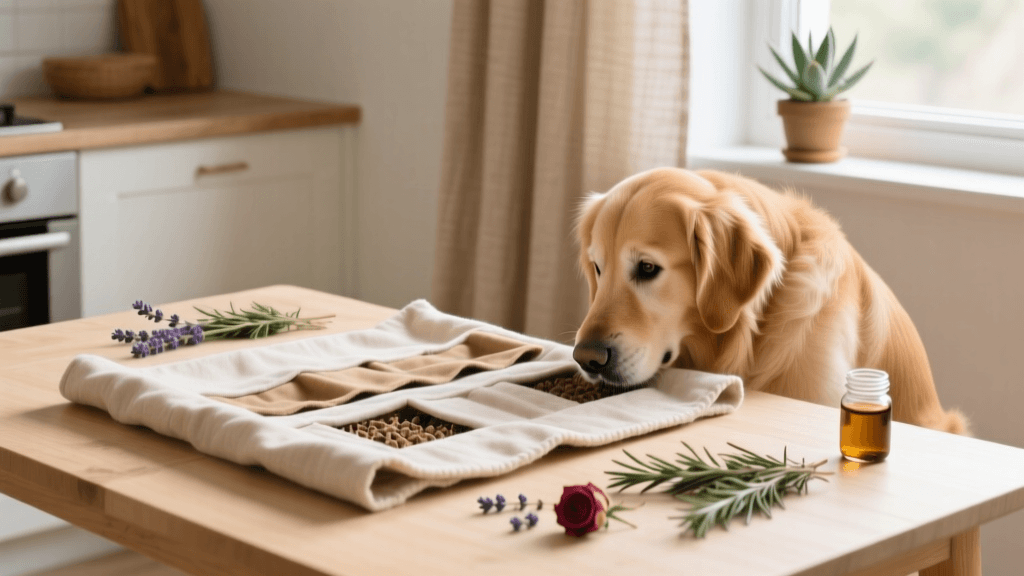
To truly understand your dog, you must first understand how they perceive the world. While humans are highly visual creatures, dogs experience their environment primarily through scent. A dog's nose is a biological marvel, equipped with up to 300 million olfactory receptors compared to our mere six million. Furthermore, the part of a dog's brain that is devoted to analyzing smells is proportionally 40 times larger than ours.
When your dog stops on a walk to sniff a fire hydrant, they are not just smelling urine; they are reading a complex chemical bulletin board. They can determine the age, gender, health status, and even the emotional state of the dogs that have passed by. This intense cognitive processing is why scent work is so exhausting for them. In fact, twenty minutes of concentrated sniffing can provide the same level of mental fatigue as an hour of rigorous physical exercise.
According to the ASPCA, providing mental enrichment through scent-based activities is crucial for preventing behavioral issues such as excessive barking, chewing, and digging. When we ignore a dog's olfactory psychology, we leave a massive portion of their brain under-stimulated. By integrating DIY scent games into your routine, you are speaking directly to your dog's primal instincts, offering them a profound sense of purpose and psychological satisfaction.
Step-by-Step Guide: Crafting the Ultimate DIY Snuffle Mat
A snuffle mat is a homemade foraging toy that mimics the experience of hunting for food in tall grass. It taps into your dog's natural scavenging instincts, slowing down their eating pace and engaging their problem-solving skills. Best of all, you can make one at home for a fraction of the cost of retail versions.
Materials and Costs
To build a durable, high-quality snuffle mat, you will need the following supplies:
- One heavy-duty plastic sink mat with a grid of holes (Cost: approx. $5 to $8 at hardware stores).
- Two yards of anti-pill fleece fabric in three different colors (Cost: approx. $10 to $15). Avoid thin fabrics that can easily tear and become a choking hazard.
- Sharp fabric scissors.
- High-value, dry training treats or your dog's regular kibble.
Total estimated cost: Under $25, which is significantly cheaper than premium commercial snuffle mats that often exceed $50.
Assembly Instructions
- Wash and dry the fleece fabric to remove any manufacturing residues.
- Cut the fleece into long strips, measuring approximately 1 inch wide and 7 inches long. You will need roughly 300 to 400 strips depending on the density you desire.
- Take one strip of fleece and thread it through two adjacent holes in the sink mat.
- Pull the ends through the loop to create a secure, tight knot.
- Repeat this process across the entire mat, alternating colors to create a visually stimulating, dense 'lawn' of fleece.
- Once completed, fluff the strips outward. To use, simply scatter dry treats deep into the fleece base and let your dog sniff them out.
Advanced DIY Scent Games: The Cardboard Foraging Box
If you want to test your dog's problem-solving abilities and persistence, the DIY cardboard foraging box is an exceptional, zero-cost alternative. This game is particularly beneficial for high-energy working breeds like Border Collies, German Shepherds, and Terriers, who possess a strong psychological drive to dismantle and 'dissect' their prey.
Save your delivery boxes, paper towel tubes, and egg cartons. Place a layer of crumpled, dog-safe packing paper at the bottom of a large cardboard box. Scatter a handful of strong-smelling treats, such as freeze-dried liver or small pieces of cheese. Add the paper towel tubes, some stuffed with treats and folded at the ends, and cover everything with more crumpled paper.
When you introduce this to your dog, supervise them closely to ensure they do not ingest large pieces of cardboard. This activity allows them to use their paws and nose simultaneously, engaging their motor skills and spatial awareness while fulfilling their instinctual urge to dig and tear.
Feature Comparison: Commercial Puzzles vs. DIY Scent Solutions
Understanding the pros and cons of different enrichment tools helps you tailor your approach to your dog's specific psychological needs. Below is a comparison chart to help you decide which method suits your lifestyle and your dog's behavior.
| Feature | Commercial Puzzle Toys | DIY Snuffle Mats | DIY Cardboard Boxes |
|---|---|---|---|
| Initial Cost | High ($15 - $45) | Low ($10 - $25) | Free (Upcycled items) |
| Durability | Very High (Hard plastics) | Moderate to High | Low (Destroyed in use) |
| Mental Stimulation | Moderate (Repetitive actions) | High (Scent tracking) | Very High (Multi-sensory) |
| Customization | None | High (Colors, density) | Unlimited |
| Supervision Needed | Low | Moderate | High (Ingestion risk) |
Decoding Canine Body Language During Scent Work
As a responsible owner, it is vital to observe your dog's body language while they engage with your homemade solutions. Scent work should be a rewarding, confidence-building experience. The American Kennel Club (AKC) emphasizes that nose work games should foster a state of 'flow' and focus, rather than anxiety or frustration.
Signs of Engagement and Flow
When your dog is successfully utilizing their olfactory brain, you will notice specific calming signals and focused behaviors. Their breathing will be rhythmic and deep, utilizing the specialized slits on the sides of their nostrils to continuously draw in air. Their ears will be relaxed or slightly forward, and their tail will likely sweep in a low, steady rhythm. A closed, relaxed mouth and a soft gaze indicate that your dog is deeply concentrated and psychologically fulfilled.
Signs of Frustration and Stress
Conversely, if a DIY puzzle is too difficult or the treats are not enticing enough, your dog may exhibit stress signals. Watch for excessive lip licking, yawning, pinned-back ears, or a stiff, high tail. If your dog begins to aggressively paw at the snuffle mat, bite the fleece in frustration, or bark at the cardboard box, they have crossed the threshold from engaged problem-solving to frustrated venting. When this happens, immediately intervene by making the task easier. Lift the fleece strips to expose the treats or tear open the cardboard boxes to release the scent. Your goal is to build their confidence, not test their patience.
Troubleshooting Your Homemade Enrichment Routine
Some dogs, particularly those accustomed to eating from a bowl in seconds, may not immediately understand the concept of foraging. If your dog stares blankly at the snuffle mat, start by placing the treats at the very top of the fleece. Praise them enthusiastically when they eat the visible treats. Gradually push the treats deeper into the mat over several days.
For dogs that are highly food-motivated and tend to inhale their meals, you can increase the difficulty by mixing kibble with highly aromatic, novel scents like a dab of dog-safe peanut butter on a cotton swab hidden within the mat. This forces them to slow down and process multiple layers of olfactory information.
Ultimately, incorporating DIY scent solutions into your dog's daily life is about more than just keeping them busy. It is about honoring their biological heritage, respecting their unique sensory perception, and deepening the psychological bond between you and your canine companion. By taking the time to craft these homemade enrichment tools, you are actively participating in your dog's mental health, ensuring they lead a balanced, fulfilled, and truly understood life.
tom-renshaw
All our authors care for dogs every day — read more of their work on the authors page.