DIY Dog Agility Equipment: Budget Training At Home Guide
Learn how to build DIY dog agility equipment on a budget. Save money while boosting your dog's obedience, fitness, and bond with these easy tutorials.
The High Cost of Canine Fitness and Obedience
Dog ownership is a profound financial commitment. Between premium kibble, routine veterinary care, pet insurance, and unexpected medical emergencies, the cost of caring for a canine companion can quickly add up. When budgets tighten, professional training and specialized canine sports are often the first expenses to be cut. However, neglecting mental and physical stimulation can lead to destructive behaviors, anxiety, and a breakdown in obedience—issues that ultimately cost far more in damaged property and behavioral rehabilitation. Fortunately, providing elite-level training and enrichment does not require a massive budget. By embracing a DIY approach to dog agility and obedience training, you can create a world-class backyard training facility for a fraction of the cost of commercial gear.
Why Agility Training is a Budget-Friendly Game Changer
Agility is more than just a competitive sport; it is a comprehensive training modality that builds confidence, reinforces obedience, and burns off excess energy. According to the American Kennel Club (AKC), agility is one of the most popular canine sports because it strengthens the bond between handler and dog through clear communication and positive reinforcement. Commercial agility equipment, however, is notoriously expensive. A single regulation jump can cost upwards of $150, and a full course can easily exceed $1,500. By utilizing hardware store materials and household items, you can replicate the training benefits of professional equipment while keeping your wallet intact.
Step-by-Step DIY Agility Equipment Guide
1. The PVC Regulation Jump (Cost: ~$15)
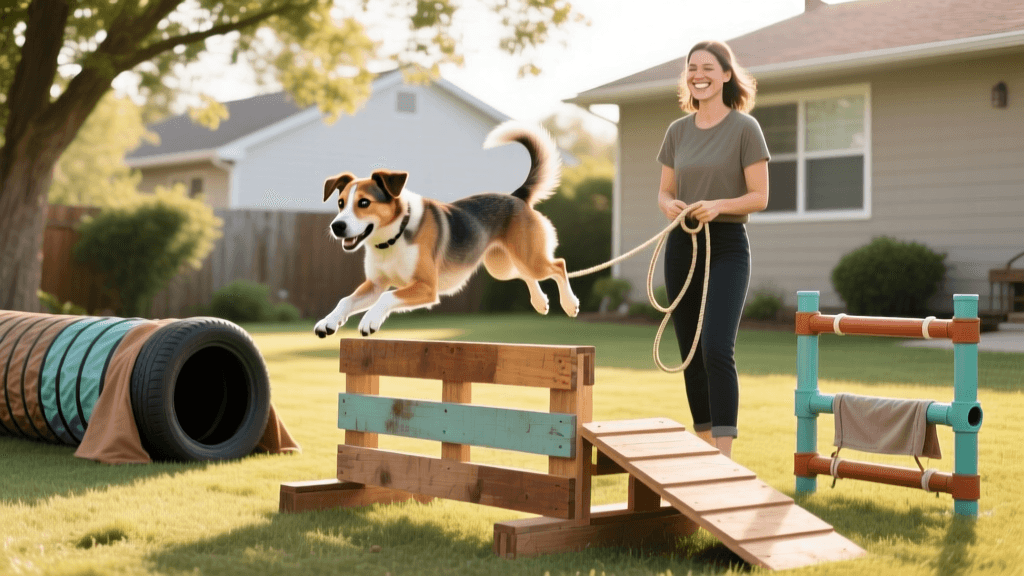
The standard bar jump is the foundation of any agility course. Building your own requires a quick trip to a local hardware store. You will need 3/4-inch PVC pipe, which is lightweight, durable, and safe for dogs.
- Materials: Three 10-foot lengths of 3/4-inch PVC pipe, four PVC T-joints, four PVC end caps, and a hacksaw.
- Cutting Guide: Cut two 36-inch pieces for the uprights. Cut four 12-inch pieces for the base feet. Cut one 48-inch piece for the crossbar.
- Assembly: Attach the T-joints to the bottom of the 36-inch uprights. Insert the 12-inch base pieces into the T-joints to create a stable, cross-shaped base. Cap the ends of the base pieces to prevent dirt from entering and to provide a smooth finish. The 48-inch crossbar simply rests across the top of the uprights.
- Training Tip: Never secure the crossbar with screws or glue. It must fall easily if your dog misjudges the height to prevent injury.
2. The Hula Hoop Tire Jump (Cost: ~$12)
The tire jump teaches dogs to focus on a specific opening and judge their spatial awareness.
- Materials: A 24-inch or 30-inch plastic hula hoop, two heavy-duty bungee cords, and a PVC base (constructed similarly to the standard jump, but with taller 48-inch uprights and horizontal arms extending outward to hold the bungee cords).
- Assembly: Suspend the hula hoop from the horizontal PVC arms using the bungee cords. The bungee cords act as a safety release mechanism; if the dog clips the hoop, it will detach rather than tipping the heavy base onto the dog.
- Training Tip: Start with the hoop resting directly on the ground. Lure your dog through the center using a high-value treat, rewarding them the moment all four paws pass through the opening.
3. Backyard Weave Poles (Cost: ~$20)
Weave poles are notoriously difficult to train and expensive to buy. Commercial sets feature complex metal bases and flexible poles. You can replicate this using garden supplies.
- Materials: Six to twelve 4-foot fiberglass garden stakes (available in the gardening section for about $2 each) and a measuring tape.
- Assembly: Push the stakes directly into your lawn, spacing them exactly 24 inches apart in a straight line. The flexibility of the fiberglass mimics commercial poles, and if a dog bumps them, they bend safely.
- Training Tip: Use the 'Channel Method' for training. Start by angling the poles outward to create a wide runway down the middle. As your dog learns to run through the channel, gradually push the poles into a straight line over several weeks.
Cost Comparison: Commercial vs. DIY Agility Gear
To truly understand the savings, consider the following breakdown comparing retail competition-grade equipment to our DIY hardware store alternatives.
| Equipment Type | Commercial Cost | DIY Cost | Total Savings |
|---|---|---|---|
| Standard Bar Jump | $120 - $250 | $15 | $105+ |
| Tire Jump | $150 - $300 | $12 | $138+ |
| Weave Poles (6 Set) | $200 - $400 | $12 | $188+ |
| Pause Box | $80 - $150 | $0 (Use Tape) | $80+ |
| Total Course | $550 - $1,100 | $39 | $511+ |
Budget Obedience: Using Household Items for Core Training
Agility is fantastic for physical exertion, but core obedience is the bedrock of a well-behaved dog. You do not need expensive training platforms or specialized gear to teach foundational commands. The Humane Society of the United States emphasizes that consistency, patience, and positive reinforcement are the true drivers of obedience, not expensive tools.
The 'Place' Command on a Budget
The 'Place' command teaches your dog to settle on a specific mat, which is invaluable for impulse control and keeping your dog out of the way when guests arrive or when you are cooking. Instead of buying a $60 elevated training cot, use a $3 rubber-backed bath mat or an old folded towel. Because the texture of the mat is distinct from your carpet or hardwood floors, your dog will quickly learn to differentiate their 'Place' from the rest of the room.
DIY Scent Work and Enrichment
Mental fatigue tires a dog out just as much as physical exercise. Scent work is a highly engaging, zero-cost activity. Save your cardboard delivery boxes and toilet paper tubes. Crumple them up, hide a few pieces of kibble inside, and place them in a pile. Let your dog use their nose to forage for their meal. This mimics natural scavenging behaviors and provides immense mental stimulation without requiring a single specialized toy.
Budget-Friendly Training Treats
When shaping new behaviors like agility weaves or a reliable recall, you need high-value rewards. Commercial training treats can cost $8 to $12 for a tiny 8-ounce bag, which is a terrible return on investment. Here is how to create a bulk supply of high-value rewards for under $10.
- Boiled Chicken Breast: A family-pack of chicken breasts costs roughly $2.50 per pound. Boil three pounds of chicken in unsalted water, shred it, and store it in the freezer. Thaw small portions for training sessions. This is the gold standard for high-value rewards.
- Hot Dog Slices: For extreme distractions (like outdoor recall training), cheap beef hot dogs can be sliced into pea-sized pieces and microwaved for two minutes to dry them out, making them less messy to carry in your pocket.
- The Kibble Exchange: For repetitive luring (like shaping a down-stay), use your dog's daily kibble allotment. Deduct their training treats from their dinner bowl to prevent overfeeding and obesity.
Training Protocols and Safety Guidelines
Having the equipment is only half the battle; knowing how to use it safely and effectively is where the real training happens. Whether you are practicing on a DIY PVC jump or working on basic sit-stays in your living room, adhere to these professional protocols:
- Keep Sessions Short: Dogs learn best in micro-sessions. Limit your training to 10 to 15 minutes, two to three times a day. Long sessions lead to frustration and diminished returns.
- End on a Win: Always finish your session with a command your dog knows perfectly, reward heavily, and release them to play. This ensures they remain eager for the next session.
- Prioritize Warm-Ups: Just like human athletes, dogs need to warm up before tackling agility equipment. Spend five minutes doing brisk walking, figure-eights through your legs, and gentle stretching before asking them to jump.
- Surface Matters: Never practice agility jumps or weaves on concrete, asphalt, or slick hardwood floors. Always train on grass, dirt, or specialized rubber matting to protect your dog's joints and prevent paw pad abrasions.
Patience is the ultimate budget-friendly training tool. Rushing the process leads to confusion and fear, which will cost you months of behavioral rehabilitation later. Let your dog figure out the puzzle at their own pace, and reward the effort, not just the final result.
Moving Forward: Free Resources and Community
As your dog masters your DIY backyard course, you may want to explore formal competition or advanced handling techniques. Organizations like the United States Dog Agility Association (USDAA) offer free downloadable course maps and rulebooks online, allowing you to set up official, regulation-sized courses in your local park using your portable DIY gear. Additionally, local dog training clubs often host 'fun matches' or open practice sessions for a nominal fee of $5 to $10, providing a low-cost way to test your dog's skills in a distracting, novel environment.
Ultimately, budget-friendly dog care is not about depriving your pet of quality experiences; it is about leveraging creativity, time, and effort to replace expensive commercial solutions. By building your own agility equipment, utilizing household items for obedience training, and preparing your own high-value rewards, you are investing the most valuable resource of all—your time—directly into your relationship with your dog. The result is a fit, obedient, and deeply bonded companion, achieved without breaking the bank.
jonas-cole
All our authors care for dogs every day — read more of their work on the authors page.