Balancing Training Treats and Daily Canine Nutrition
Learn how to balance high-value training treats with your dog's daily diet to prevent obesity while maintaining focus during obedience sessions.
The Hidden Cost of Positive Reinforcement
Modern dog training relies heavily on positive reinforcement, a scientifically backed method that rewards desired behaviors to increase the likelihood of them being repeated. Whether you are teaching a puppy basic sit commands, shaping complex agility sequences, or engaging in behavioral modification for leash reactivity, food remains the most potent and practical tool in a trainer's arsenal. However, this reliance on food rewards introduces a significant health challenge that many dog owners overlook: caloric overload.
According to the Association for Pet Obesity Prevention, over 55 percent of dogs in the United States are classified as overweight or obese. Excess weight in canines is not merely a cosmetic issue; it drastically reduces life expectancy and increases the risk of osteoarthritis, diabetes, and cardiovascular disease. When you are conducting a fifteen-minute obedience session and handing out a treat every thirty seconds, the calories accumulate rapidly. This deep dive explores how to strategically manage your dog's nutritional intake during training, ensuring peak mental performance without compromising their long-term physical health.
Understanding the Ten Percent Rule
The foundation of managing training treats lies in the widely accepted veterinary guideline known as the Ten Percent Rule. The World Small Animal Veterinary Association (WSAVA) Global Nutrition Committee recommends that treats, chews, and table scraps should never constitute more than 10 percent of a dog's total daily caloric intake. The remaining 90 percent must come from a complete and balanced commercial or veterinary-formulated diet to ensure the dog receives essential micronutrients, vitamins, and minerals.
For a highly active dog undergoing intensive daily training, hitting that 10 percent threshold is remarkably easy. If you are using standard commercial training bites that contain 15 calories each, and you conduct a session requiring 20 repetitions, you have already fed your dog 300 calories. For many small to medium-sized breeds, 300 calories exceeds their entire daily treat allowance, meaning you must subtract an equivalent amount of kibble from their regular meals to maintain a neutral energy balance.
Calculating Your Dog's Daily Caloric Needs
To effectively balance training rewards, you must first determine your dog's Maintenance Energy Requirement (MER). This is the number of calories your dog needs daily to maintain their current weight, factoring in their age, neuter status, and activity level.
The calculation begins with the Resting Energy Requirement (RER), which is the baseline energy needed for basic bodily functions. The formula is:
RER = 70 x (body weight in kg)^0.75
For example, a 44-pound (20 kg) dog has an RER of approximately 661 calories per day. To find the MER, you multiply the RER by a specific life-stage multiplier. For a neutered adult dog with a normal activity level, the multiplier is 1.6. Therefore, the MER is 661 x 1.6 = 1,058 calories per day.
Applying the 10 percent rule, this 44-pound dog can safely consume a maximum of 105 calories from treats daily. If you are using Zuke's Mini Naturals (approximately 3 calories per treat), you have a budget of 35 treats per day. If you switch to freeze-dried liver (approximately 10 calories per piece), your budget drops to just 10 treats. Understanding this math is critical for structuring your training sessions and selecting the appropriate reward density.
Strategic Treat Selection for Obedience Training
Not all training scenarios require the same level of motivation. A dog practicing a familiar 'down-stay' in a quiet living room requires far less incentive than a dog practicing recall in a park full of distractions. Categorizing your treats by value and caloric density allows you to match the reward to the difficulty of the task.
| Treat Type | Calories (Per Piece/Oz) | Avg Cost (Per Ounce) | Best Training Use | Nutritional Note |
|---|---|---|---|---|
| Commercial Soft Bites | 3 - 5 calories | $1.20 | Repetitive drills, shaping, indoor obedience | Often contain added sugars and preservatives |
| Freeze-Dried Liver | 10 - 12 calories | $2.50 | High distraction environments, recall, agility | Single ingredient, very high protein, rich in Vitamin A |
| Boiled Chicken Breast | 35 calories (per oz) | $0.50 | Behavioral modification, counter-conditioning | Lean protein, highly digestible, no additives |
| Fresh Blueberries | 1 calorie (per berry) | $0.40 | Puppy training, rapid-fire marking, luring | High in antioxidants, low glycemic index |
| Dog's Daily Kibble | 3 - 8 calories | $0.15 | Foundational obedience, household manners | Perfectly balanced, prevents dietary upset |
Low-Calorie Whole Food Alternatives
When your training session requires high-volume repetition, such as loose-leash walking or heelwork, commercial treats can quickly blow your dog's caloric budget. Whole foods offer an excellent, cost-effective alternative that supports canine health.
- Green Beans: Canned (no salt added) or steamed fresh green beans cost roughly $0.15 per ounce and contain only 2 calories per bean. They are high in fiber, which promotes satiety, making them ideal for food-motivated dogs on a weight management plan.
- Carrots: Baby carrots or diced raw carrots provide a satisfying crunch for about 4 calories per baby carrot. They are excellent for dental health and cost less than $0.20 per ounce.
- Watermelon: Seedless watermelon cubes (rind removed) are 92 percent water, making them a hydrating, low-calorie (1.5 calories per cube) summer training treat. Cost averages $0.30 per ounce.
Preparation Tip: Always dice whole foods into uniform, pea-sized pieces (approximately 1/4 inch cubes). Dogs do not care about the size of the treat; they care about the frequency of the reward. A single blueberry swallowed whole is just as reinforcing as a large biscuit, but it carries a fraction of the caloric load.
Timing Your Training Sessions for Optimal Digestion
The intersection of training and nutrition also involves the timing of meals. Vigorous physical activity combined with a full stomach poses a severe health risk, particularly for large, deep-chested breeds like Great Danes, Standard Poodles, and German Shepherds. Gastric Dilatation-Volvulus (GDV), commonly known as bloat, is a life-threatening condition where the stomach fills with gas and twists on itself.
The American Kennel Club strongly advises against exercising or engaging dogs in strenuous training sessions immediately before or after eating. To mitigate the risk of GDV and prevent exercise-induced regurgitation, schedule your intensive training sessions either one hour before your dog's main meal, or wait at least two hours after they have eaten. Training on a slightly empty stomach also naturally increases your dog's food drive, making them more responsive to the treats you are offering.
The 'Kibble as Treat' Method and Meal Deduction
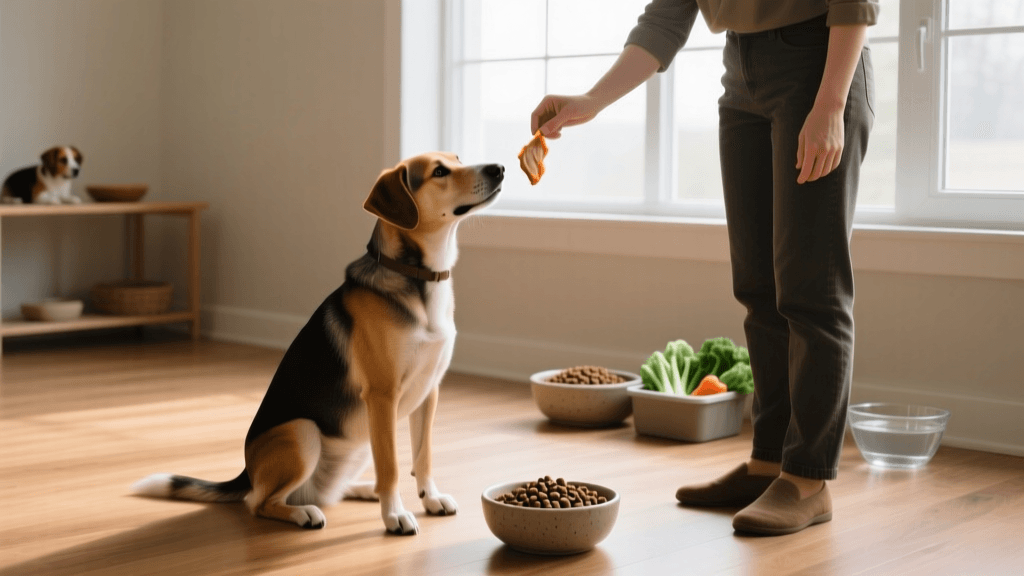
For dogs that are highly food-motivated, the most nutritionally sound strategy is to use their daily allotment of kibble as their primary training reward. Measure out your dog's total daily kibble requirement in the morning. Place 10 percent of that kibble into a separate training pouch, and feed the remaining 90 percent in their bowl at mealtime. This guarantees that you will never accidentally overfeed your dog, regardless of how long your training session lasts. If you do not use all the kibble in the pouch during training, simply return it to their food bowl for dinner.
If you must use higher-value treats like cheese or hot dogs for a difficult behavioral modification protocol, you must actively deduct those calories from their daily bowl. One standard hot dog contains roughly 150 calories. If you use half a hot dog (75 calories) for a training session, you must remove approximately 1/4 cup of standard dry kibble from their dinner to maintain the caloric equilibrium.
Transitioning from Food Lures to Variable Rewards
A common mistake in obedience training is relying on food for every single repetition indefinitely. This not only strains your dog's digestive system and waistline but also creates a dog that will only perform commands when they see a treat in your hand. To protect your dog's nutritional health, you must systematically fade the food lure and transition to a variable ratio schedule of reinforcement.
Once a dog reliably understands a command, stop rewarding them every single time. Instead, reward them unpredictably—perhaps on the third repetition, then the first, then the fifth. This 'slot machine' effect actually increases the dog's drive and focus, as they work harder in anticipation of the unknown reward. By interspersing high-value treats with verbal praise, toy play, and life rewards (like being released to sniff a bush), you can drastically reduce the volume of food consumed during training while simultaneously building a more reliable, engaged working dog.
Ultimately, successful dog training is an exercise in holistic management. By respecting the ten percent rule, calculating precise caloric needs, utilizing low-calorie whole foods, and timing sessions to protect digestive health, you can forge a powerful training bond without sacrificing your dog's physical well-being.
robin-maitland
All our authors care for dogs every day — read more of their work on the authors page.