Decoding The Viral Guilty Dog Look: Myth Vs Reality
Is your dog's viral guilty look a real apology? Discover the science behind canine appeasement signals and how to manage destructive behavior.

The Internet’s Favorite Canine Myth
Every week, a new video goes viral on TikTok or Instagram Reels featuring a dog looking incredibly "guilty" next to a destroyed couch cushion, an emptied trash can, or a chewed-up pair of designer shoes. These videos accumulate millions of views because they tap into our human tendency to anthropomorphize our pets. We see the lowered head, the averted eyes, and the tucked tail, and we immediately project our own complex emotions onto our furry companions. We laugh, we share, and we assume the dog knows exactly what they did wrong and feels remorseful about it.
However, as canine behavioral science has advanced, a very different reality has emerged. The viral "guilty look" is not an admission of wrongdoing, nor is it a canine apology. Understanding what this body language actually means is crucial for any dog owner looking to build a trusting, fear-free relationship with their pet. Misinterpreting these signals often leads to ineffective training methods, increased anxiety, and a breakdown in communication between human and hound.
The Science: What Research Tells Us
The definitive study on this phenomenon was conducted by Dr. Alexandra Horowitz, a leading cognitive scientist and founder of the Dog Cognition Lab at Barnard College. In her groundbreaking research, Horowitz set up a controlled environment where dogs were either given or denied a forbidden treat while their owners were out of the room. When the owners returned, they were instructed to either scold the dog or greet the dog warmly, regardless of whether the dog had actually eaten the treat.
The results were illuminating. The dogs displayed the classic "guilty" body language most frequently when they were scolded by their owners, completely irrespective of whether they had actually disobeyed. The dogs that were falsely accused of eating the treat showed just as much "guilt" as the dogs that had actually eaten it. According to the American Kennel Club, dogs do not possess the complex secondary emotions required for guilt, which requires a deep understanding of past actions and moral standards. Instead, they are reacting to the immediate social environment and the owner's tone of voice.
Decoding Canine Appeasement Signals
What the internet calls "guilt" is actually a cluster of canine appeasement signals. In the wild and in domestic settings, dogs use appeasement behaviors to diffuse tension, signal non-aggression, and pacify a perceived threat. When you walk into a room, see the destroyed shoes, and your body language shifts—your shoulders tense, your breathing changes, and your tone drops—your dog immediately reads your micro-expressions. They do not connect your anger to the shoes; they connect your anger to their current presence.
To better understand the difference between human emotions and canine communication, review the comparison table below:
| Feature | Human Guilt | Canine Appeasement |
|---|---|---|
| Trigger | Internal moral compass and reflection | External social pressure and owner's body language |
| Core Emotion | Remorse, regret, empathy | Fear, anxiety, desire to pacify and avoid conflict |
| Timing | Can reflect on past actions (hours or days later) | Strictly tied to the immediate present moment |
| Physical Signs | Avoiding eye contact, slumping, verbal apologies | Whale eye, lip licking, yawning, lowered posture, tucked tail |
The Psychology of Timing: Why Scolding Fails
One of the most fundamental rules of canine psychology is the associative learning window. For a dog to associate a consequence (positive or negative) with a specific behavior, the consequence must occur within one to three seconds of the action. This is often referred to as the "3-second rule" in dog training.
If your dog chews up a pillow at 10:00 AM, and you come home from work at 5:00 PM to discover the mess, scolding the dog is entirely counterproductive. The dog's brain is incapable of linking your 5:00 PM anger to the 10:00 AM pillow chewing. Instead, the dog learns a different, equally damaging lesson: "When my human comes home, bad things happen, and I need to act submissive to avoid their wrath." Behaviorists at the ASPCA note that punishment after the fact only creates fear and damages the human-animal bond without stopping the unwanted behavior.
Breed-Specific Instincts: Why They Do It
Destructive behavior is rarely born out of spite; it is usually a manifestation of unmet biological needs or breed-specific instincts. Understanding your dog's genetic background is key to addressing the root cause of the behavior.
- Terriers (e.g., Jack Russell, Rat Terrier): Bred to hunt and dig out vermin. If they don't have an outlet for digging and tearing, they will "hunt" the stuffing out of your couch.
- Retrievers (e.g., Golden, Labrador): Bred to carry game in their mouths. They have a high biological need to mouth and chew objects, especially during adolescence and teething phases.
- Hounds (e.g., Beagles, Coonhounds): Driven by scent. They will destroy trash cans or pantry doors not out of malice, but because their olfactory senses are overpowering their impulse control.
Actionable Solutions: Prevention and Enrichment
Since scolding after the fact is scientifically proven to be ineffective, how do we stop the destruction? The answer lies in proactive management and targeted enrichment. The Humane Society of the United States emphasizes that destructive chewing is usually a symptom of boredom or anxiety, requiring environmental adjustments rather than punishment.
1. Environmental Management
Set your dog up for success by removing the opportunity to fail. If your dog is prone to counter-surfing or trash-raiding, invest in heavy-duty baby gates or a secure crate. A high-quality wire crate (such as the MidWest Homes for Pets iCrate, costing between $50 and $80) provides a safe den environment. Ensure the crate is introduced positively, using high-value treats, so it is viewed as a sanctuary, not a prison.
2. Targeted Mental Enrichment
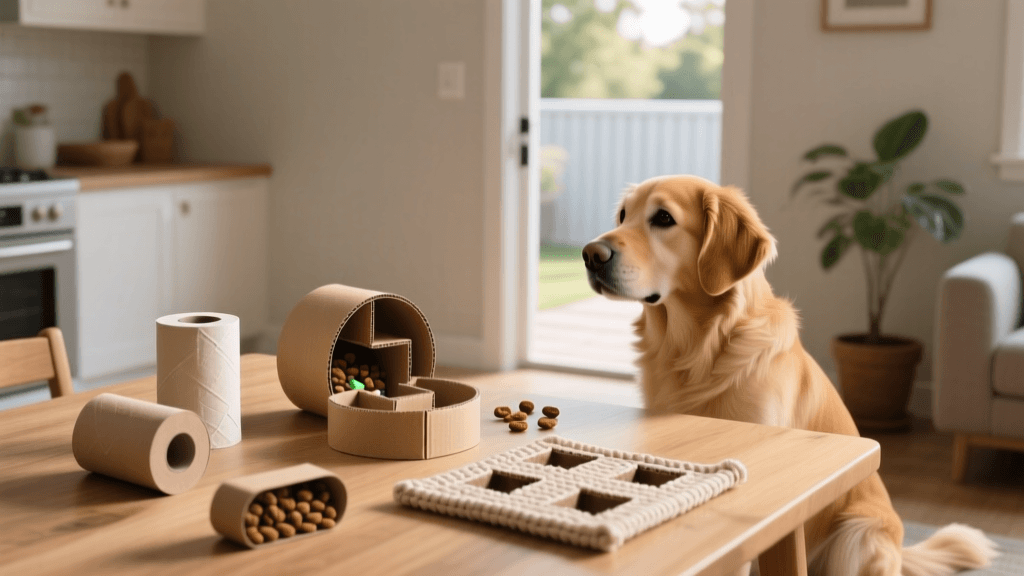
A tired dog is a good dog, but mental fatigue is often more effective than physical exhaustion. Incorporate these specific enrichment tools into your daily routine:
- KONG Classic Dog Toy ($15 - $25): Do not just hand it to your dog empty. Stuff it with plain Greek yogurt, mashed bananas, and a few blueberries. Freeze it for exactly 4 hours before giving it to your dog before you leave the house. This provides up to 45 minutes of focused, soothing licking and chewing, which releases endorphins in the canine brain.
- Outward Hound Nina Ottosson Dog Brick Puzzle ($20 - $30): This intermediate-level puzzle requires the dog to flip lids and slide blocks to find hidden kibble. It engages their problem-solving instincts and tires them out mentally.
- Snuffle Mats ($20 - $40): Perfect for hounds and scent-driven breeds. Sprinkle their daily kibble allowance into the fabric strips to encourage natural foraging behaviors. Ten minutes of sniffing is cognitively equivalent to an hour of walking.
3. The "Interrupt and Redirect" Technique
If you actually catch your dog in the act of chewing something inappropriate, do not yell. Use a neutral interrupter word like "Oops!" or "Ah-ah!" to break their focus. The moment they drop the item and look at you, immediately offer a highly valued, species-appropriate chew toy (like a Benebone or a bully stick). When they take the appropriate toy, praise them calmly. This teaches the dog exactly what they should be chewing, rather than just punishing them for what they shouldn't.
Final Thoughts on Canine Communication
The next time you see a viral video of a "guilty" dog, or you walk into your living room to find a shredded pillow, take a deep breath. Recognize that your dog's lowered head and whale eye are not an apology; they are a plea for peace. By shifting your perspective from frustration to scientific understanding, you can replace ineffective scolding with proactive management, breed-appropriate enrichment, and clear communication. Your dog doesn't need to feel guilty; they just need you to lead them with clarity, patience, and empathy.
priya-sutaria
All our authors care for dogs every day — read more of their work on the authors page.