Do Viral Dog Talking Buttons Work? A Behavioral Guide
Discover the science behind viral dog talking buttons. Learn how canine cognition works, training steps, and if your pet truly understands the words.
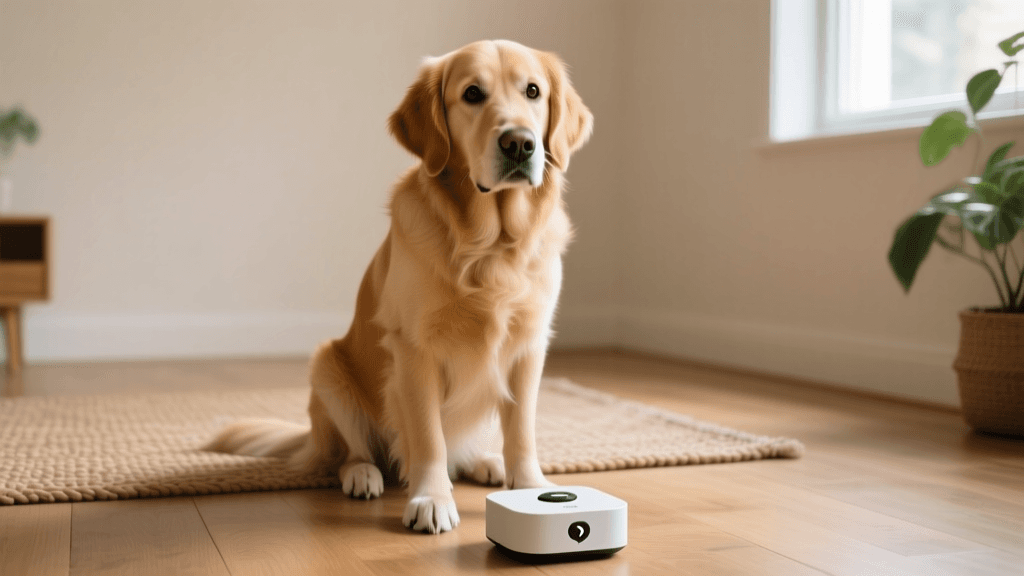
The TikTok Phenomenon: Bunny, Stella, and the Soundboard Revolution
If you have spent any time on TikTok, Instagram, or YouTube Shorts over the past few years, you have likely encountered a viral sensation: dogs 'talking' using soundboard buttons. From Bunny the Sheepadoodle asking 'ouch stranger' to Stella the Catahoula/Blue Heeler mix demanding 'walk now,' these canine influencers have amassed millions of followers and sparked a massive trend in pet care. But as a dog owner, you might be wondering: is this just a clever trick, or are our dogs truly communicating complex thoughts? To understand this viral trend, we must dive deep into canine psychology, associative learning, and the science of animal cognition.
The trend largely revolves around commercial soundboard kits, with FluentPet being the most prominent brand. These kits feature hexagonal, tile-like mats that hold recordable buttons. Owners record specific words or phrases, and dogs are trained to press the buttons with their paws or noses to express desires, observations, or even abstract concepts. While the internet celebrates these moments as proof of near-human linguistic ability, veterinary behaviorists and canine cognitive scientists offer a more nuanced perspective.
Canine Cognition: Operant Conditioning vs. True Language
To understand what happens when a dog presses a button that says 'outside,' we have to look at how dogs learn. At its core, button training relies on operant conditioning. The dog learns that performing a specific action (pressing the button) results in a specific outcome (the door opens). This is the same psychological principle behind a dog sitting for a treat or a rat pressing a lever for a food pellet.
However, dogs are not merely robotic stimulus-response machines. They possess remarkable cognitive abilities, particularly in the realm of 'Fast Mapping.' Fast mapping is the ability to form a quick, rough hypothesis about the meaning of a new word after only one or a few exposures. This phenomenon was most famously demonstrated by Chaser, a Border Collie who learned the names of over 1,000 distinct toys and could retrieve them by name. As reported by Smithsonian Magazine, researchers found that dogs can infer the meaning of new words by exclusion, much like human toddlers.
So, when a viral dog presses a button that says 'love you' after their owner leaves, are they expressing emotional longing, or have they simply learned that pressing that button often results in the owner returning or offering physical affection? The scientific consensus leans toward associative learning combined with highly attuned social intelligence. Dogs are masters of reading human routines and emotional cues, meaning they may use buttons to trigger a desired social interaction rather than to express an abstract philosophical concept.
Comparison Chart: Associative Learning vs. Human Linguistics
To clarify the distinction between viral button usage and actual human language, consider the following comparison:
| Cognitive Feature | Dog Soundboard Usage (Associative) | Human Linguistic Comprehension |
|---|---|---|
| Syntax & Grammar | Limited. Dogs may string buttons together (e.g., 'walk now'), but order rarely changes the fundamental request. | Complex. Word order dictates meaning (e.g., 'The dog bit the man' vs. 'The man bit the dog'). |
| Abstract Concepts | Highly contextual. 'Later' or 'yesterday' are usually associated with delayed rewards, not temporal timelines. | True understanding of past, present, future, and hypothetical scenarios. |
| Motivation | Driven by immediate needs, environmental triggers, or social reinforcement. | Driven by information sharing, emotional expression, and abstract thought. |
| Learning Mechanism | Operant conditioning, classical conditioning, and fast mapping. | Innate language acquisition device combined with social learning. |
Setting Up Your Own Soundboard: A Practical Guide
If you want to participate in this trending enrichment activity, it is crucial to approach it as a mental stimulation exercise rather than a way to turn your pet into a human surrogate. Here is a practical, actionable guide to getting started.
Equipment and Costs
- Soundboard Kit: The FluentPet 'Get Started' Kit is the industry standard, typically costing around $149.95. It includes 6 recordable buttons and hexagonal base mats.
- Alternative Options: Basic recordable answer buzzers (often used in classrooms) can be found on Amazon for roughly $25 to $30 for a pack of four, though they lack the spatial mapping benefits of the hexagonal mats.
- Non-Slip Backing: If using standalone buzzers, invest in a $10 non-slip rug pad to prevent the buttons from sliding across hardwood floors when your dog steps on them.
Step-by-Step Training Protocol
- Choose High-Value Words: Start with words that have immediate, tangible outcomes. 'Outside,' 'Play,' and 'Treat' are the best starting points. Avoid abstract words like 'Love' or 'Mad' until the dog has mastered concrete nouns and verbs.
- Record with Consistency: Use a clear, neutral, and enthusiastic voice. Keep the audio clip under two seconds. Do not use a high-pitched 'baby voice,' as this can confuse the dog's auditory processing.
- Model the Behavior (Targeting): Before expecting your dog to use the button, you must model it. Every time you open the door to go outside, press the 'Outside' button yourself. Do this consistently for 2 to 3 weeks.
- Capture the Paw Strike: Use positive reinforcement techniques. As noted by the ASPCA, rewarding desired behaviors with high-value treats accelerates learning. If your dog sniffs or paws at the button, immediately press it yourself, reward them, and fulfill the action.
- Spatial Mapping: Keep the buttons in a fixed location. Dogs have excellent spatial memory. Moving the soundboard from the living room to the kitchen will force the dog to relearn the physical location of their vocabulary.
Potential Pitfalls: When Viral Trends Harm Dog Psychology
While soundboards can be incredible enrichment tools, the pressure to create 'viral' moments can lead to poor training practices and canine frustration. One major issue is the extinction burst. If a dog presses the 'Play' button repeatedly but the owner is busy and ignores the request, the dog may become frustrated, leading to destructive behavior or excessive barking. You must only teach buttons for requests you are actually willing to fulfill 80% of the time.
Another issue is overstimulation. Some dogs become obsessed with the buttons, pressing them incessantly for dopamine hits. If your dog begins to exhibit compulsive button-pressing, it is time to put the soundboard away on a schedule, treating it like any other high-value toy that requires boundaries.
Reading Between the Buttons: True Canine Communication
As fascinating as viral soundboards are, they should never replace your ability to read your dog's natural body language. Dogs are constantly 'talking' to us through their ears, tails, posture, and facial expressions. A dog pressing a 'Happy' button while exhibiting a tucked tail, whale eye, and lip licking is not happy; they are stressed and attempting to perform a trick they think will appease you.
According to the American Kennel Club (AKC), understanding subtle canine communication signals—like yawning when not tired, sneezing during play to signal 'this is just a game,' or turning the head away to de-escalate tension—is fundamental to responsible dog ownership. Use the soundboard as a fun bridge for specific requests, but rely on your knowledge of breed instincts and body language to truly understand your dog's emotional state.
Final Thoughts on the Trend
The viral dog button trend is a double-edged sword. On one hand, it has encouraged millions of owners to engage in deep, interactive cognitive training with their pets, moving beyond basic obedience into the realm of mental enrichment. On the other hand, it risks anthropomorphizing canine psychology to fit a social media narrative. By grounding your training in the science of associative learning and respecting your dog's natural, non-verbal communication, you can enjoy the benefits of this trend while maintaining a healthy, stress-free relationship with your best friend.
beth-carrasco
All our authors care for dogs every day — read more of their work on the authors page.