Budget Dog Enrichment: DIY Puzzles for Mental Health
Discover budget-friendly dog enrichment ideas. Learn how to satisfy your dog's psychological needs with DIY puzzles and free mental stimulation games.
The Psychology Behind Canine Enrichment
Understanding your dog goes far beyond teaching them to sit or stay; it requires a deep dive into their psychological needs, innate instincts, and cognitive drives. As a dog owner, you might already know that physical exercise is crucial for maintaining your pet's health. However, mental stimulation is equally vital, yet it is often overlooked or mistakenly assumed to be an expensive endeavor requiring high-end puzzle toys and professional training classes. The truth is that fulfilling your dog's psychological needs can be incredibly budget-friendly if you understand the science behind canine enrichment.
Canine enrichment is the practice of providing environments and activities that allow dogs to express their natural behaviors. In the wild, canines spend up to eighty percent of their waking hours foraging, hunting, and problem-solving to secure their next meal. Domestication has removed the need for survival-based foraging, but it has not erased the hardwired neurological pathways that demand mental engagement. When dogs are deprived of cognitive challenges, they often develop behavioral issues such as excessive barking, destructive chewing, or chronic anxiety. According to the RSPCA, environmental enrichment is a fundamental component of animal welfare, directly impacting a dog's emotional state and reducing stress-related behaviors. By tapping into these natural drives, you can provide profound mental satisfaction without breaking the bank.
Decoding Breed-Specific Instincts on a Budget
To create effective, low-cost enrichment, you must first understand your dog's breed-specific instincts. Every dog was originally bred for a purpose, and those genetic blueprints still dictate how they interact with the world. Scent hounds, such as Beagles and Bloodhounds, possess an olfactory system that is exponentially more sensitive than ours. Their brains light up when they are tracking scents, making nose-work the ultimate psychological reward. You do not need expensive scent kits to fulfill this need; simply scattering their daily kibble across a safe, grassy backyard or hiding treats in crumpled paper bags provides intense mental fatigue.
Terriers, on the other hand, were bred to hunt and dispatch vermin. Their instinctual drive is to dig, tear, and shred. A budget-friendly way to satisfy a terrier's psychological need to destroy is to provide them with a destruction box filled with safe, recyclable cardboard and hidden treats. Herding breeds like Border Collies and Australian Shepherds crave complex problem-solving and spatial awareness. They thrive on games that require them to figure out a sequence of actions to achieve a reward, such as learning to open a series of low-cost, DIY puzzle boxes. By aligning your budget-friendly activities with your dog's genetic predispositions, you ensure that the mental stimulation is genuinely fulfilling rather than just mildly distracting.
Top Budget-Friendly DIY Enrichment Games
Let us explore three highly effective, budget-friendly DIY enrichment games that cater to these psychological needs, complete with specific instructions and cost breakdowns.
1. The Upcycled Fleece Snuffle Mat
This game targets the foraging and scent-tracking instincts of almost all dogs, particularly hounds and retrievers. To make one, visit a local thrift store and purchase a thick, machine-washable fleece blanket (usually costing between two and four dollars). Cut the blanket into strips measuring exactly two inches wide and eight inches long. Next, take a rubber sink mat (often found at dollar stores) and tie the fleece strips through the holes using double knots. The result is a dense, shaggy mat that mimics the texture of tall grass. Scatter your dog's daily kibble into the mat, forcing them to use their nose to locate their meal. This simple activity can turn a two-minute eating ritual into a twenty-minute cognitive workout, burning as much mental energy as a long walk.
2. The Muffin Tin Shell Game
This puzzle appeals to herding breeds and highly intelligent mixed breeds that enjoy visual tracking and problem-solving. Take a standard metal or silicone muffin tin and place a high-value treat in three of the cups. Cover all the cups with tennis balls or crumpled balls of paper. Your dog must figure out how to dislodge the covers to access the rewards. This costs absolutely zero dollars if you repurpose items from around your home, yet it engages your dog's working memory and spatial reasoning.
3. The Cardboard Box Foraging Zone
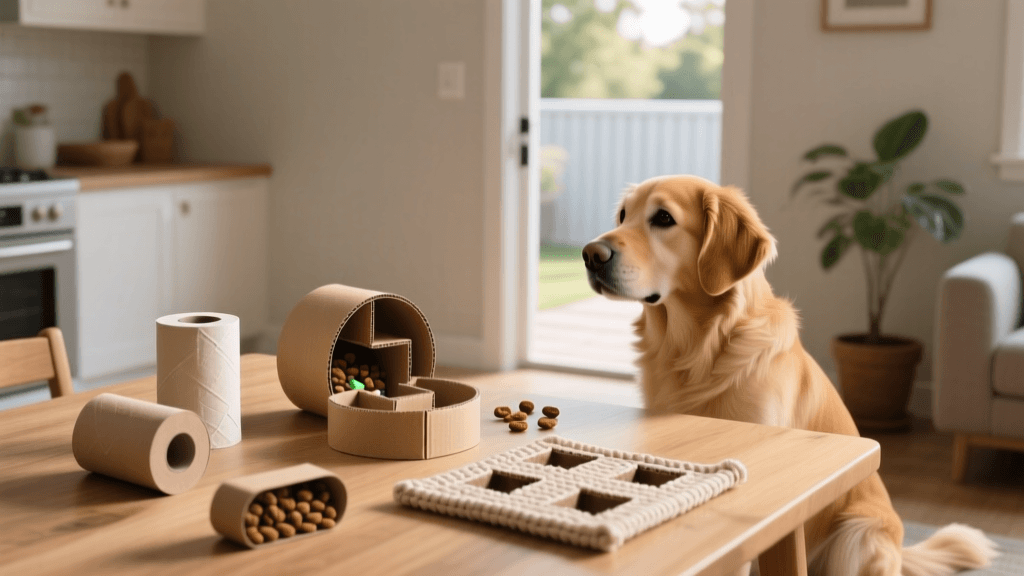
This is the ultimate psychological outlet for terriers and high-energy chewers. Save your delivery boxes and remove all tape, staples, and plastic labels. Place the boxes in a designated play area and scatter dry treats or kibble inside and around them. Allow your dog to rip, shred, and paw through the cardboard to find the hidden treasures. The act of shredding mimics the tearing of prey, releasing endorphins and providing a deep sense of psychological satisfaction.
Cost Comparison: Commercial vs. DIY Enrichment
To truly appreciate the value of understanding your dog's psychology over simply buying commercial products, consider the financial and cognitive differences between store-bought toys and DIY enrichment. The table below outlines a cost and engagement comparison for a medium-sized dog over a one-month period.
| Enrichment Method | Estimated Monthly Cost | Primary Psychological Drive Targeted | Average Engagement Time |
|---|---|---|---|
| Commercial Puzzle Toy | $25.00 - $45.00 | Problem Solving | 10 - 15 Minutes |
| Upcycled Snuffle Mat | $3.00 - $5.00 (One-time) | Olfactory Foraging | 20 - 30 Minutes |
| Cardboard Destruction Box | $0.00 (Recycled) | Prey Tearing / Shredding | 15 - 25 Minutes |
| Kibble Scatter (Nose Work) | $0.00 | Scent Tracking | 15 - 20 Minutes |
Safety First: Supervising Budget Toys
As the data illustrates, commercial puzzle toys are not only significantly more expensive, but they also often yield shorter engagement times. Once a dog solves a rigid plastic puzzle, they quickly memorize the mechanical solution, rendering the toy psychologically obsolete. In contrast, DIY enrichment methods like the snuffle mat and cardboard box offer dynamic, unpredictable experiences that require continuous olfactory and tactile processing, leading to longer engagement and deeper mental fatigue.
However, understanding your dog also means recognizing their physical limitations and safety risks. The American Kennel Club emphasizes that while mental stimulation is critical, all enrichment activities must be closely supervised to prevent accidental ingestion of non-food items. When utilizing cardboard boxes, ensure your dog is spitting out the paper rather than swallowing it, as large amounts of ingested cardboard can cause gastrointestinal blockages. Similarly, inspect upcycled fleece mats regularly for loose strips that could pose a choking hazard. If your dog is an aggressive chewer who tends to consume foreign objects, pivot away from destruction-based games and lean heavily into scent-work and scatter feeding, which are entirely safe and equally stimulating.
Ultimately, providing budget-friendly dog care is not about being cheap; it is about being resourceful and deeply attuned to your dog's inner world. By observing their natural tendencies, respecting their breed-specific instincts, and leveraging everyday household items, you can build a rich, psychologically rewarding environment that keeps your dog happy, balanced, and mentally sharp without straining your wallet.
marcus-aldridge
All our authors care for dogs every day — read more of their work on the authors page.