Dog Calming Signals Guide 2026: Build Trust & Bond
Learn to decode your dog's calming signals in 2026. Discover how responding to appeasement behaviors builds deep trust and strengthens your bond.
The Evolution of Canine Bonding in 2026
Building a profound, unbreakable bond with your dog requires more than just providing food, shelter, and daily walks. As we navigate dog ownership in 2026, the veterinary behavior community heavily emphasizes empathetic, two-way communication. The most successful relationships between humans and canines are built on mutual understanding, specifically by recognizing and honoring your dog's subtle communication cues. Among the most critical of these cues are 'calming signals'—a sophisticated language of appeasement and de-escalation that dogs use to manage stress, avoid conflict, and maintain social harmony.
When you learn to decode and appropriately respond to these signals, you transition from being a mere caretaker to a trusted partner. This guide explores the psychology behind canine calming signals, how to identify them, and how utilizing reciprocal communication can foster a secure attachment bond that lasts a lifetime.
What Are Canine Calming Signals?
Originally popularized by Norwegian canine behaviorist Turid Rugaas, the concept of calming signals refers to a repertoire of body language cues dogs use to self-soothe, calm down an overly aroused counterpart, or signal peaceful intentions. In the wild and in domestic settings, conflict is dangerous and energetically costly. Therefore, dogs have evolved a complex system of 'appeasement behaviors' to prevent aggression before it starts.
According to the RSPCA's comprehensive guide on dog body language, recognizing these subtle stress and appeasement indicators is vital for preventing behavioral deterioration. When a dog displays a calming signal and the human ignores it or forces the dog into a more stressful situation, the dog may escalate to defensive aggression or, worse, shut down entirely—a psychological state known as learned helplessness. By acknowledging these signals in 2026, modern dog owners can actively build a 'secure base' for their pets, proving that their human will listen and protect them.
The 7 Core Calming Signals Your Dog Uses
To build trust, you must first become fluent in your dog's native language. Here are the seven most common calming signals and what they mean in the context of your relationship:
1. Yawning Out of Context
While yawning certainly indicates tiredness, a dog yawning during a training session, a vet visit, or a tight hug is communicating internal stress. It is a physiological attempt to lower their own heart rate and signal to you that they are feeling overwhelmed.
2. Lip Licking and Nose Flicking
A quick flick of the tongue over the nose is one of the fastest and most easily missed appeasement signals. It often occurs when a dog is confused by a command, feels intimidated by a looming human posture, or is anticipating a correction. It translates roughly to, 'I am trying to comply, please be patient with me.'
3. Turning the Head or Body Away
Direct, sustained eye contact is considered confrontational in canine culture. If you lean over your dog to pet them and they turn their head away, or pivot their entire body sideways, they are politely asking for space. Respecting this boundary is a massive trust-builder.
4. Sniffing the Ground
Suddenly becoming intensely interested in a seemingly barren patch of grass when another dog or a loud noise approaches is a displacement behavior. The dog is using scent-work to lower their own arousal levels and signaling to the approaching entity that they are not a threat.
5. Curving the Approach
Polite dogs rarely walk in a straight line directly toward one another or toward a nervous human. They walk in an arc or curve. If your dog curves away from you when you call them, they are not being disobedient; they are using polite body language to show they mean no harm.
6. Slow Movements and Freezing
High arousal leads to fast, jerky movements. Conversely, a dog moving in slow motion, or momentarily freezing, is attempting to de-escalate a highly charged environment. If you call your dog and they walk back to you in slow motion, they are trying to calm both you and themselves down.
7. The Play Bow as a Diffuser
While often a request for play, the 'play bow' (front elbows on the ground, rear in the air) is frequently used to diffuse tension after a minor social faux pas, such as bumping into another dog too hard. It is a canine apology and a request to reset the interaction.
Reciprocal Communication: Speaking 'Dog' Back
The true magic of relationship building happens when humans begin to use calming signals back to their dogs. In 2026, force-free trainers advocate for 'mirroring'—using your own body language to tell your dog that you are safe, calm, and listening. Below is a structured guide on how to respond to your dog's signals to deepen your bond.
| Canine Signal | Emotional Context | 2026 Best Practice Human Response |
|---|---|---|
| Yawning / Lip Licking | Mild stress, confusion, or pressure | Pause the training session, soften your posture, and take a deep breath. Give the dog a 30-second reset. |
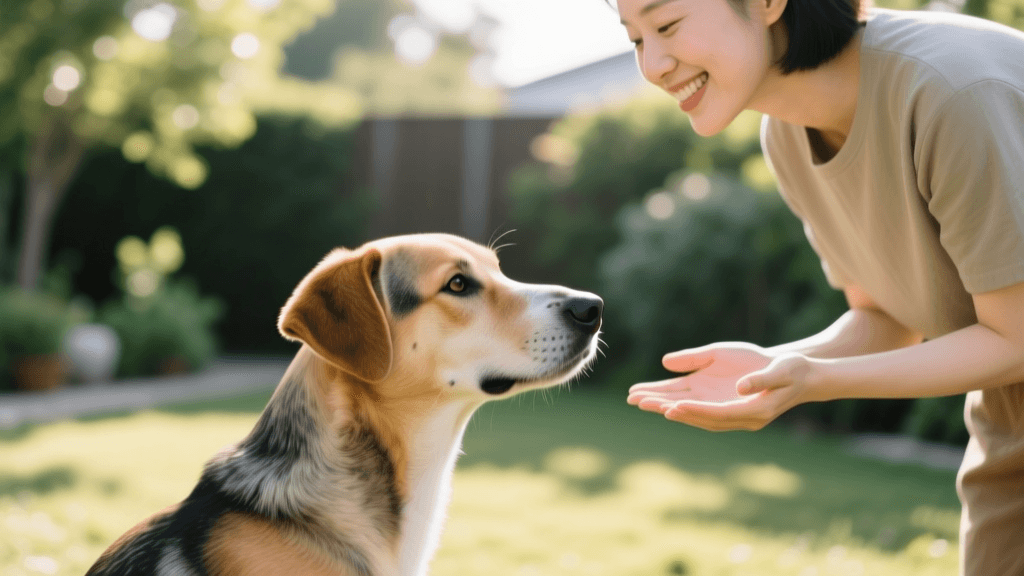
| Turning Head Away | Feeling crowded or intimidated | Turn your own head or shoulders slightly away. Offer a closed hand for sniffing rather than reaching over their head. |
| Sniffing Ground | Overstimulation, needing a mental break | Do not pull the leash. Allow 15-20 seconds of 'sniffari' time to let their nervous system regulate. |
| Slow Movements | Attempting to de-escalate human frustration | Lower your voice volume, relax your facial muscles, and avoid repeating commands. Praise the calm approach. |
| Curving Approach | Polite, non-threatening greeting | Approach your dog in a slight arc rather than walking straight at them. This is especially effective with rescue dogs. |
Real-World Scenarios: Bonding Through De-escalation
Understanding these signals in theory is helpful, but applying them in real-world scenarios is where the human-canine bond is truly forged. Let us look at three common situations where honoring calming signals transforms the relationship.
The Veterinary Waiting Room
Vet clinics are high-stress environments. If your dog is sitting beside you and begins rapidly lip-licking and yawning, they are communicating anxiety. Instead of forcing them into a 'sit-stay' or offering rapid-fire treats which can sometimes increase frustration, use a calming signal. Turn your body sideways to the room, soften your gaze, and gently scatter a few high-value treats on the floor for them to forage. This honors their stress, gives them a coping mechanism (sniffing), and proves you are their protector.
The Overly Enthusiastic Guest
When a guest enters your home and leans over your dog to pet them, your dog may freeze or turn their head away. Many owners mistakenly say, 'Oh, they are just being shy, go ahead and pet them.' This breaks trust. In 2026, the standard of care is to advocate for your dog. Step between the guest and the dog, ask the guest to ignore the dog, and allow your dog to initiate contact by curving in and sniffing. This advocacy creates a profound sense of safety.
The Reactive Dog Encounter
If you are walking your dog and an off-leash or highly aroused dog approaches, your dog may freeze or sniff the ground to signal non-aggression. Keep your leash loose (a tight leash transmits tension directly to the dog's neck), turn your body sideways to the approaching dog, and calmly create distance. Your dog will learn that you understand their social cues and will manage the environment for them.
The Science of Secure Attachment
The psychological framework behind this approach is rooted in Attachment Theory, which applies to dogs just as it does to human children. A 'securely attached' dog views their owner as a secure base from which to explore the world and a safe haven to return to when frightened. Research highlighted by the American Kennel Club regarding canine body language and emotional states confirms that dogs are highly attuned to human emotional feedback and body language.
When you consistently ignore a dog's calming signals, you become an unreliable safe haven. The dog learns that their communication is ineffective, leading to chronic anxiety or behavioral fallout. Conversely, when you mirror their calming signals, respect their boundaries, and advocate for their emotional well-being, you trigger a positive oxytocin feedback loop. This neurochemical response, often called the 'love hormone,' cements the bond between you and your dog, resulting in a more confident, relaxed, and deeply connected companion.
Conclusion: Listening is the Ultimate Act of Love
As dog care standards continue to evolve in 2026, the focus has rightfully shifted toward emotional welfare and psychological enrichment. Bonding with your dog is not about forcing compliance; it is about engaging in a continuous, respectful dialogue. By learning to read the subtle yawns, lip licks, and slow movements your dog offers, and by thoughtfully responding with your own calming body language, you build a relationship founded on mutual trust. The next time your dog speaks to you in whispers, listen closely—your relationship will be infinitely stronger for it.
priya-sutaria
All our authors care for dogs every day — read more of their work on the authors page.