Decoding Puppy Body Language: A First-Time Owner Guide
Learn to read your puppy's body language and stress signals. This first-time owner guide covers calming signals, fear signs, and happy cues.
Welcome to the World of Canine Communication
Bringing a new puppy home is an exhilarating experience filled with sloppy kisses, clumsy paws, and endless moments of joy. However, as a first-time dog owner, one of the most profound challenges you will face is understanding what your puppy is actually trying to tell you. Dogs do not possess spoken language; instead, they rely on a complex, nuanced system of body postures, facial expressions, ear positioning, and spatial awareness to communicate their emotional state. When we misunderstand these signals, we risk damaging the trust we are trying to build, inadvertently increasing our puppy's anxiety, or missing critical windows for socialization.
One of the most common mistakes first-time owners make is anthropomorphism—projecting human emotions and reasoning onto canine behavior. For instance, when a puppy chews up a favorite pair of shoes and then cowers with 'guilty' eyes and a tucked tail when you walk in, it is easy to assume the dog feels remorse. In reality, the dog does not understand the concept of revenge or spite. According to the ASPCA's guide on canine body language, that 'guilty' look is actually an appeasement gesture. The puppy is reading your angry body language and exhibiting submissive calming signals to de-escalate the situation. Understanding this fundamental difference in perception is the first step toward becoming a fluent reader of canine communication.
The Baseline: Recognizing a Happy and Relaxed Puppy
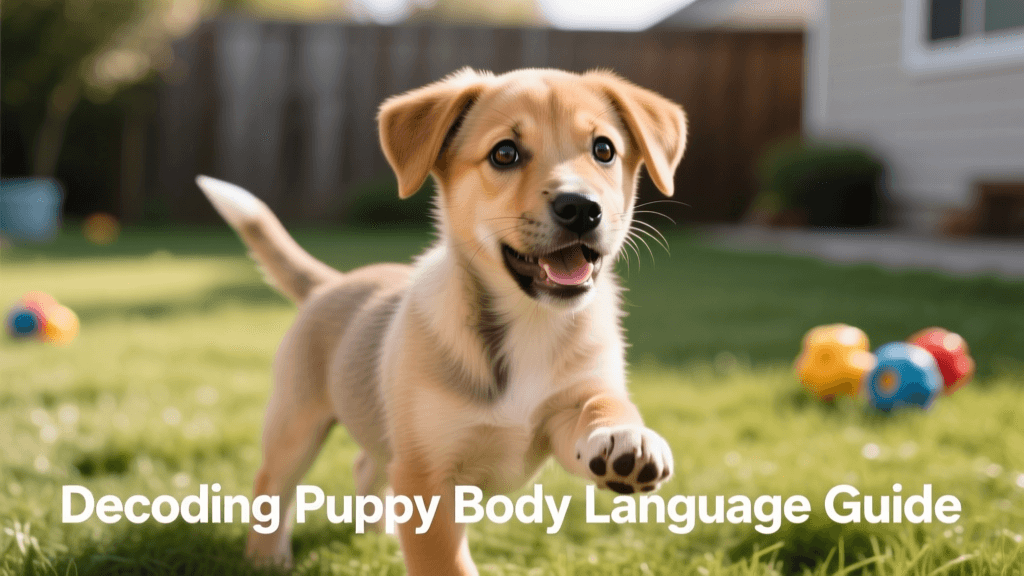
Before you can identify when your puppy is stressed, you must establish their baseline—the physical state they exhibit when they are completely comfortable, safe, and content. A relaxed puppy will have a soft, open facial expression. Their mouth may be slightly open with the corners of the lips relaxed, resembling a gentle smile. Their ears will rest in their natural, breed-specific position, neither pinned back rigidly nor pricked aggressively forward.
When your puppy is ready to engage in play, you will likely see the classic 'play bow.' This is a universal canine invitation where the front elbows touch the ground while the hindquarters remain elevated in the air. It is often accompanied by a bouncy, exaggerated gait and short, playful barks. However, tail wagging requires careful interpretation. A common myth is that a wagging tail always equals a happy dog. While a loose, sweeping wag that involves the entire body (often called a 'helicopter tail') indicates pure joy, a stiff, high, and rapidly vibrating tail can indicate high arousal, tension, or even impending aggression. Always look at the whole body, not just the tail, to gauge your puppy's true emotional state.
Decoding Stress: The Subtle 'Calming Signals'
Puppies are constantly processing a massive amount of sensory input, which can easily lead to overstimulation. When a puppy feels stressed, anxious, or overwhelmed, they will deploy what renowned canine behaviorist Turid Rugaas coined as 'calming signals.' These are subtle, often fleeting behaviors designed to self-soothe and communicate to others (including humans) that the dog means no harm and wishes to lower the tension in the environment.
As a first-time owner, learning to spot these micro-expressions is vital. If you are training your puppy to 'sit' and they suddenly yawn, they are not bored or tired; they are likely feeling confused or pressured by the training session. Similarly, rapid lip-licking when no food is present is a primary indicator of nervousness. Another critical signal is 'whale eye,' where the puppy turns their head away but keeps their eyes fixed on the stressor, exposing the whites of their eyes in a crescent shape. The organization Fear Free Pets emphasizes that recognizing these early stress signals allows owners to intervene before the puppy's anxiety escalates into fear-based reactivity, growling, or defensive biting.
Quick Reference Guide to Puppy Body Language
To help you navigate your puppy's daily emotional shifts, refer to this structured comparison chart detailing common signals, their underlying meanings, and the appropriate actions you should take as an owner.
| Body Part / Signal | Emotional State | Meaning & Context | Recommended Owner Action |
|---|---|---|---|
| Tail Tucked Under | Fear / Severe Anxiety | The puppy feels threatened or deeply insecure in the current environment. | Remove the puppy from the stressor immediately. Do not force interaction or offer pity; simply provide a safe space. |
| Lip Licking / Yawning | Mild Stress / Confusion | An appeasement signal indicating the puppy is feeling pressured or unsure of what is expected. | Take a step back. End the training session or lower your voice. Give the puppy a moment to decompress. |
| Whale Eye (Half-Moon) | High Anxiety / Guarding | The puppy is hyper-focused on a perceived threat while trying to look away to avoid conflict. | Do not reach for the puppy or the item they are guarding. Toss a high-value treat away from the object to redirect them. |
| Play Bow & Bouncing | Joy / Invitation | A clear, joyful request for social interaction and physical play. | Engage in play! Use a flirt pole or tug toy to match their energy while teaching bite inhibition. |
| Pinned Back Ears | Appeasement / Fear | Depending on context, either a submissive greeting or a sign of active fear and submission. | Approach calmly and sideways. Avoid looming over the puppy, which can be perceived as a predatory threat. |
Actionable Steps: Managing Puppy Stress and Overstimulation
Understanding body language is only half the battle; knowing how to respond practically is where first-time owners must shine. Puppies are essentially canine toddlers. They lack emotional regulation and can easily become overtired, leading to the dreaded 'puppy witching hour' characterized by frantic zoomies and nipping. Here are specific, actionable strategies to manage your puppy's environment and stress levels:
1. Enforce Mandatory Nap Times
Puppies require between 18 to 20 hours of sleep per day to support their rapid neurological and physical development. An overtired puppy is a stressed puppy. Establish a strict schedule where your puppy is placed in their crate for a nap after every 45 to 60 minutes of awake time. This prevents the buildup of cortisol (the stress hormone) and drastically reduces nuisance biting.
2. Optimize the Crate Environment
The crate should be a sanctuary, not a punishment zone. Proper sizing is critical for house training and comfort. For small breeds (like a French Bulldog or Cavalier King Charles Spaniel), a 24-inch crate is appropriate. For medium to large breeds (like a Labrador Retriever or Golden Retriever), invest in a 36-inch or 42-inch crate equipped with an adjustable divider panel, which typically costs between $40 and $80. The divider allows you to expand the space as the puppy grows, preventing them from soiling one end and sleeping in the other. Line the crate with a washable, chew-resistant mat and cover the top with a breathable blanket to create a den-like atmosphere that reduces visual stimulation.
3. Utilize Pheromone Therapy
To actively lower baseline anxiety, especially during the first few weeks in a new home, use synthetic pheromones. Products like the Adaptil Junior Diffuser or Collar (costing approximately $20 to $25) release a synthetic replica of the dog-appeasing pheromone (DAP) produced by nursing mother dogs. This chemical signal communicates safety and comfort directly to the puppy's olfactory system, helping to soothe them during stressful events like thunderstorms, crate training, or vet visits.
4. Implement 'Sniffaris' for Mental Decompression
Physical exercise is not enough; puppies need mental enrichment to tire out their brains. Instead of feeding all meals from a bowl, scatter their kibble across a grassy yard or a snuffle mat. This engages their primary sense—smell—and lowers their heart rate. A 15-minute sniffing session is often more mentally exhausting than a 30-minute walk on a leash.
Navigating the Puppy Fear Periods
As you decode your puppy's body language, you must also be aware of their developmental timeline, specifically the 'fear periods.' These are biologically hardwired windows where a puppy's brain is hyper-receptive to traumatic experiences, and previously confident puppies may suddenly exhibit intense fear toward mundane objects like trash cans or hats.
According to the American Kennel Club (AKC), the first major fear period occurs between 8 and 11 weeks of age, which often coincides with the time a puppy leaves the breeder and goes to their new home. A second, less predictable fear period typically occurs between 6 and 14 months of age, aligning with sexual maturity and the transition into adolescence.
During these sensitive windows, your primary goal is to avoid 'flooding'—forcing the puppy to confront their fears. If your puppy shows fear signals (tucked tail, whale eye, freezing) toward a stranger or a loud noise, do not drag them forward or force them to accept pets. Instead, increase the distance between the puppy and the trigger until their body language softens. From that safe distance, toss high-value treats, such as freeze-dried liver or boiled chicken breast (budget about $10 to $15 a week for premium training treats). Let the puppy observe the trigger without the pressure of direct interaction. This builds positive associations and teaches the puppy that they can trust you to advocate for their boundaries.
Conclusion: Building Trust Through Observation
Decoding your puppy's body language is not a skill you master overnight; it is a lifelong practice of observation, empathy, and adjustment. By learning to recognize the subtle difference between a happy play bow and a stressed lip lick, you transform from a simple caretaker into a trusted advocate for your dog. When a puppy realizes that their human understands their 'no' and respects their calming signals, the foundation for a deeply bonded, confident, and well-adjusted adult dog is securely laid. Take the time to simply sit and watch your puppy in various environments. Note their baseline, respect their stress signals, and celebrate their joyful expressions. Your patience and willingness to learn their silent language will be rewarded with unwavering loyalty and a profound interspecies friendship.
aaron-whyte
All our authors care for dogs every day — read more of their work on the authors page.