Curb Leash Reactivity: The Engage-Disengage Game (2026)
Master leash reactivity in 2026 with the engage-disengage game. Learn threshold management, top front-clip harnesses, and canine body language cues.
Understanding the Psychology of Leash Reactivity
Leash reactivity is one of the most common, yet deeply misunderstood, behavioral challenges faced by dog owners in 2026. When a dog lunges, barks, or snarls at the end of a leash, it is rarely an act of unprovoked aggression. Instead, it is typically a manifestation of fear, anxiety, or barrier frustration. To effectively manage a reactive dog, we must first understand the psychological and neurobiological mechanisms driving the behavior.
When a dog spots a trigger—such as an unfamiliar dog, a fast-moving cyclist, or a loud vehicle—their sympathetic nervous system activates the 'fight or flight' response. In an off-leash environment, a fearful dog might choose 'flight' by increasing the distance between themselves and the perceived threat. However, the physical constraint of a leash removes the flight option. Feeling trapped, the dog defaults to 'fight,' utilizing explosive, loud behaviors to drive the trigger away. This is known as barrier frustration and fear-based reactivity.
Furthermore, modern canine behavioral science emphasizes the concept of 'trigger stacking.' This occurs when a dog experiences multiple minor stressors in a single day—such as a loud garbage truck, a rushed morning walk, and a sudden doorbell ring. Each stressor elevates their cortisol and adrenaline levels. By the time they encounter a trigger dog on their afternoon walk, their emotional threshold has been breached, resulting in an explosive reaction. Managing reactivity in 2026 requires a holistic approach that accounts for both the immediate environment and the dog's cumulative stress load.
Essential Gear for Reactive Dogs in 2026
Before implementing any behavioral modification protocol, ensuring you have the correct, humane handling equipment is paramount. The American Veterinary Society of Animal Behavior (AVSAB) strongly advises against the use of aversive tools like prong collars, choke chains, or electronic shock collars, as these suppress warning signs and can exacerbate underlying anxiety, leading to sudden, unprovoked bites.
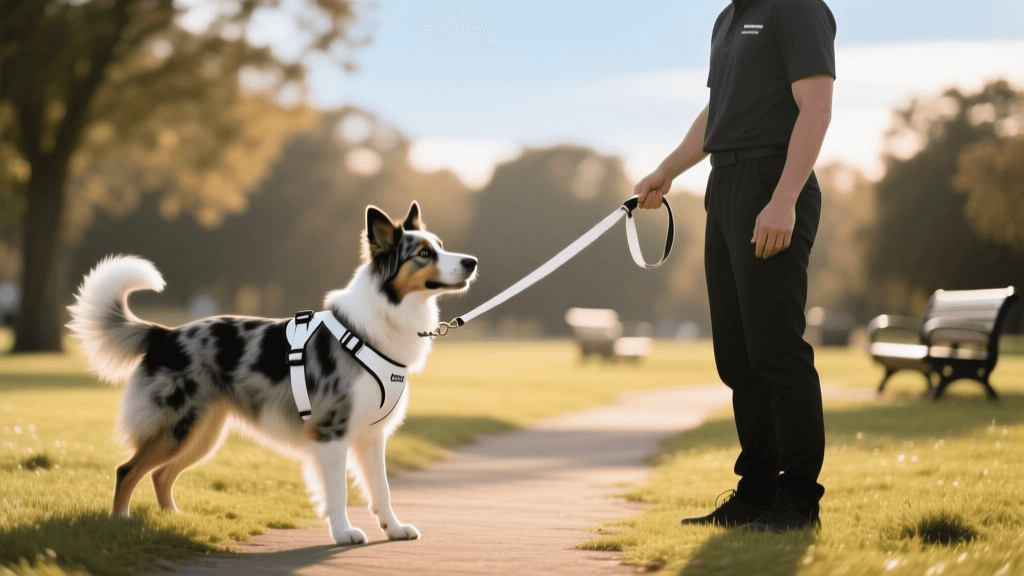
For leash-reactive dogs, a front-clip harness is the gold standard. By attaching the leash to a ring on the dog's chest, you gently redirect their forward momentum back toward you when they pull, preventing them from launching into a full-body lunge.
| Equipment Type | 2026 Top Recommendation | Pros | Cons |
|---|---|---|---|
| Front-Clip Harness | 2 Hounds Design Freedom No-Pull Harness | Dual-clip options; velvet-lined chest strap prevents chafing; excellent leverage. | Can be slightly complex to fit perfectly on barrel-chested breeds. |
| Head Halter | PetSafe Gentle Leader | Provides maximum steering control for powerful dogs; prevents neck strain on the handler. | Requires extensive desensitization; dogs often try to paw it off initially. |
| Flat Collar | Ruffwear Cinq Points Collar | Comfortable for everyday wear; holds ID tags securely. | Offers zero leverage against lunging; risks tracheal damage if the dog pulls hard. |
The Engage-Disengage Game: A Step-by-Step Guide
Developed by renowned dog trainer Leslie McDevitt, the Engage-Disengage game is a powerful counter-conditioning and desensitization protocol. It teaches your dog that seeing a trigger predicts a high-value reward, ultimately changing their emotional response from 'threat' to 'opportunity for treats.'
Step 1: Find the Sub-Threshold Distance
Your dog's 'threshold' is the distance at which they notice a trigger but remain capable of thinking, learning, and eating. If your dog is barking, lunging, or refusing a piece of roasted chicken, you are over threshold. You must start the game at a distance where the dog can observe the trigger calmly—this might be 50 yards in a park or simply looking out a second-story window.
Step 2: Mark the 'Engage'
When your dog spots the trigger (e.g., another dog walking by), immediately mark the behavior with a clicker or a consistent verbal marker like 'Yes!' The exact moment your dog's eyes lock onto the trigger, you mark it. You are capturing the neurological event of noticing the trigger.
Step 3: Reward the 'Disengage'
After marking, present a high-value treat (such as freeze-dried beef liver or boiled chicken breast). The dog will turn away from the trigger to eat the treat. This physical act of turning away is the 'disengage.' By repeating this, the dog learns the pattern: 'I look at the scary thing, I hear the click, I turn to my human to get chicken.' Over time, the dog will begin to voluntarily look at the trigger and immediately snap their head back to you in anticipation of the reward, without you even needing to use the clicker.
Tracking Progress: Threshold Distance Log
Progress in reactivity training is rarely linear. Keeping a structured log helps you identify patterns, manage trigger stacking, and celebrate micro-victories. Below is an example of how a dog's threshold distance might improve over a structured four-week period in 2026, assuming daily, low-stress practice sessions.
- Week 1: Threshold distance is 40 feet. Dog requires 3 seconds to disengage after the click. High-value treats (real meat) required.
- Week 2: Threshold distance closes to 30 feet. Dog begins to voluntarily disengage on 20% of repetitions without a click. Treat delivery speed increases.
- Week 3: Threshold distance closes to 20 feet. Dog exhibits relaxed body language (open mouth, loose tail wag) upon seeing the trigger at this distance.
- Week 4: Threshold distance closes to 15 feet. Dog immediately offers eye contact upon noticing the trigger, bypassing the need for the 'engage' mark entirely.
Reading Canine Body Language Before the Lunge
To keep your dog under threshold, you must become fluent in canine body language. Dogs communicate their rising anxiety long before they bark or lunge. According to the ASPCA's guide on canine aggression and reactivity, recognizing early stress signals allows you to intervene before the sympathetic nervous system fully hijacks your dog's brain.
Watch for these subtle 'calming signals' and early stress indicators:
- Whale Eye: The dog turns their head away but keeps their eyes fixed on the trigger, exposing the whites of their eyes.
- Lip Licking and Yawning: When not tired or eating, rapid lip licking or exaggerated yawning indicates acute psychological stress.
- Stiffening and Freezing: A sudden halt in movement, a rigid spine, and a closed mouth are immediate precursors to a lunge.
- Tail Position: A tail held high and vibrating, or a tail tucked tightly beneath the belly, both signal high emotional arousal.
Troubleshooting Common Setbacks in 2026
Even with a flawless protocol, setbacks happen. If your dog's reactivity worsens, evaluate your environment and your training mechanics.
The Treat Refusal Problem
If your dog will not eat, they are over threshold. The digestive system shuts down during a severe 'fight or flight' response. Immediately increase your distance from the trigger by doing an emergency U-turn. Do not force the dog to stay in the environment; distance is your most valuable tool.
The 'Bark and Lunge' Loop
If your dog lunges before you can click, you waited too long to mark, or the trigger approached too quickly (e.g., an off-leash dog running toward you). In these moments, do not punish the dog. Punishment suppresses the growl or bark, which are vital warning systems. Instead, calmly manage the situation by creating space, using your front-clip harness to guide them away, and resetting in a quieter area.
Managing Urban Environments
City living in 2026 presents unique challenges for reactive dogs, with narrow sidewalks and unpredictable triggers. Utilize 'visual barriers' to your advantage. Park your car between your dog and a busy street, use trees to break the line of sight, or walk during off-peak hours (early morning or late evening) to set your dog up for success while they build their emotional resilience.
Conclusion: Patience and Empathy
Managing a leash-reactive dog is a marathon, not a sprint. It requires profound empathy, environmental management, and consistent, positive reinforcement. By utilizing modern, science-backed tools like front-clip harnesses and the Engage-Disengage game, you can help your dog navigate the world with confidence rather than fear. Remember that every walk is an opportunity to build trust, proving to your dog that you are their advocate and protector in a chaotic world.
aaron-whyte
All our authors care for dogs every day — read more of their work on the authors page.