Budget Dog Enrichment: Tapping Into Natural Foraging Instincts
Discover how to satisfy your dog's natural foraging instincts with budget-friendly DIY enrichment games that prevent boredom and save money.
The Hidden Costs of Canine Boredom
Dog ownership is a deeply rewarding experience, but it can also be surprisingly expensive. Between premium kibble, routine veterinary care, grooming, and pet insurance, the financial commitment of caring for a canine companion adds up quickly. However, one of the most overlooked expenses in dog ownership is the cost of behavioral issues stemming from boredom and unfulfilled psychological needs. When dogs are left without adequate mental stimulation, they often resort to destructive behaviors. Chewing through drywall, destroying expensive furniture, or developing separation anxiety can lead to massive repair bills, costly professional training sessions, and even expensive veterinary interventions for swallowed foreign objects.
Fortunately, understanding your dog's psychological need to forage offers a brilliant, budget-friendly solution. By tapping into your dog's natural instincts using everyday household items, you can provide top-tier mental enrichment without spending a fortune on commercial puzzle toys or expensive doggy daycares.
The Evolutionary Psychology of Foraging
To truly understand your dog, you must first look at their ancestors. Long before dogs were sleeping on orthopedic beds and eating from stainless steel bowls, their wild ancestors spent up to 80% of their waking hours hunting, scavenging, and foraging for food. This deep-seated evolutionary drive has not disappeared simply because we have domesticated them. In fact, canine behavioral science shows that dogs possess a strong, innate instinct to work for their meals.
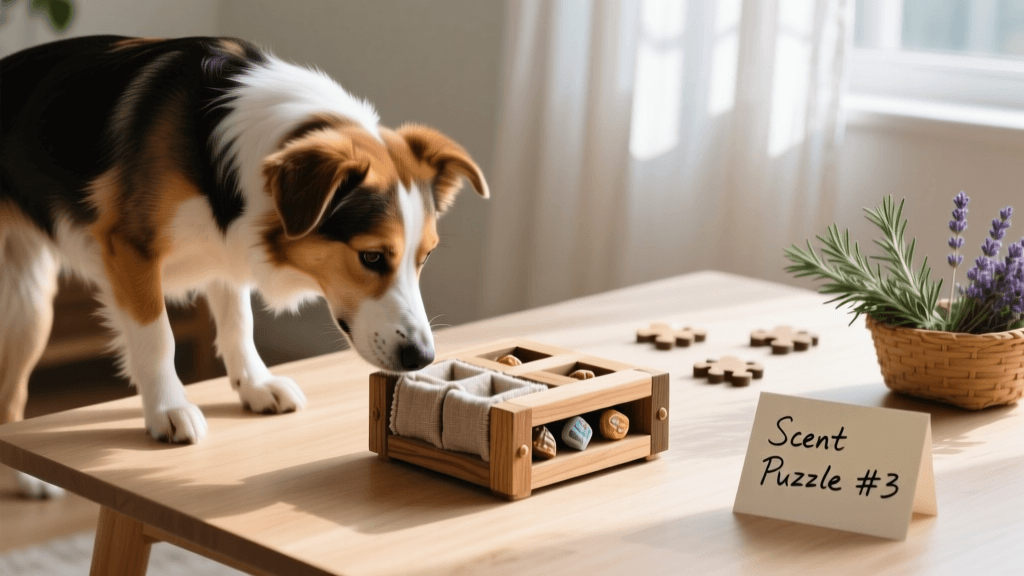
In animal psychology, there is a well-documented phenomenon known as 'contrafreeloading.' This occurs when an animal chooses to work for food even when identical, easily accessible food is available for free. Dogs are classic contrafreeloaders; they actually prefer to solve a puzzle or hunt for their kibble rather than eating it from a static bowl. According to the ASPCA's guide on dog enrichment, providing mental stimulation that mimics natural foraging behaviors is critical for preventing anxiety, depression, and destructive behaviors in domestic dogs.
When we feed a dog from a standard bowl, they consume their daily caloric intake in less than three minutes. This leaves them with hours of unspent mental energy. Olfactory enrichment, or 'sniffing,' is particularly vital. The American Kennel Club (AKC) notes that a dog's sense of smell is up to 100,000 times more sensitive than a human's, and engaging their nose lowers their heart rate, releases dopamine, and acts as a natural calming mechanism. Ten minutes of intense sniffing and foraging can tire a dog out as much as a one-hour physical walk, saving you time and energy while keeping your dog psychologically balanced.
The Commercial Toy Trap
The pet industry has capitalized on the need for canine enrichment, producing thousands of commercial puzzle toys. While brands like Outward Hound, Kong, and Nina Ottosson make fantastic products, they come with a premium price tag. A single high-quality puzzle feeder can cost anywhere from $20 to $50. Furthermore, dogs are highly intelligent problem solvers. Once a dog learns the mechanical trick to a specific plastic puzzle—such as sliding a block or flipping a lever—the cognitive load drops significantly. The $40 toy essentially becomes a very expensive, standard food bowl. By utilizing household items, you can create novel, high-cognitive-load challenges for pennies.
Budget-Friendly DIY Foraging Games
Here are four highly effective, budget-friendly DIY foraging games that leverage your dog's natural scavenging and shredding instincts.
1. The Muffin Tin Shell Game
This is a perfect entry-level foraging game that costs absolutely nothing if you already have standard bakeware.
- Materials: A standard 12-cup metal muffin tin, dry kibble or small treats, and 12 tennis balls (or crumpled balls of clean paper).
- Setup: Place a few pieces of kibble into several of the muffin cups. Place a tennis ball over the top of each cup to hide the food.
- The Psychology: This mimics the act of uncovering hidden prey or scavenging beneath debris. The dog must use their nose to locate the food and their paws or snout to dislodge the balls. As your dog masters this, you can increase the difficulty by only baiting three cups but covering all twelve, forcing them to rely entirely on their olfactory senses rather than visual memory.
2. The Towel Roll-Up Burrito
Dogs love to unroll and manipulate soft textures. This game taps into their instinct to dig and burrow.
- Materials: An old, clean bath towel (approximately 27x54 inches) and your dog's daily ration of kibble.
- Setup: Lay the towel flat on the floor. Evenly sprinkle the kibble across the entire surface. Starting from the short end, roll the towel up as tightly as possible into a long cylinder. For advanced dogs, tie the rolled towel into a loose knot.
- The Psychology: The dog must use their paws and teeth to unroll the towel, creating a multi-sensory experience involving touch, smell, and problem-solving. It is highly engaging and easily washable, making it a hygienic, zero-cost enrichment tool.
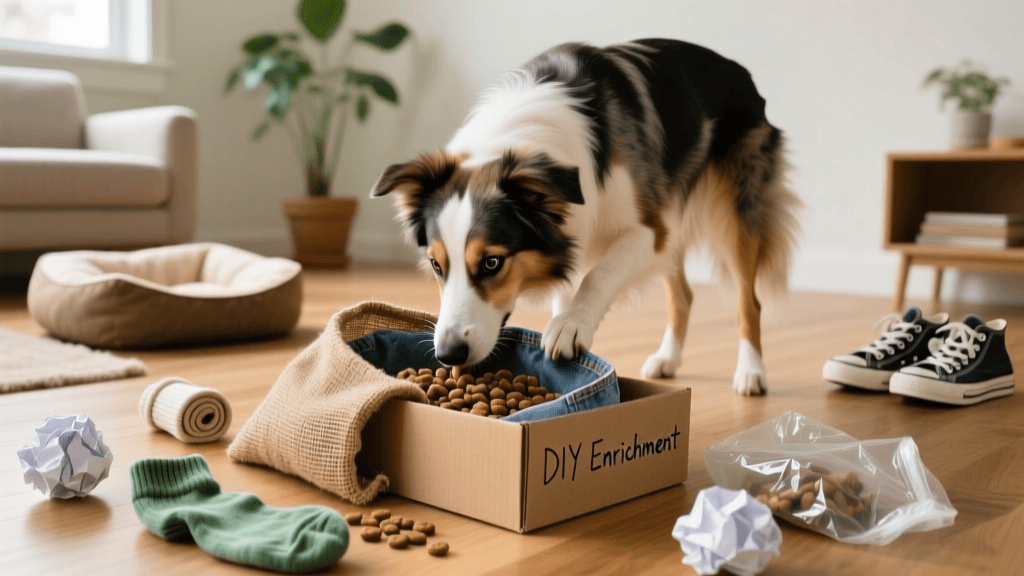
3. The Cardboard Box Destruction Zone
Many dogs have a natural 'shredding' instinct, which is linked to the final stages of the predatory sequence (catch, kill, dissect). If you don't provide an outlet for this, they may dissect your couch cushions instead.
- Materials: Various sizes of clean cardboard boxes (from recycling or deliveries), non-toxic paper tape, and high-value treats.
- Setup: Place treats inside a small box and tape it shut. Place that small box inside a slightly larger box, add a few more treats and some crumpled paper, and tape it shut. Repeat this nesting process up to three layers.
- The Psychology: This provides an incredible outlet for destructive energy in a controlled, safe manner. The dog gets to rip, tear, and shred the cardboard to access the food rewards. According to the Texas A&M College of Veterinary Medicine, allowing dogs to engage in safe, species-specific behaviors like shredding can significantly reduce stress and anxiety in the home environment.
4. The Thrift-Store Snuffle Mat
Commercial snuffle mats can cost upwards of $35. You can make a highly durable, custom-sized version for under $5.
- Materials: A rubber sink mat with holes (available at dollar stores for $1 to $3) and a cheap fleece blanket from a thrift store ($2).
- Setup: Cut the fleece blanket into hundreds of strips, each about 1 inch wide and 6 inches long. Tie each strip securely through the holes of the rubber sink mat using a simple overhand knot. Fluff the strips up to create a dense, grass-like surface.
- The Psychology: This is pure olfactory enrichment. Sprinkle kibble deep into the fleece strips. The dog must slowly sniff and part the 'grass' with their nose to find every single piece of food. This dramatically slows down fast eaters and provides intense mental fatigue.
Cost and Engagement Comparison
To illustrate the financial and psychological benefits of DIY enrichment over commercial alternatives, review the comparison table below.
| Enrichment Method | Estimated Cost | Setup Time | Cognitive Load | Durability / Reusability |
|---|---|---|---|---|
| Commercial Puzzle Toy | $15 - $50 | 1 Minute | Moderate (until solved) | High (Hard Plastic) |
| DIY Muffin Tin Game | $0 | 2 Minutes | Low to Moderate | High (Metal Tin) |
| Towel Roll-Up Burrito | $0 | 3 Minutes | Moderate | High (Washable Towel) |
| Cardboard Box Zone | $0 | 5 Minutes | High (Sensory & Physical) | Low (Single Use / Recyclable) |
| DIY Snuffle Mat | $3 - $5 | 45 Minutes (Initial) | High (Olfactory) | Moderate (Hand Washable) |
Habituation and the Importance of Rotation
A core concept in canine psychology is 'habituation.' This means that if a dog is exposed to the exact same stimulus repeatedly, they will eventually stop responding to it. If you leave the same plastic puzzle toy on the floor every day, your dog will quickly become bored of it. The key to budget-friendly enrichment is novelty and rotation. By keeping a 'closet' of different DIY setups (towel burritos on Monday, muffin tins on Wednesday, cardboard boxes on Friday), you maintain the novelty factor. The dog never knows exactly what physical mechanics will be required to earn their meal, keeping their cognitive engagement exceptionally high.
Safety Protocols for DIY Enrichment
While budget-friendly DIY toys are fantastic, safety must always be your primary concern. Dogs explore the world with their mouths, and the line between 'shredding for fun' and 'ingesting dangerous materials' can sometimes blur.
- Supervision is Mandatory: Never leave a dog unattended with cardboard, towels, or fleece strips. If your dog is a 'gulper' who tries to swallow large pieces of cardboard or fabric rather than shredding and spitting them out, you must intervene immediately to prevent life-threatening gastrointestinal blockages.
- Avoid Toxic Adhesives: When taping boxes, use plain paper tape or fold the cardboard into itself to lock it. Avoid duct tape or packaging tape with heavy chemical adhesives.
- Check for Choking Hazards: If using tennis balls in the muffin tin, ensure the balls are significantly larger than your dog's throat. For large breed dogs, use rubber playground balls instead of standard tennis balls to prevent choking.
Conclusion
Understanding your dog's psychological need to forage, sniff, and work for their food is the cornerstone of a happy, well-adjusted pet. You do not need to drain your bank account on expensive commercial gadgets to provide this essential enrichment. By looking at your recycling bin, your linen closet, and your local thrift store through the lens of canine psychology, you can create a rich, stimulating environment that honors your dog's natural instincts. Budget-friendly dog care isn't about cutting corners; it is about applying knowledge, creativity, and empathy to meet your dog's deepest behavioral needs while keeping your finances firmly in the green.
marcus-aldridge
All our authors care for dogs every day — read more of their work on the authors page.