DIY Scent Puzzles to Understand Your Dog's Instincts
Discover how homemade DIY scent puzzles and enrichment games can help you understand your dog's natural breed instincts and problem-solving psychology.
The Hidden World of Canine Olfaction
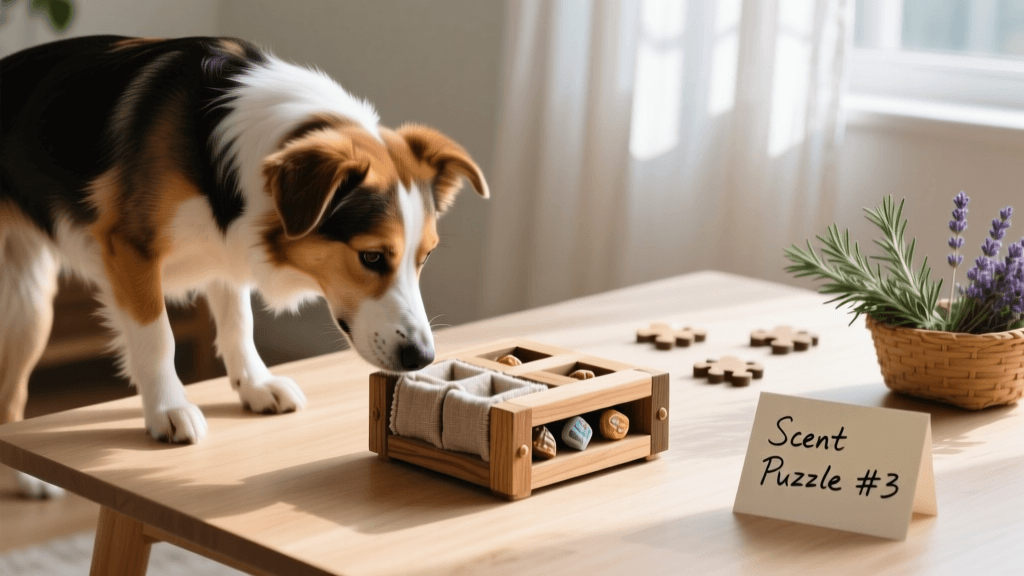
As humans, we navigate the world primarily through our eyes. But to truly understand your dog, you must step into their invisible, aromatic universe. A dog's sense of smell is not just a tool for finding food; it is their primary method of communicating, exploring, and processing their environment. According to the Smithsonian Magazine, a dog's olfactory cortex is roughly 40 times larger than ours, and they possess up to 300 million olfactory receptors compared to our mere 6 million.
When we deny dogs the opportunity to use their noses, we are essentially blindfolding them. This sensory deprivation often leads to boredom, anxiety, and destructive behaviors. By creating homemade DIY scent puzzles, you do more than just entertain your dog—you open a window into their cognitive processes, emotional state, and deeply ingrained breed instincts. Observing how your dog interacts with a homemade puzzle reveals volumes about their underlying psychology.
Why DIY Puzzles Reveal Breed Psychology
Commercial toys are often designed with a one-size-fits-all mentality. However, different breed groups possess distinct evolutionary drives. Terriers were bred to dig and destroy prey; hounds were bred to track scents over miles; and herding dogs were bred to solve complex spatial problems. When you build a DIY puzzle from household items, you can tailor the difficulty and observe your dog's natural problem-solving hierarchy. Do they use their paws or their nose? Do they persist through frustration, or do they look to you for help? These micro-behaviors are the keys to understanding your dog's unique psychological makeup.
Project 1: The Upcycled Fleece Snuffle Mat
The snuffle mat is a staple in canine enrichment, designed to mimic the natural foraging behavior of grazing and hunting in tall grass. It is particularly effective for observing scent-driven hounds and anxious dogs who need a calming, repetitive task.
Materials and Cost
- Base: 1 rubber sink mat with holes (Cost: $3 - $5)
- Fabric: 2-3 old fleece blankets (Cost: $0 if upcycled)
- Treats: High-value, strongly scented treats like freeze-dried liver or pungent kibble
Step-by-Step Instructions
- Cut the fleece into strips measuring exactly 1 inch wide by 6 inches long.
- Take two strips, place them together, and push them through a single hole in the rubber mat.
- Tie them into a loose double knot on the underside. Repeat this process until the entire mat is densely covered.
- Timing: Expect to spend about 45 to 60 minutes tying the knots. It is a great activity while watching TV.
Behavioral Observation
Hide the treats deep within the fleece. When you present the mat, observe your dog's approach. A dog relying on instinctive tracking will sweep their nose side-to-side in a grid pattern. A dog exhibiting terrier-like impatience may immediately resort to digging at the mat with their front paws. Understanding this initial reaction helps you identify whether your dog defaults to their nose (scent hound) or their paws (terrier/working breed) when faced with a challenge.
Project 2: The Muffin Tin Shell Game
This puzzle tests your dog's working memory, spatial awareness, and impulse control. It is an excellent tool for understanding the cognitive style of highly intelligent breeds like Border Collies, Poodles, and German Shepherds.
Materials and Cost
- Base: 1 standard 12-cup metal or silicone muffin tin (Cost: $0 - $10)
- Covers: 12 tennis balls or crumpled balls of heavy craft paper (Cost: $2)
- Bait: Small, pea-sized training treats
Step-by-Step Instructions
- Place a single treat into 3 of the 12 muffin cups.
- Cover all 12 cups with the tennis balls or paper balls.
- Allow your dog to watch you place the treats (this engages their visual-spatial memory).
- Release them with a cue like "Find it!"
Behavioral Observation
Watch how your dog removes the obstacles. Herding breeds and retrievers will often use their noses to carefully nudge the balls aside, demonstrating precision and impulse control. Conversely, livestock guardian breeds or mastiffs might attempt to flip the entire tin or crush the paper balls, showcasing a brute-force, macro-environmental approach to problem-solving. The American Kennel Club notes that engaging a dog's natural scenting abilities through structured games significantly reduces stress and improves human-canine communication.
Project 3: The Cardboard 'Prey' Destruction Box
Many owners misunderstand destructive behavior as purely "bad" behavior. In reality, the urge to tear, shred, and dismantle is a natural expression of the predatory sequence (specifically the "dissect" phase). This DIY puzzle allows you to safely study and satisfy this instinct.
Materials and Cost
- Structure: 1 medium cardboard shipping box (Cost: $0)
- Filler: Crumpled packing paper, toilet paper rolls, and old junk mail (Cost: $0)
- Reward: Dry kibble or hard biscuits scattered throughout
Step-by-Step Instructions
- Close the flaps of the box but do not tape it shut.
- Layer the crumpled paper and toilet paper rolls inside, sprinkling kibble between every layer.
- Present the closed box to your dog in a designated "mess zone" (like a patio or bathroom).
Behavioral Observation
This setup is highly revealing for terriers, dachshunds, and spitz breeds. Observe their "kill shake"—do they grab the box and thrash their head side-to-side? This is a hardwired instinct meant to snap the neck of small prey. By providing a legal outlet for this behavior, you gain a profound understanding of your dog's genetic imperatives, allowing you to redirect unwanted household destruction into appropriate, enriching channels.
Observation Chart: Decoding Your Dog's Puzzle Style
Use the following data table to decode your dog's behavioral responses during DIY puzzle play. This chart bridges the gap between simple observation and deep psychological understanding.
| Behavior Observed | Psychological Meaning | Associated Breed Instinct |
|---|---|---|
| Sweeping nose in a grid pattern | Methodical processing of olfactory data; high focus. | Scent Hounds (e.g., Beagles, Bloodhounds) |
| Aggressive pawing and digging | High frustration tolerance; reliance on tactile manipulation. | Terriers (e.g., Jack Russells, Dachshunds) |
| Looking at owner, then at puzzle | Social referencing; seeking collaborative problem-solving. | Herding / Companion (e.g., Collies, Poodles) |
| Grabbing and thrashing the object | Activation of the predatory "dissect" sequence. | Working / Hunting (e.g., Huskies, Retrievers) |
| Walking away after 30 seconds | Low frustration threshold or lack of olfactory motivation. | Sighthounds or Brachycephalic breeds |
Safety and Enrichment Best Practices
While DIY puzzles are incredible tools for understanding your dog, safety must remain the priority. The PDSA (People's Dispensary for Sick Animals) emphasizes that all enrichment activities should be supervised to prevent the ingestion of non-food items.
- Supervision is Mandatory: Never leave a dog alone with cardboard, fleece, or small balls. Once the treats are gone, the puzzle should be removed.
- Caloric Management: Use a portion of your dog's daily kibble allowance for puzzles to prevent obesity. Adjust their meal sizes accordingly.
- The Rule of Rotation: Dogs habituate quickly to static environments. To keep their cognitive wheels turning, rotate between the snuffle mat, the muffin tin, and the destruction box on alternating days.
"Understanding your dog is not about teaching them to be human; it is about giving them the space to be a dog. Homemade scent puzzles provide the ultimate canvas for their natural instincts to flourish."
Conclusion
Building DIY scent puzzles is a low-cost, high-reward investment in your relationship with your dog. By stepping back and observing how they dismantle a cardboard box, navigate a snuffle mat, or solve a shell game, you transition from simply owning a dog to truly understanding them. You begin to see the world through their nose, respecting the ancient instincts that drive them, and ultimately forging a deeper, more empathetic bond.
jonas-cole
All our authors care for dogs every day — read more of their work on the authors page.